Back to Glossary
Concept Glossary

Mono-no-Aware: The Pathos of Things & Sweet Melancholy of Impermanence

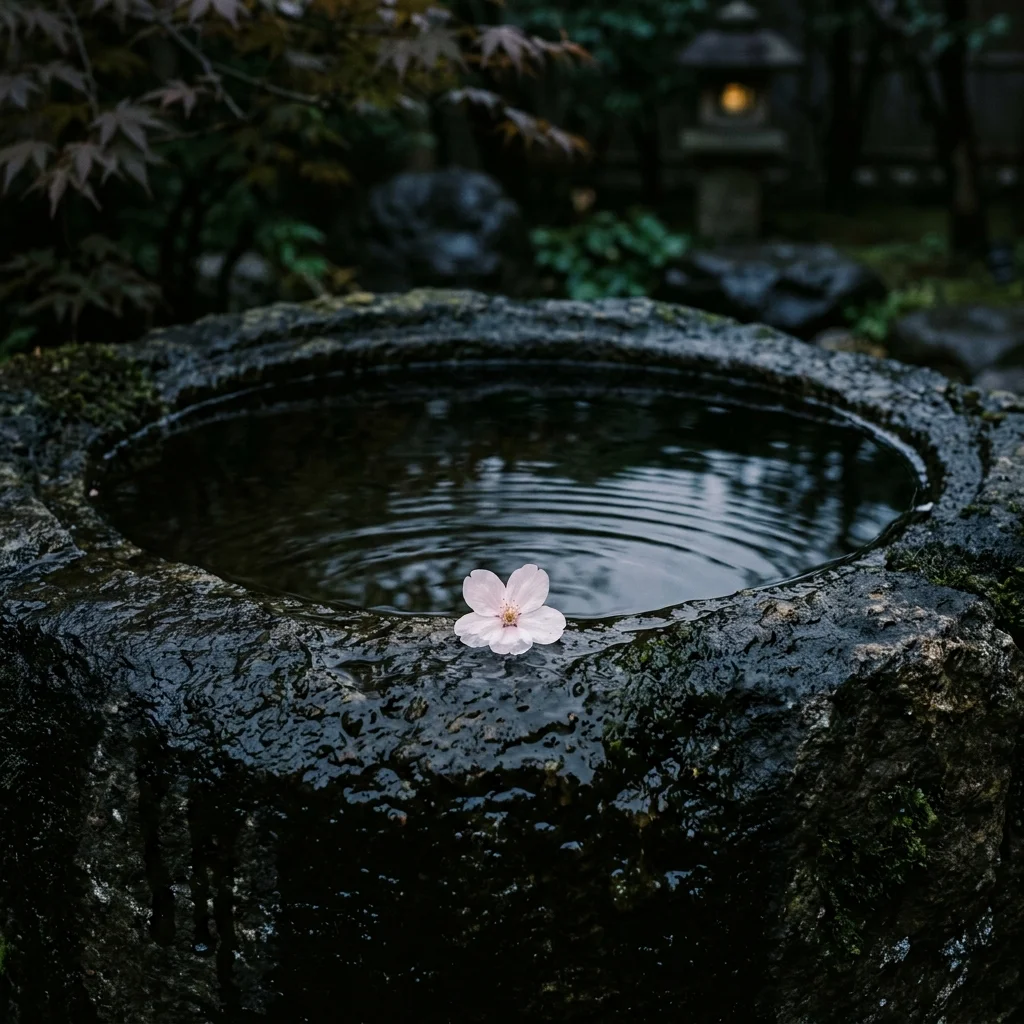
A single pale cherry blossom petal resting on the dark, wet surface of a hand-carved stone water basin.
Cultural Concept

MONO-NO-AWARE

物の哀れ / もののあわれ

A lone cherry blossom petal suspended on a dark granite water basin, representing the fleeting beauty and gentle pathos of Mono-no-Aware.

Linguistic Definition (TL;DR)

Mono-no-Aware represents the quintessential Japanese aesthetic of finding deep beauty in the transience, impermanence, and gentle sadness of life. Rooted in Zen mindfulness, this concept encourages a profound emotional empathy toward the fleeting nature of all physical things, celebrating their passing as the core of beauty.

Etymology & Linguistic Analysis

// 01

The profound and poetic Japanese aesthetic phrase Mono-no-Aware (物の哀れ) is a beautiful linguistic pairing of three distinct components: Mono (物), the possessive particle no (の), and the rich noun Aware (哀れ). To truly grasp the emotional weight of this phrase, we must trace how each element evolved from ancient oral exclamations into a highly refined philosophy of art in minute detail.

The first word, Mono (物), translates directly to 'things', 'objects', or 'external reality'. It refers not only to physical items like stone lanterns and cherry blossoms but also to human events, relationships, and the entire surrounding universe. The heart of the phrase lies in the final word, Aware (哀れ). In ancient, pre-literate Japan, aware was not a vocabulary word; it was an oral exclamation of deep emotional surprise, similar to 'ah!' or 'oh!'. It represented the spontaneous, involuntary sound a human makes when deeply moved by an extraordinary sunset, a sudden tragedy, or a beautiful voice. Over centuries of classical literary refinement during the Heian court, this raw exclamation transformed into a noun representing 'deep, empathetic pathos', 'poetic sorrow', or 'the bittersweet sigh of emotional realization'.

Therefore, when combined as Mono-no-Aware, the phrase translates literally to 'the deep pathos of things' or 'the empathetic sigh triggered by the transience of external reality'. Spoken with a soft, lingering cadence—pronounced /moh-noh-noh-ah-wah-reh/—the word carries a gentle, melancholic rhythm, inviting the listener to slow down, breathe, and notice the quiet, fading beauty of the natural world, realizing that we are all passing through the same temporal stream.

Deep Philosophical Foundations

// 02

At its deepest philosophical core, Mono-no-Aware is a direct material extension of Japan’s spiritual heritage: Zen Buddhism and Shinto animism, serving as a visual and emotional reminder of the primary Buddhist truth of impermanence (Mujo).

In the Zen Buddhist tradition, the primary law of the universe is Mujo—the absolute truth that nothing stays the same, nothing is ever finished, and nothing is perfect. The seasons cycle relentlessly, flowers bloom and fade, clouds gather and disperse, and human lives rise and fall. Rather than resisting this inevitable decay, Zen teaches us to accept it with quiet mindfulness. Resisting change is viewed as the primary source of all human suffering. Mono-no-Aware elevates this acceptance into a highly refined aesthetic. It suggests that the beauty of an object is not located in its permanence, but in its very fragility. A cherry blossom is considered beautiful precisely because it falls after a single week; if it were made of permanent plastic and lasted forever, it would lose its emotional power. The gentle sadness we feel when looking at a falling petal is not a negative depression; it is a beautiful, empathetic connection to the universal flow of life, allowing us to find peace in our own transient existence.

Complementing this Zen perspective is the Shinto animistic belief in the emotional resonance between humans and the natural world. Shinto teaches that the natural landscape is alive with spiritual presence, and that a sensitive human heart should naturally feel a deep, mutual empathy with the surrounding elements. When the autumn leaves turn crimson and fall, or when the evening wind rustles through dry reeds, the sensitive person does not look at it as a cold, scientific event. They feel a deep, physical resonance—a shared sigh of change between the human spirit and the spirit of the land. This emotional attunement is the core of authentic Japanese character, where true wisdom is defined as the capacity to feel deeply, acknowledging that our feelings are echoed by the natural world around us.

Historical Evolution

// 03

The historical journey of Mono-no-Aware spans from the early Heian imperial court diaries to the revolutionary literary criticism of the Edo period.

During the Heian period (794–1185), court aesthetics were dominated by the aristocratic pursuit of refined emotional sensitivity (known as Miyabi). Elites spent their days writing complex poetry, comparing the color of their silk robes to the seasonal flowers, and detailing the bitter sorrow of secret love affairs. The ultimate literary manifestation of this era occurred in the year 1008 with the publication of Murasaki Shikibu’s masterpiece, The Tale of Genji (源氏物語). Across its fifty-four chapters, the novel details the lives, loves, and political fortunes of the imperial court. Crucially, the characters are constantly depicted as pausing to weep over the sound of crickets, the reflection of the moon in a water cup, or the falling cherry blossoms, demonstrating that true nobility was measured by one's capacity to feel the transience of life. In the 'Murasaki' chapter, Genji famously observes the fading morning glory (*Asagao*), weeping over the transient youth of his lover and the fragility of human destiny.

During the Edo period (1603–1867), this courtly aesthetic was analyzed and redefined by the legendary literary scholar Motoori Norinaga (1730–1801). Norinaga embarked on a lifetime study of classical Japanese literature, seeking to strip away the heavy moralistic layers of Chinese Confucianism and Buddhism that had been forced onto these texts. He argued that the absolute, pure core of Japanese culture was located in Mono-no-Aware. Norinaga wrote that to understand this concept is to have a heart that can distinguish the subtle details of reality and respond to them with appropriate emotion. He rescued *The Tale of Genji* from being read as a simple moral warning about infidelity, elevating it as a profound guide to human empathy and emotional honesty, cementing Mono-no-Aware as the baseline of Japanese aesthetic criticism and proving that the emotional heart, not rigid dogma, is the true anchor of human morality.

Cultural Case Studies

// 04

To observe how the philosophy of Mono-no-Aware manifests in the physical world, we can examine two iconic Japanese cultural practices: the historical evolution of **Hanami (Cherry Blossom Viewing)** and the quiet, late-autumn custom of **Momijigari (Autumn Leaf Hunting)**.

1. The Historical Evolution of Hanami: While modern tourists often view Hanami as a festive outdoor picnic under pink trees, the custom began as a deeply spiritual, aristocratic contemplation of impermanence. During the early Nara period, elites celebrated plum blossoms (*Ume*), which were imported from Tang dynasty China and symbolized cold winter resilience. However, during the Heian period, the focus shifted dramatically to the indigenous cherry blossom (*Sakura*). The reason was purely aesthetic: the cherry blossom blooms with explosive, uniform beauty and then falls silently at the first gentle breeze, representing the perfect physical manifestation of a beautiful, fleeting life. Tracing classical poetry from the *Manyoshu* to the *Kokin Wakashu*, we see how poets wrote that the falling petals looked like drifting snow, celebrating the bittersweet realization that the flowers would be gone tomorrow, transforming a simple botanical cycle into a national ritual of collective transience.

2. The Quiet Contemplation of Momijigari: Momijigari, or the hunting of autumn maple leaves, represents the parallel autumnal execution of Mono-no-Aware. Unlike the festive, crowded spring cherry blossom viewings, Momijigari is traditionally a quiet, introspective journey into the mountains or Zen temple gardens. Diners and travelers walk slowly along gravel paths, observing the slow, daily shift of green maple leaves into brilliant crimsons, oranges, and deep ochres. Crucially, the peak of the aesthetic experience is not when the trees are fully covered in bright red leaves, but when the leaves begin to fall, carpet-covering the green moss below in a damp, decaying mosaic. A traditional Shigaraki potter, opening his wood-fired kiln (*Anagama*) after seven days of continuous firing, discovers an asymmetrical glaze crack (*Kannyu*) on a tea bowl. Rather than rejecting it, he embraces this transient flaw as an act of nature, mirroring the beautiful decay of the autumn leaves and demonstrating a physical connection to the natural passage of time.

Practical Guide for Foreigners

// 05

For international travelers and modern city dwellers, adopting the spirit of Mono-no-Aware is a powerful way to cultivate deep emotional empathy, practice mindfulness, and find profound peace in the natural flow of life.

How to Experience Transience in Daily Life: You can easily integrate this aesthetic into your routine by slowing down during natural transitions. When a sudden rainstorm begins, instead of immediately rushing indoors or complaining about the weather, stand near a window or under a canopy for three minutes. Listen to the rhythmic sound of the drops striking the ground, watch the water flow along the street, and feel the sudden drop in temperature. Recognize that this exact storm, with these exact patterns, is a unique, fleeting moment that will never happen again, turning a simple weather event into a quiet meditation on the beautiful transience of all things.

Navigating Life Transitions with Grace: Adopting a Mono-no-Aware perspective can help ease the pain of major life changes: moving to a new city, ending a relationship, or growing older. Instead of fighting these changes or clinging desperately to the past, try to view your life as a series of distinct, beautiful, and transient chapters. Just as we do not hate the autumn because the leaves fall, we can learn to appreciate the ending of a life chapter as a natural, necessary phase that makes the new season possible. We accept our own physical aging and scars as natural, beautiful evidence of a life fully lived, letting go of the constant pressure to achieve a sterile, synthetic perfection, and transforming sorrow into a gentle, supportive embrace of life’s organic cycles.

Dialogue Scenarios

// 06

To understand how Mono-no-Aware is spoken and integrated into natural Japanese conversations, review this bilingual dialogue scenario between a local tea practitioner and an international traveler.

Scenario A: Observing the Autumn Leaf Fall (京都の禅寺の庭園で)
A traveler sits on the wooden veranda (Engawa) of a quiet Zen temple in Kyoto, watching maple leaves fall onto the mossy garden below.

Traveler: This garden is incredibly beautiful, but it also makes me feel a bit sad. Watching these brilliant red leaves drift down and decay on the wet moss makes me think about how fast this year has passed.
Local Friend: そうですね。その「少し寂しい」と感じる心こそが、まさに「物の哀れ」ですよ。美しさと儚さは、常に隣り合わせなのです。
(Yes, that is true. That feeling of 'slight loneliness' is the exact heart of Mono-no-Aware. Beauty and transience always walk hand-in-hand.)
Traveler: In the West, we often try to preserve things, to keep them looking brand-new and perfect forever. Here, it feels like you are deliberately celebrating the decay and the end of the season.
Local Friend: はい。もしこの紅葉が一年中赤いプラスチック製だったら、私たちはこんなに感動しないでしょう。散りゆくからこそ、今この一瞬が愛おしいのです。
(Yes. If these red leaves were made of permanent plastic and lasted all year, we wouldn't be so moved. Because they fall, this exact single moment is precious to us.)
Traveler: I see. So the sadness isn't a bad thing; it’s actually what makes the beauty feel so deep and real. It’s like a quiet sigh of gratitude.
Local Friend: その通りです。散りゆく木の葉に自分自身の人生を重ね合わせ、愛おしむ。それこそが、日本人が何千年も大切にしてきた心の機微なのです。無常を受け入れることで、本当に豊かな静寂が生まれるのですよ。
(Exactly. Overlaying your own life journey onto the falling leaves, and cherishing it. That is the subtle emotional nuance Japanese people have treasured for thousands of years. By accepting impermanence, a truly rich tranquility is born.)

Modern Ecological & Social Relevance

// 07

In our modern globalized society, the ancient aesthetic of Mono-no-Aware has emerged as a critical element in environmental sustainability, mental health, and advanced psychological resilience.

As the world faces the severe ecological pressures of climate change and rapid urban development, our modern industrial economies rely on a highly destructive cycle of buying, discarding, and replacing mass-produced plastic goods. This consumerist mindset is driven by a constant desire for the new, the shiny, and the permanent, resulting in massive global waste. Adopting a Mono-no-Aware perspective offers a direct path toward a sustainable, low-carbon future. By encouraging us to accept and find deep beauty in the natural aging, wear, and eventual end of physical goods, Mono-no-Aware breaks the cycle of mindless consumption, helping us find satisfaction in a minimalist lifestyle that respects the earth's limited resources. It teaches us to maintain and love our old, repaired items rather than constantly replacing them.

In the parallel realm of mental health and social psychology, Mono-no-Aware is playing an increasingly vital role in combating the growing epidemic of digital anxiety and clinical perfectionism. Modern life is saturated with digital platforms that project highly curated, filtered, and permanent versions of reality, putting constant pressure on individuals to achieve perfect lives. This unrealistic pursuit of perfection is a major driver of global anxiety and depression. Mono-no-Aware acts as a soothing, compassionate refuge. It reminds us that perfection is a synthetic illusion, and that authentic beauty is found in our shared vulnerability, our scars, and our unique, imperfect journeys. By mindfully accepting the impermanence of all things, we build the deep resilience needed to face life's challenges with grace and peace, transforming social anxiety into a shared, empathetic connection with the cosmos.

Practical Mastery

Actionable Cultural Skills

Integrate the philosophical wisdom of Mono-no-aware into your everyday lifestyle through these practical, hands-on Japanese technical disciplines.

Seasonal Transient Haiku Composition

無常の俳句創作
初級 (Beginner)⏱️ 30 Minutes

Capturing a single, fleeting seasonal moment of change and impermanence using the traditional 5-7-5 syllable poetic format.

Textured paper card (Tanzaku)Ink brush pen
📋 Practical Steps
  1. 01.Walk outside during a seasonal transition (such as early spring or late autumn), looking specifically for transient markers: a falling petal, a drying leaf, or a long evening shadow.
  2. 02.Formulate three short lines following the strict syllable count of 5, 7, and 5, incorporating a mandatory seasonal reference word (known as a <em>Kigo</em>).
  3. 03.Write the poem systematically onto your Tanzaku paper card using smooth brush strokes, reflecting on the truth that the moment you captured has already passed.

Tsukimi Moon-Viewing Space Preparation

月見の数寄空間造作
中級 (Intermediate)⏱️ 45 Minutes

Designing a serene, minimalist outdoor tea space to observe and contemplate the silent, transient path of the full autumn moon.

Small low wooden tableSourced autumn silvergrass (Susuki)White ceramic plate with round rice dumplings (Tsukimi Dango)
📋 Practical Steps
  1. 01.Set up your low wooden table on an open veranda, balcony, or garden clearing that has an unobstructed view of the eastern evening sky.
  2. 02.Arrange a few stems of Susuki silvergrass in a simple bamboo vase, placing it on the right side of the table to represent the wild harvest.
  3. 03.Arrange fifteen round, white rice dumplings in a pyramid shape on a clean ceramic plate, placing it adjacent to the grass as a humble offering to the changing moon.

Tactile Preservation of Autumn Foliage

落葉の感覚保存作法
初級 (Beginner)⏱️ 3 Days

Harvesting and pressing brilliant, fallen autumn leaves to preserve their delicate, transient colors before they decay.

Sourced fallen autumn maple leavesHeavy wooden pressing boardsAbsorbent parchment paper
📋 Practical Steps
  1. 01.Walk through a park or forest in late autumn, carefully selecting three fallen maple leaves that exhibit rich red or golden gradients without being torn.
  2. 02.Place each leaf flat between two sheets of dry, absorbent parchment paper, ensuring the delicate tips and stems are completely straight.
  3. 03.Sandwich the paper between heavy wooden pressing boards, placing weights on top, and let them rest for three days to extract moisture while locking in the transient colors.