Back to Glossary
Concept Glossary

Komorebi: Sunlight Filtering Through Trees - The Subtle Poetic Play of Forest Light

Komorebi: Sunlight Filtering Through Trees - The Subtle Poetic Play of Forest Light
Cultural Concept

KOMOREBI

木漏れ日 / こもれび

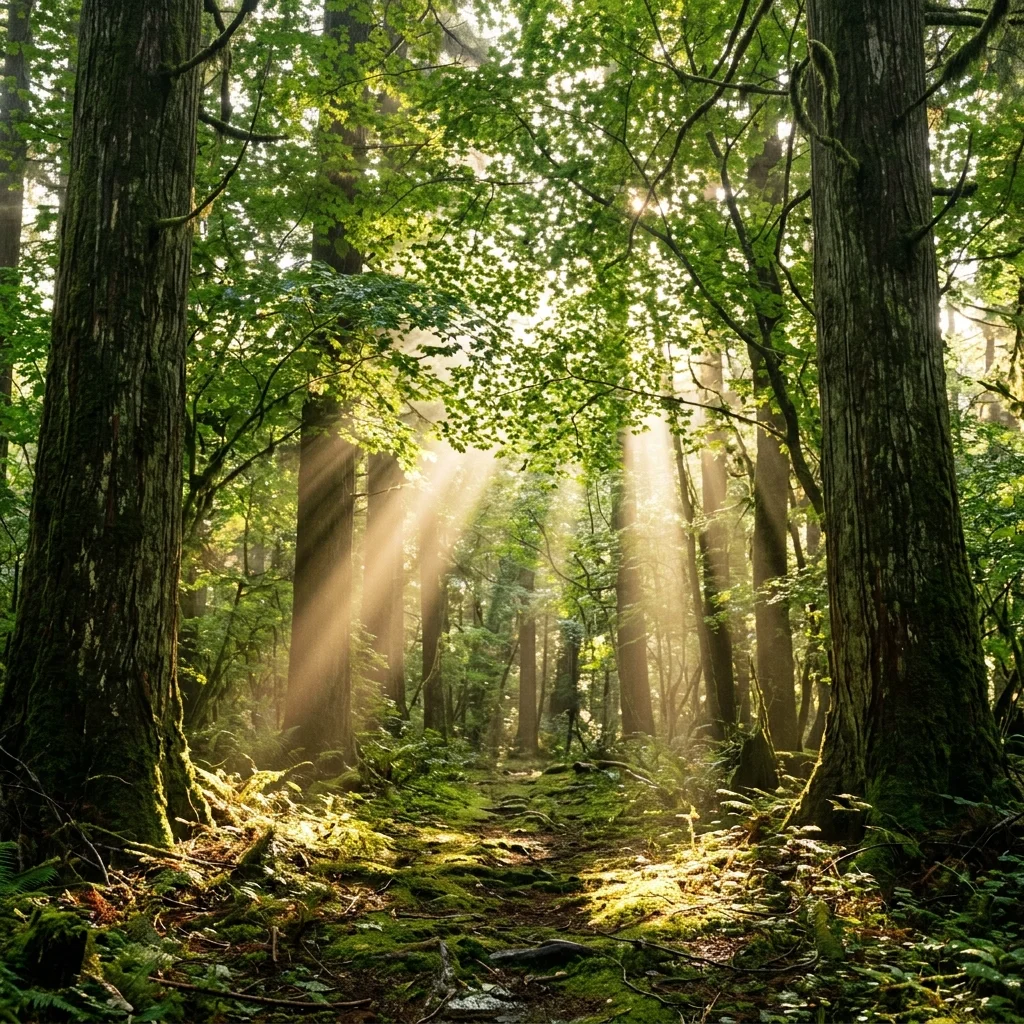
A majestic manifestation of Komorebi: soft, golden shafts of afternoon sun slicing through a green cedar canopy, casting pools of light onto a quiet forest floor.

Linguistic Definition (TL;DR)

Komorebi is the beautiful, untranslatable Japanese term representing sunlight filtering through the leaves of trees. It embodies a delicate Shinto connection to nature's transient art, capturing how wind, foliage, and solar rays interact in a dynamic, non-repeatable light dance that scientifically calms the human nervous system.

Etymology & Linguistic Analysis

// 01

The word Komorebi (木漏れ日) is an exceptionally beautiful, poetic linguistic compound that stands globally as a prime example of untranslatable Japanese aesthetic vocabulary. The word is composed of three distinct kanji characters: the first, Ko (木), represents a tree, timber, or forest; the second, More (漏れ), is the noun form of the verb Moru (漏れる), meaning 'to leak', 'to filter', 'to escape', or 'to slip through'; and the third, Bi (日), represents the sun, daylight, or a specific day. Literally translated, the term represents 'light leaking through trees' or 'the sun filtering through foliage'.

Phonetically pronounced as /ko-mo-reh-bee/, the word carries a soft, whispering rhythm that mimics the sound of wind rustling through a forest canopy. Etymologically, the term has been used in classical Japanese poetry since the Heian period to describe the subtle, shifting moods of the natural world. Unlike sterile, scientific terms for light scattering or optical refraction, *Komorebi* is an active, biological description. It does not treat the trees or the sun as separate, static objects; instead, it defines a dynamic, living relationship—a beautiful canvas where light is shaped, filtered, and softened by the movement of living leaves, capturing the essence of organic impermanence.

Deep Philosophical Foundations

// 02

At its philosophical core, Komorebi is a direct manifestation of Japan's ancient Shinto animism and the Zen Buddhist appreciation of Impermanence (Mujo). It represents the belief that the natural world is a sacred canvas inhabited by millions of spiritual entities (Kami), and that the divine is best experienced through the subtle, shifting details of nature.

In the Shinto worldview, a forest is not a collection of wood resources; it is a sacred cathedral where every ancient tree, stone, and stream carries a living spirit. *Komorebi* is conceptualized as the visual breath of these spirits—a physical manifestation of the *Kami*'s presence. As the wind moves the leaves and the sun shifts across the sky, the pools of light on the forest floor constantly change shape, merge, and disappear. This dynamic movement is a visual reminder of *Mujo*: the truth that nothing remains static, and that beauty is found precisely in its fleeting, non-repeatable nature. To stand under a canopy of oak or maple and watch the *Komorebi* is to participate in a quiet, meditative ritual of connection, aligning one's internal rhythms with the slow, organic cycles of the earth.

Complementing this is the Zen concept of Yugen (profound grace and mystery). *Komorebi* does not flood the world with harsh, revealing glare; instead, it filters light, casting deep shadows and soft pools of illumination. This filtration creates a sense of mystery and depth, inviting the observer to contemplate the invisible spaces and the quiet transitions, fostering a state of deep, reflective mindfulness.

Historical Evolution

// 03

The historical integration of Komorebi into Japanese culture spans from the early imperial poetry anthologies of the Heian period to the meticulous garden engineering of the Muromachi and Edo periods.

During the Heian period (794–1185), the court nobility developed a highly refined emotional aesthetic centered on *Mono no Aware* (the beautiful sadness of impermanence). In anthologies like the Kokin Wakashuu, poets frequently utilized the image of *Komorebi* as a metaphor for fleeting human emotions, transit love, and the quiet passing of time. To be considered cultured, one had to possess the emotional sensitivity to appreciate how the green light of spring shifted into the golden filter of autumn leaves, establishing a literary tradition where natural light was linked to the human heart.

By the Muromachi period (1336–1573), as Zen Buddhism became the dominant spiritual force among the samurai class, the appreciation of *Komorebi* was materialized in **Japanese garden design (Nihon Teien)**. Zen garden designers realized that direct, unshielded sunlight created harsh, flat visual fields that disrupted meditation. They began placing tall, deciduous trees like maple and elm near historic stone lanterns (*Toro*) and water basins (*Tsukubai*). When the sun rose, the leaves filtered the light, casting soft, dappled parallel shadows across the raked gravel and mossy stones. During the Edo period, this thermodynamic and optical design was integrated into urban residential architecture. The deep wooden eaves (*Noki-saki*) and sliding bamboo screens (*Sudare*) of Kyoto merchant houses (*Machiya*) were engineered specifically to filter the hot summer sun, projecting a cooling, dynamic pattern of indoor *Komorebi* that made dense urban living peaceful and physically comfortable.

Cultural Case Studies

// 04

In contemporary society, the science and aesthetic of Komorebi are driving major movements in forest therapy (*Shinrin-yoku*), modern biophilic architecture, and psychological well-being programs, representing a highly successful scale of natural integration.

1. Scientific Shinrin-Yoku Programs: Tokushima and Nagano Prefectures are global centers for *Shinrin-yoku* (forest bathing) scientific research. Certified forest therapists lead participants through deep forest trails specifically during the late morning and early afternoon when *Komorebi* is at its peak. Medical studies show that watching the dappled, moving light patterns of *Komorebi* stimulates the parasympathetic nervous system, significantly reducing salivary cortisol levels, lowering blood pressure, and increasing heart rate variability (HRV). The visual oscillation of the light patterns acts as a natural neural relaxant, proving that aesthetic natural contact has measurable medical benefits.

2. Biophilic Architectural Design: Renowned Japanese architects (such as Kengo Kuma) utilize the physics of Komorebi to design premium, sustainable public buildings. By constructing facade systems using irregular, overlapping wooden louvers (*Lattices*) made from local cedar, these buildings filter incoming sunlight. Inside the concrete lobby or library, the light behaves exactly like *Komorebi*, casting soft, moving dapples across the floors and walls. This biophilic design reduces the need for artificial cooling and lighting while creating a calming, forest-like environment that enhances mental focus and spatial comfort for users.

3. Mindfulness and Corporate Wellness: Major multi-national corporations in Tokyo have established dedicated 'Komorebi Relaxation Zones' within their high-rise offices. These spaces feature indoor biophilic green walls, organic cedar wood furniture, and specialized dynamic LED lighting systems that replicate the exact color temperature and wind-sway patterns of natural light filtering through leaves. Employees use these zones for brief, screen-free recovery breaks, showing how integrating ancient sensory aesthetics into high-stress modern environments restores mental energy and boosts creative productivity.

Practical Guide for Foreigners

// 05

For international eco-travelers and mindfulness seekers in Japan, experiencing and capturing the spirit of Komorebi offers a profound opportunity to cultivate deep peace and connect with the country's ancient natural heritage.

Practice Mindful Forest Bathing: When hiking through historic trails like the Nakasendo path or Kumano Kodo, do not rush to reach the destination. Slow your pace significantly. Stop underneath a canopy of tall trees, look straight up, and close your eyes. Open them slowly, focusing entirely on how the wind shifts the green canopy and how the golden light slivers down. Let your breathing synchronize with the movement of the light pools on the mossy ground, allowing the natural environment to calm your mind.

Aesthetic Photophilic Framing: If you are a photographer, capture Komorebi by avoiding flat, direct sunlight. Search for high-contrast zones where the background is in deep shadow (such as a dark temple wall or a forest floor) and a single pool of filtered light illuminates a green moss patch or a wet stone. Avoid using artificial flash or filters. Let the natural, raw contrast of the filtered light highlight the organic texture of the materials, creating a wabi-sabi shot suitable for visual appreciation.

Respecting Sacred Shrine Groves: When visiting historic Shinto shrines (such as Meiji Jingu in Tokyo or Ise Jingu in Mie), remember that the massive forest groves (*Chinju no Mori*) surrounding the shrines are sacred zones. Walk quietly along the gravel paths, and when you observe the *Komorebi* casting golden circles across the ancient stone steps, treat the scene with reverence. Avoid loud conversations, stay on the pathways, and let the quiet visual beauty of the forest guide your thoughts.

Dialogue Scenarios

// 06

Review these bilingual dialogue scenarios to understand how travelers and designers discuss the visual and emotional impact of Komorebi.

Scenario A: Two Hikers on the Kumano Kodo Trail (熊野古道の杉林の中で)
An international traveler and a local guide pause under a giant cedar tree in the afternoon.

Traveler: Look at how the light is breaking through the high leaves! It's like a soft, golden curtain dancing on the moss. It's incredibly beautiful.
Guide: ええ、本当に綺麗ですね。これは日本語で「木漏れ日(こもれび)」と言うんですよ。ただの太陽光ではなく、木々と風と光が一緒に作り出す、その瞬間だけの芸術なんです。
(Yes, it's truly beautiful. We call this 'Komorebi' in Japanese. It's not just sunlight; it's a unique art of that exact instant, created by the trees, wind, and light together.)
Traveler: 'Ko-mo-re-bi'... what a poetic word. It feels so calming just to stand here and watch the patterns shift on the ground.
Guide: 風が吹くたびに光の形が変わるでしょう。まさに自然の呼吸を見ているようですね。少しここで休んで、この光を楽しみましょう。
(Notice how the shape of the light changes every time the wind blows. It's like watching the forest breathe. Let's rest here for a moment and enjoy this light.)

Scenario B: An Architect explaining a Design Concept (設計事務所のミーティングで)
A lead designer presents a biophilic library design to an international client.

Architect: 今回の図書館の設計では、メインロビーの天井に地元の杉を使ったルーバーを配置します。これにより、差し込む太陽光が美しく分散されます。
(In this library design, we will arrange cedar louvers on the main lobby ceiling. This will beautifully disperse the incoming sunlight.)
Client: Ah, I see! The shadows on the floor look exactly like a forest floor. It has a very natural, warm feeling.
Architect: はい、私たちが目指したのは、室内で「木漏れ日」を感じられる空間です。 harsh な直射日光を遮りながら、一日を通して移り変わる光の表情を楽しめるようにしています。利用者の心が自然と落ち着くはずです。
(Yes, we aimed for a space where one can feel 'Komorebi' indoors. While blocking harsh direct sun, it allows users to enjoy the shifting expressions of light throughout the day. It should naturally calm the users' minds.)
Client: That is extraordinary. Bringing that organic outdoor peace inside is exactly what we wanted. Let's proceed with this plan!

Modern Ecological & Social Relevance

// 07

In our modern globalized 21st-century society, Komorebi stands as a vital design and psychological principle to combat the severe stress of hyper-urbanization, concrete stasis, and nature-deficit disorder.

As global populations migrate to massive concrete megacities, we spend over 90% of our lives inside sealed, artificially lit buildings. This separation from natural light cycles has severely disrupted our circadian rhythms, leading to sleep disorders. The concept of *Komorebi* offers a powerful pathway back to equilibrium: by actively integrating filtered, dynamic light patterns into urban architecture, schools, and workplaces, we can rebuild our biological connection to the earth. The visual variety of shifting light patterns keeps our minds alert yet calm, showing that human wellness is intimately linked to the preservation of natural, living light gradients.

Furthermore, in the realm of sustainable urban planning and green infrastructure, *Komorebi* is driving a movement toward dense urban forestry and ecological corridors. By turning hot, concrete avenues into breezy, dappled pavilions of *Komorebi*, we build cities that are not only ecologically sustainable, but visually poetic and mentally restorative, proving that the future of advanced design lies in organic, mindful coexistence with the elements.

Practical Mastery

Actionable Cultural Skills

Integrate the philosophical wisdom of Komorebi into your everyday lifestyle through these practical, hands-on Japanese technical disciplines.

Micro-Light Forest Bathing

木漏れ日の森林浴
初級 (Beginner)⏱️ 20 Mins

Practice the foundational coordinates of Shinrin-yoku forest breathing, using the shifting patterns of Komorebi to regulate your nervous system.

Quiet shrine forest pathTherapeutic visual focus
📋 Practical Steps
  1. 01.Find a park or a forest with a dense canopy of deciduous trees. Choose a sunny day in the late morning or early afternoon.
  2. 02.Stand quietly beneath the trees. Keep your feet shoulder-width apart, your knees slightly bent, and your arms relaxed at your sides.
  3. 03.Close your eyes and take 3 deep, abdominal breaths, inhaling through your nose for 4 seconds and exhaling slowly for 6 seconds.
  4. 04.Open your eyes slowly. Instead of looking straight ahead, look straight up at the tree canopy. Locate a single point where the sunlight breaks through.
  5. 05.Observe the light dapples. Notice how the green leaves filter the white sun into soft golden points, and how the wind gently shifts the patterns.
  6. 06.Lower your gaze and locate a pool of Komorebi on the ground. Step into the light pool, feeling the slight thermal warmth on your skin.
  7. 07.Continue breathing deeply, letting your mind focus entirely on the shifting visual rhythms for 10 minutes, allowing your heart rate to slow naturally.

Biophilic Window Shading Assembly

木漏れ日を織る簾
中級 (Intermediate)⏱️ 1 Hour

Construct a simple biophilic bamboo screen to filter harsh indoor sunlight into soft, natural Komorebi-style dappled patterns.

Natural split-bamboo slatsOrganic hemp twine
📋 Practical Steps
  1. 01.Acquire a roll of natural split-bamboo fencing (approx. 1 meter wide) and a ball of organic dark-dyed hemp twine.
  2. 02.Cut the bamboo slats into uniform lengths of exactly 80 centimeters. Clean each slat with a damp cloth to highlight the natural texture.
  3. 03.Set up a simple vertical hanging frame using two wooden dowels at the top and bottom to stabilize the weaving.
  4. 04.Weave the hemp twine around each bamboo slat. Meticulously insert a small spacer (such as a 1mm cardboard strip) between each slat.
  5. 05.Maintain perfectly uniform spacing along the entire width. This gap allows a small, filtered stream of light to pass through.
  6. 06.Bind the twine securely at the bottom with a clean double-knot, and attach hanging loops to the top wooden dowel.
  7. 07.Hang the screen over a sun-facing window. Observe how the harsh, flat afternoon sun is instantly transformed into beautiful linear light dapples.

Moss Garden Canopy Staging

坪庭の苔庭仕立て
上級 (Advanced)⏱️ 2 Hours

Engineer a small-scale biophilic moss garden designed around the solar coordinates of a tree canopy to maximize natural light filtering.

Shallow stone basinForest hair-cap mossTextured river stones
📋 Practical Steps
  1. 01.Select an outdoor garden corner or a large shallow stone basin located beneath a deciduous tree (such as a Japanese maple).
  2. 02.Wipe the basin or clear the ground soil. Layer the base with 2 centimeters of porous volcanic river gravel for optimal drainage.
  3. 03.Add a rich, organic soil layer composed of peat moss and fine local clay, shaping it into soft, undulating mounds.
  4. 04.Collect and lay down multiple species of local forest moss (such as Kyoto hair-cap moss), pressing them firmly onto the damp soil.
  5. 05.Locate the solar path: observe where the tree's branches filter the sun during the peak afternoon hours (12:00 to 14:00).
  6. 06.Place a single, dark textured river stone at the exact center where the afternoon Komorebi pool casts its brightest circle.
  7. 07.Water the moss gently with a fine mist. Sit quietly during the peak hour, observing how the filtered light highlights the emerald moss textures.