Back to Glossary
Concept Glossary

Utsuroi: The Beauty of Transition, Seasonal Shifts, and Fleeting Moments

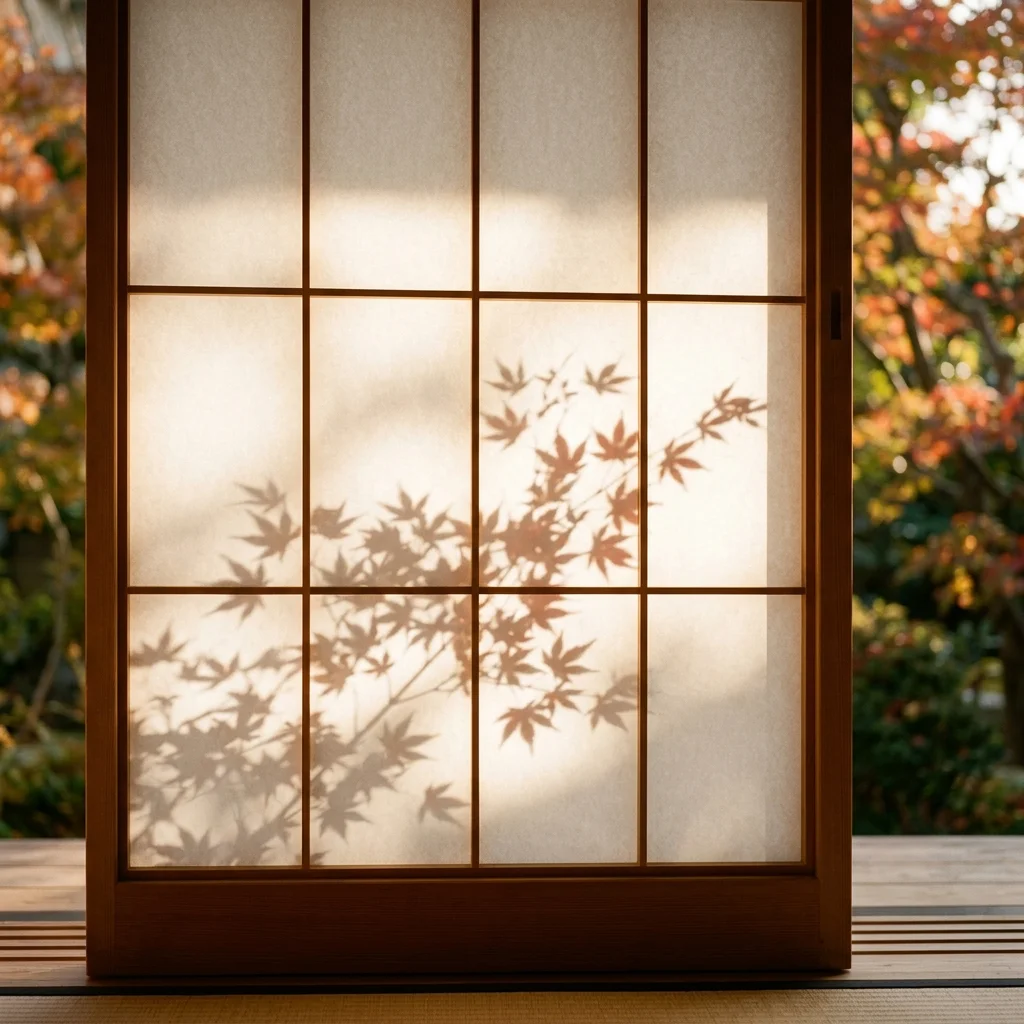
Warm afternoon sunset shadows of maple leaves cast elegantly onto a frosted sliding paper screen (shoji).
Cultural Concept

UTSUROI

移ろい / うつろい

The visual poetry of Utsuroi: the warm, shifting shadows of autumn leaves cast onto a Shoji screen, transforming a flat partition into a living canvas of time's passage.

Linguistic Definition (TL;DR)

Utsuroi is the quintessential Japanese philosophical concept representing the gradual, flowing, and ephemeral transition of time, space, and seasons. Rooted in Shinto animism and wabi-sabi, it celebrates the beauty of impermanence by focusing on the precise moments of physical and visual change.

Etymology & Linguistic Analysis

// 01

The word Utsuroi (うつろい / 移ろい) is a beautiful noun derived from the classical Japanese verb Utsurou (移ろう), which is the dynamic, continuous form of Utsuru, meaning 'to shift', 'to move', 'to reflect', or 'to change color'. Literally translated, the term means 'the flowing transition', 'the gradual shift', or 'the process of fading'.

Phonetically pronounced as /oot-soo-roy/, the word has a soft, liquid sound that mimics the slow, continuous movement of water or wind. In Japanese classical literature, the word is highly unique because it does not refer to a static, completed change (which is written as *Henka*). Instead, *Utsuroi* represents the active, delicate process of transition itself—the beautiful, highly transient phase that exists between two states, defining a cultural worldview where all reality is viewed as a continuous, flowing stream.

Deep Philosophical Foundations

// 02

At its deepest philosophical level, Utsuroi is a direct material extension of Japan's spiritual heritage: **Shinto animism** and the Zen Buddhist concept of **Mujo (universal impermanence)**. It represents the belief that beauty lies not in perfect, static permanence, but in the fragile, flowing transition of time.

In the Western philosophical tradition, beauty has historically been linked to eternity and perfect preservation—such as monumental stone statues and flawless oil paintings designed to resist time. In the Japanese worldview, this pursuit of eternity is viewed as a delusion that runs counter to the natural law of the cosmos. Zen teaches that *Mujo* is the absolute truth: all form is empty, and all things are continuously changing. *Utsuroi* is the aesthetic celebration of this impermanence. The dry leaf, the rotting timber, the fading blush of a cherry blossom petal, and the long, shifting shadow of dusk are not viewed as failures of form, but as the highest expressions of authentic beauty, evoking a deep sense of *Mono no Aware* (the beautiful, transient sadness of things).

Complementing this is the Shinto reverence for the seasonal breath of the *Kami* (spirits). Shinto teaches that the divine presence is found in the very movement of the seasons—the melting of spring ice, the rising of summer mist, the falling of autumn leaves, and the quiet silence of winter snow. To ignore these transitions is to disconnect oneself from the sacred rhythm of the earth. *Utsuroi* is the mindful practice of tuning one's senses to these micro-shifts, fostering a lifestyle of absolute presence and deep, wabi-sabi gratitude for the fleeting gifts of time.

Historical Evolution

// 03

The historical evolution of Utsuroi spans from the early imperial *Waka* poetry anthologies of the Heian period to the highly refined tea rooms of the Azuchi-Momoyama period.

During the Heian period (794–1185), the aristocratic court developed an extraordinary sensitivity to the micro-transitions of nature. In anthologies like the *Kokin Wakashu* (Collection of Japanese Poems of Ancient and Modern Times), poets did not merely write about spring or autumn. They wrote extensively about the *utsuroi* of cherry blossoms—specifically the precise moment when the wind blows and the petals begin to drift down, or the fading of autumn leaves (*Momiji*) under the morning frost. The changing colors of these natural objects were treated as direct metaphors for the transience of human love and the brevity of imperial life.

By the Sengoku (Warring States) period and early Edo period, under the guidance of legendary tea masters like **Sen no Rikyu** (1522–1591), *Utsuroi* was physically built into Japanese architecture through the design of the **Chashitsu (Tea Room)**. Rikyu realized that a tea room should not be a brightly, uniformly lit space; instead, it should act as a dark, quiet sanctuary that registers the shifting light of the sky outside. The windows were paneled with translucent *Shoji* paper, designed to catch and diffuse the afternoon sun. As the sun moved across the sky, the light inside the tea room slowly shifted from bright gold to cool gray, casting long, moving shadows across the tatami mats and the alcove (*Tokonoma*). This dynamic play of light and dark turned the physical room into a living clock of *Utsuroi*, forcing the tea guests to experience the absolute uniqueness of the present moment.

Cultural Case Studies

// 04

The practical application of Utsuroi is deeply woven into Japan's unique cultural structures: **Shichijuni-kou (The 72 Micro-Seasons)**, **Tsukimi (Moon Viewing)**, and the spatial shadow physics of **Engawa Balconies**.

1. Shichijuni-kou (The 72 Micro-Seasons): While the Western calendar splits the year into four massive seasons, Japan's traditional agricultural calendar divides the year into **24 solar terms (Sekki)**, which are further split into **72 micro-seasons (Kou)** lasting approximately five days each. Every micro-season has a highly poetic, botanical title that registers a precise ecological transition (e.g., 'Swallows Arrive' in early April, or 'Rotting Grass Becomes Fireflies' in mid-June). This extreme calendar standardization is a beautiful systemization of *Utsuroi*, training the community's mind to notice and celebrate the micro-shifts of the local flora and climate.

2. Tsukimi (Moon Viewing) and the Beauty of Clouds: In the traditional mid-autumn festival of *Tsukimi*, Japanese families gather to view the full moon. Remarkably, in Japanese poetry and art, a perfectly clear sky is not considered the ideal setting for moon viewing. Instead, the most celebrated state is *Mu-tsuki* (clouded moon)—where thin, wispy clouds slowly drift across the moon's face, partially obscuring and then revealing its cold light. The beauty lies in the *utsuroi* of the clouds, which creates a dynamic, mysterious, and transient visual play that a sterile, clear sky completely lacks.

3. The Engawa as a Light Interface: The traditional Japanese veranda balcony, known as *Engawa*, is a wooden buffer zone that sits between the indoor tatami room and the outdoor garden. Constructed from untreated cedar or cypress, the *Engawa* is exposed to the elements. As the seasons shift, the wooden deck slowly changes color, aging from bright straw-yellow to a deep, weathered silver-brown patina (*Ame-iro*). The *Engawa* physically registers the *utsuroi* of the climate, serving as a beautiful architectural interface that blends the passage of time directly into the material structure of the home.
Practical Guide for Foreigners

// 05

For international visitors and modern urban residents, cultivating the spirit of Utsuroi is a profound path to reduce chronic anxiety, overcome the speed of modern life, and find peace in everyday transitions.

Appreciating Imperfect Seasons: When traveling in Japan, resist the urge to visit only during the peak tourist windows (such as the absolute height of the cherry blossom bloom or the autumn leaves). Instead, explore during the transitional weeks—specifically the late spring (*Hana-fubuki*, the cherry blossom blizzard when the petals fall like snow) or the early winter (*Kogashi*, when the bare branches are framed by frost). These transitional periods offer a quiet, highly atmospheric beauty that is completely free of crowds, embodying the true spirit of wabi-sabi.

Mindful Culinary Seasons: Japanese cuisine (*Washoku*) is deeply governed by the seasons, divided into three culinary phases: *Hashiri* (first harvest of the season, representing fresh anticipation), *Shun* (the peak harvest, representing full maturity), and *Nagori* (the final harvest, representing nostalgic regret). You can practice *Utsuroi* at the dinner table by seeking out *Nagori* ingredients—such as slightly mature, dry mushrooms or late-harvest eggplant—appreciating their deep, concentrated flavors that mark the transition into the next season.

Ambient Lighting in Home Design: Modern interior design often relies on bright, uniform LED ceiling lights that remain constant 24/7. You can bring the calming influence of *Utsuroi* into your home by transitioning to dynamic ambient lighting: use warm, low-level lamps and dimmers that you slowly turn down as dusk approaches. This transition allows your nervous system to adjust naturally to the setting sun, enhancing melatonin production and connecting your internal circadian rhythm with the natural cycle of the earth.

Dialogue Scenarios

// 06

Review these bilingual dialogue scenarios to understand how designers and everyday observers discuss and appreciate the flowing transitions of Utsuroi.

Scenario A: An Interior Designer and a Client (ホテルのロビー設計現場で)
A designer explains why they chose natural plaster over synthetic paint to capture daylight.

Client: This plaster wall has slight color variations and textures. Wouldn't it look cleaner and more consistent if we used a flat, pure white synthetic acrylic paint?
Designer: Flat paint remains the same all day, but this natural plaster catches the shifting daylight. As the sun moves, the wall's texture slowly shifts, casting soft gray shadows. It captures the *Utsuroi* of the afternoon.
Client: I see. So the wall actually changes color and character depending on the hour and the weather outside.
Designer: Exactly. The wall becomes a living record of the day's transition, creating a space that feels alive, warm, and in harmony with time's flow.

Scenario B: Two Friends Walking in a Kyoto Garden (京都の寺院庭園で)
Two friends admire the falling leaves of a maple tree during late autumn.

Friend A: Look, the red leaves are falling so fast. In a few days, this beautiful maple tree will be completely bare and empty. It's a bit sad, isn't it?
Friend B: 確かに少し寂しいけれど、葉が落ちる「移ろい」のプロセスこそが最も美しいんだよ。地面に敷き詰められた赤い落ち葉の絨毯と、むき出しの静かな枝のコントラストを見てごらん。
(It is slightly lonely, but the very process of transition—the *Utsuroi*—is what is most beautiful. Look at the contrast between the carpet of red leaves on the ground and the quiet, bare branches.)
Friend A: You're right. The tree is shifting from autumn color into winter silence. It's a beautiful, peaceful transition.
Friend B: そう、変化を拒まず、その一瞬の移り変わりを受け入れることが大切なんだよ。
(Yes, it is important not to resist change, but to embrace that fleeting moment of transition.)

Modern Ecological & Social Relevance

// 07

In our modern 21st-century digital society, Utsuroi has emerged as a critical design philosophy to combat the epidemics of chronic anxiety, temporal distortion, and circadian disruption.

In the age of continuous connectivity and globalized supply chains, our lives are increasingly insulated from seasonal changes. We work in climate-controlled offices under artificial lights that remain constant year-round, and we eat agricultural products that are shipped globally, eliminating the natural rhythm of harvest. This insulation has caused severe temporal distortion—a feeling that time is slipping away in a blur of digital sameness—which is a major driver of modern depression and sleep disorders. The philosophy of *Utsuroi* offers a beautiful path to healing: by re-integrating the micro-shifts of nature into our daily routine (such as adjusting our indoor light levels and eating highly localized, seasonal foods), we can restore our internal circadian biology, ground ourselves in physical reality, and find calm in the natural flow of time.

Furthermore, in the creative realms of architecture and product design, *Utsuroi* is driving a transition toward dynamic, eco-responsive materials. Architects are increasingly utilizing metals like copper and zinc that oxidize and age gracefully over decades, clay plaster walls that respond to air humidity, and spatial layouts that harness natural wind and light. By designing structures that physically register the *utsuroi* of the local climate, we can build a high-performance society that operates in absolute harmony with the natural boundaries of our planet, proving that true progress lies in embracing natural change, not resisting it.

Practical Mastery

Actionable Cultural Skills

Integrate the philosophical wisdom of Utsuroi into your everyday lifestyle through these practical, hands-on Japanese technical disciplines.

Micro Seasonal Garden Observation

七十二候の自然観察
初級 (Beginner)⏱️ 15 Minutes

Cultivating extreme sensory mindfulness of nature's gradual transition, identifying the subtle changes in local flora and temperature every 5 days.

Traditional 72-season calendar (Shichijuni-kou)Observation notebook
📋 Practical Steps
  1. 01.Check the traditional Japanese 72-season calendar to understand the current micro-season (e.g., East Wind Melts the Ice, or First Lotus Blossoms).
  2. 02.Walk slowly into a local park or garden, close your eyes for 2 minutes to tune your hearing and skin to the wind velocity and humidity.
  3. 03.Open your eyes and look closely at a single plant or tree branch, noting the exact color transitions, bud formations, or insect activity in your notebook.

Shifting Shadow Interior Shitsurae

移ろう影の空間調律
中級 (Intermediate)⏱️ 1 Hour

Creating a dynamic wabi-sabi shadow play inside your living room, using natural materials to capture the flowing passage of daylight.

Translucent paper screen or partitionA single branch with structural leaves (e.g., maple or bamboo)Soft, warm ambient spotlight
📋 Practical Steps
  1. 01.Position a translucent screen or frosted glass partition adjacent to a blank wall that receives natural sunlight.
  2. 02.Place the structural branch behind the screen, adjusting its distance so that a soft, blurred shadow silhouette is cast onto the front face.
  3. 03.Allow the natural shifting of the sun throughout the afternoon to slowly move and morph the shadow lines, creating a living clock of Utsuroi.

Ephemeral Autumn Leaves Ikebana

落葉を惜しむ挿花
上級 (Advanced)⏱️ 45 Minutes

Assembling a minimalist flower arrangement that celebrates the exact transition into winter, highlighting dry textures and fading color.

A decaying autumn branch with semi-withered leavesA dark ceramic vase (Raku or Bizen-yaki)Sharp floral shears
📋 Practical Steps
  1. 01.Select an asymmetrical branch containing a mixture of fully colored red leaves, dry brown curled leaves, and empty bare twigs.
  2. 02.Trim the stem carefully, leaving the dry, decaying elements completely intact to showcase the transition of death (*Kare-ha*).
  3. 03.Secure the branch in the dark vase, allowing several dry leaves to rest naturally on the table surface as if they had just fallen, capturing the beautiful transience of Utsuroi.