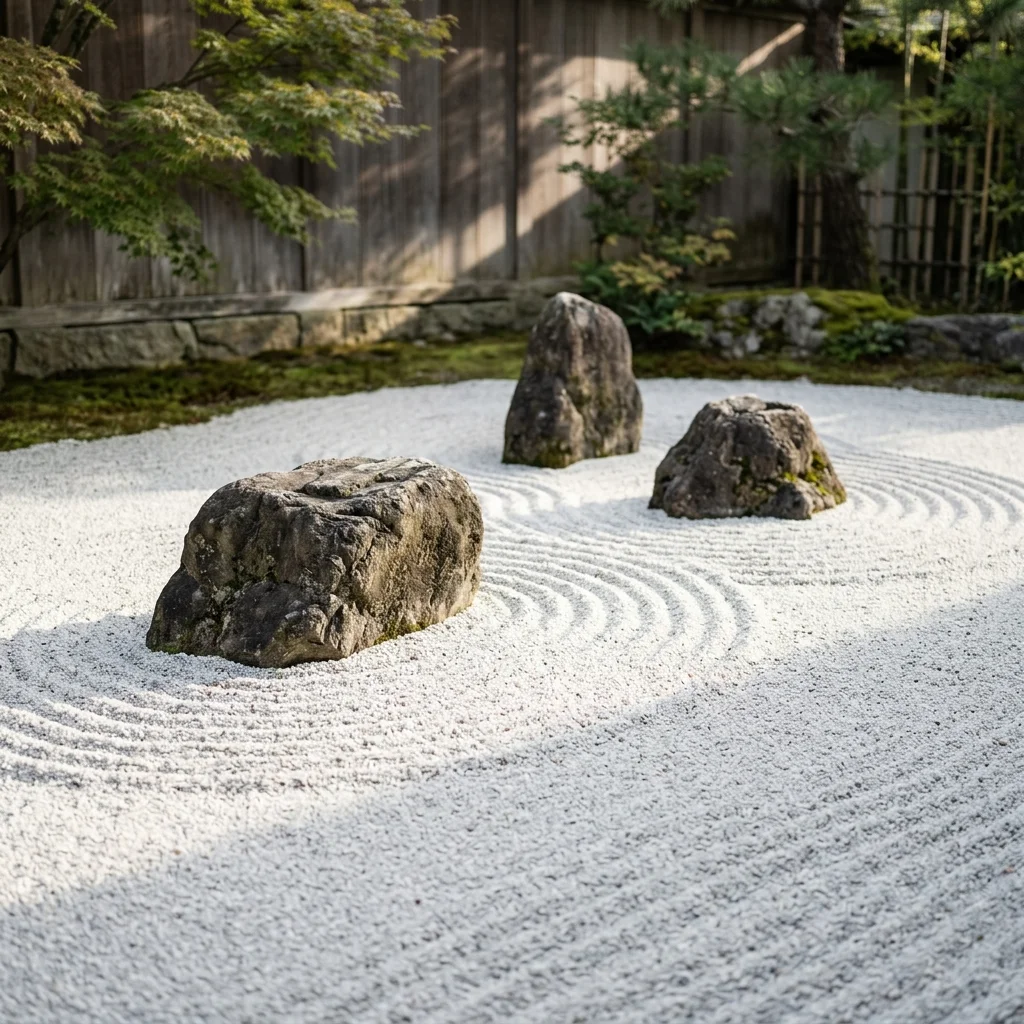
The physical manifestation of Mitate can be studied through three iconic cultural expressions: the dry garden of **Ryoan-ji**, the bamboo flower vase **Onjoji** by Sen no Rikyu, and the visual structure of traditional **Bonsai**.
Historical Case Study: The 15 Stones of Ryoan-ji
Located in northwest Kyoto, the dry garden of the Zen temple Ryoan-ji is the ultimate physical monument to Mitate. The garden is a simple rectangular plot of raked white sand containing fifteen natural stones arranged in five clusters, surrounded by low clay walls. There are no plants, no water, and no trees. For centuries, visitors have sat on the temple veranda, looking at the stone composition. Because the design is highly abstract, it acts as a perfect screen for mitate projection:
- The Tigress and Cubs: Some see a mother tiger leading her cubs across a dangerous river.
- Islands in the Sea: Others see the mountaintops of the mythical islands of the immortals rising above the ocean mist.
- The Mind's Eye: Zen teachers suggest the garden represents the five elements of the cosmos, or the absolute emptiness of the mind.
Crucially, the garden is designed so that from any vantage point on the veranda, at least one stone is always hidden from view. This spatial trick reinforces the philosophy of mitate: the complete reality can never be seen physically; it can only be realized through active mental and spiritual projection within the mind's eye.
Artisan Experience: The Cracked Bamboo Vase 'Onjoji'
In the spring of 1590, during Toyotomi Hideyoshi's military siege of Odawara, Sen no Rikyu accompanied the warlord. Finding himself in the mountains without appropriate tea utensils, Rikyu cut a thick stalk of local green bamboo and carved three simple openings to create a rustic flower vase. Over the next days, a deep crack formed along the side of the green bamboo, allowing water to slowly drip from the base. When Hideyoshi's officers saw the cracked, leaking cylinder, they declared it ruined and useless. Rikyu, however, was deeply moved. He saw the crack not as a defect, but as a beautiful manifestation of impermanence and a representation of the ancient temple Onjo-ji, which possessed a famous cracked bronze bell. He named the vase Onjoji and utilized the slow drip of water to represent the silent, steady flow of life. Today, Onjoji is recognized as one of the most precious tea utensils in Japanese history, showing how the mitate mind can elevate a damaged piece of timber into a priceless spiritual treasure.
Design Metaphor: Bonsai and the Infinite Forest
Bonsai, the art of cultivating miniature trees in shallow containers, is a continuous practice of Mitate. A bonsai artist does not seek to grow a small, cute houseplant. Instead, they use meticulous pruning, wiring, and root management to force a small juniper or maple tree to adopt the exact visual proportions, gnarled bark textures, and wind-swept angles of an ancient, thousand-year-old tree clinging to a mountain cliff. The shallow container represents the earth, and the moss growing over the roots represents a dense mountain undergrowth. When looking at a masterfully styled Bonsai, the viewer's mind immediately scales the image, feeling the cold wind, the mountain air, and the passage of centuries, demonstrating the profound psychological power of mitate to squeeze a vast natural forest into a small ceramic pot.