Back to Glossary
Concept Glossary

Kintsugi: The Golden Joinery - Embracing Imperfection and Repaired Scars

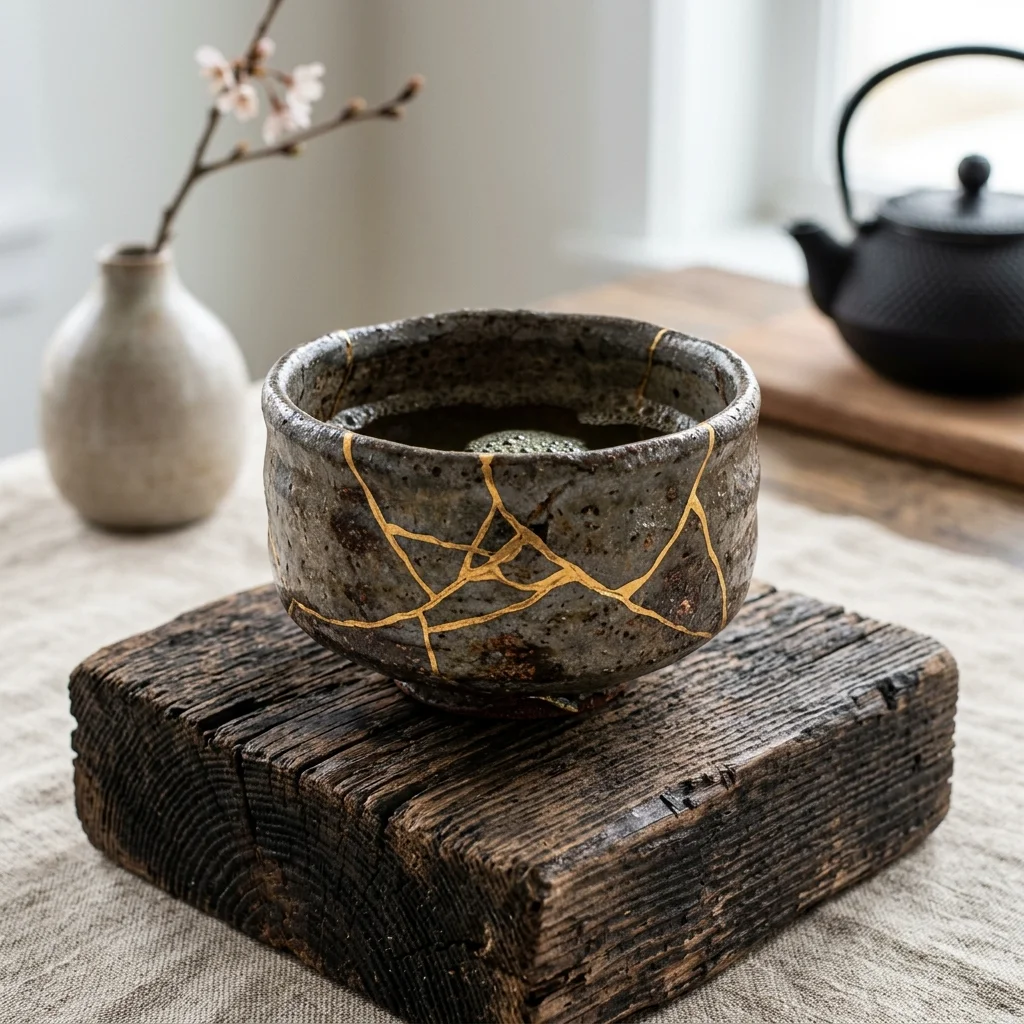
A highly textured, cracked ceramic tea bowl beautifully restored with pure gold powder lacquer resting on weathered timber.
Cultural Concept

KINTSUGI

金継ぎ / きんつぎ

The supreme visual statement of Wabi-Sabi: a rustic tea bowl whose fracture lines are transformed into shimmering gold veins through Kintsugi.

Linguistic Definition (TL;DR)

Kintsugi is the traditional Japanese art of repairing fractured pottery using natural lacquer and pure gold powder. Rooted deeply in Zen philosophy and wabi-sabi, it highlights cracks rather than hiding them, celebrating imperfection, resilience, and the rich history of physical objects.

Etymology & Linguistic Analysis

// 01

The word Kintsugi (金継ぎ) is a compound composed of two distinct Japanese words: Kin (金), meaning 'gold' or 'precious metal', and Tsugi (継ぎ), meaning 'joinery', 'repair', or 'connection'. Literally translated, it means 'golden joinery' or 'repair with gold'. A closely related term is Kintsukuroi (金繕い), which translates to 'golden mending'. Both words describe a highly specialized craftsmanship process that elevates the repair of fractured ceramics into a celebrated medium of high-art.

Phonetically pronounced as /kin-tsoo-gee/, the word carries a clean, crisp cadence, representing the precision-oriented metallurgy and lacquer-work involved in the craft. In modern international languages, the term has transcended its physical definition, becoming a powerful linguistic loanword used in psychology, literature, and lifestyle design to represent the beauty of emotional recovery, finding value in personal scars, and accepting impermanence.

Deep Philosophical Foundations

// 02

At its deepest level, Kintsugi is a direct, physical manifestation of the classic Japanese aesthetic of Wabi-Sabi—finding deep beauty in impermanence, simplicity, and imperfection. It functions as a visual antidote to the modern consumerist cycle of disposability, advocating for a lifestyle of mindful stewardship and emotional resilience.

In the Zen Buddhist tradition, the law of Mujo (universal impermanence) asserts that all physical things are in a constant state of flux, inevitably heading toward decay. Rather than viewing the fracture of a ceramic bowl as a tragic end to its usefulness, the Kintsugi mind sees it as an essential, beautiful chapter in its life history. The crack is not a flaw to be hidden, but a mark of experience. By filling the fracture lines with shimmering gold, the craftsman highlights the damage, celebrating the break as a source of aesthetic renewal and elevated worth. This aligns with the Zen philosophy of non-attachment (Mushotoku), encouraging us to accept change and aging with grace.

Additionally, Kintsugi is deeply connected to the spirit of Mottainai—a sense of profound regret over waste. The broken bowl is treated with active reverence, utilizing natural materials like Urushi lacquer and gold to restore its function while amplifying its beauty. The scars are treated not as a source of shame, but as a proud testament to the object's resilience, demonstrating a deep respect for physical resources.

Historical Evolution

// 03

The historical origins of Kintsugi are closely intertwined with the development of the Japanese Tea Ceremony (Chado) during the Muromachi period (1336–1573). According to popular historical legend, the Shogun Ashikaga Yoshimasa (1436–1490) sent a prized, cracked Chinese celadon tea bowl back to China for repairs. When the bowl returned, it had been crudely mended with heavy, unsightly metal staples (Kasugai). Deeply displeased by this sterile, industrial repair, the Shogun tasked Japanese craftsmen to find a more visually sympathetic solution.

The artisans turned to the ancient craft of Urushi-e (lacquer painting), combining natural tree sap with fine gold powder to fill the cracks. The result was a stunning, shimmering golden seam that transformed the broken bowl into a unique masterpiece of wabi-sabi beauty. This breakthrough revolutionized tea aesthetics, leading to a movement where repaired vessels were sought after by powerful tea masters like Sen no Rikyu, who valued Kintsugi-repaired bowls above flawless new imports. By the Edo period (1603–1867), the demand was so high that some collectors were rumored to have deliberately smashed precious Chinese and Japanese ceramics just to have them mended with golden joints, cementing Kintsugi as a highly prestigious, celebrated art form.

Cultural Case Studies

// 04

The physical practice of Kintsugi is centered around the use of Ki-Urushi (raw lacquer), a natural sap harvested from the Toxicodendron vernicifluum tree. Urushi is not a modern synthetic paint; it is an organic polymer that cures through a slow, biochemical cross-linking reaction that requires high humidity and warmth to harden.

1. The Chemistry of Urushi Consolidation: The lacquer is incredibly durable, acid-resistant, and heat-resistant, once cured. In the restoration process, Urushi is mixed with flour to create Mugi-urushi (a powerful, natural wood-adhesive) or with sawdust to make Kokuso (a dense gap-filler). The slow curing process inside a specialized humid box (Urushi-furo) allows the lacquer to molecularly bond with the porous clay body of the ceramic, creating a joint that is structurally stronger than the original clay.

2. Maki-e (蒔絵) Metallic Adornment: Once the structural seam is cured and sanded flush, the artisan applies a final, delicate line of red lacquer. While this layer is still wet and sticky, pure gold powder (Fun) is dusted over the surface using a soft bamboo tube (Makizutsu). The gold particles bind to the curing lacquer, and once dry, the surface is hand-burnished with a highly polished agate stone or fish tooth, transforming the raw metallic dust into a smooth, brilliant golden vein that shimmers under tea room lighting.

3. Cultural Case Study: The Hon'ami Koetsu "Seppo" Tea Bowl: A legendary historical masterpiece of Kintsugi is the Seppo (meaning 'Snowy Peak') raku tea bowl crafted by the celebrated Edo-period artist Hon'ami Koetsu. When the bowl cracked during the firing process, Koetsu did not discard it; instead, he repaired it with massive, thick lead and gold lacquer seams. The resulting design resembles a snow-covered mountain slope, turning a major firing failure into one of the most famous, highly valued tea bowls in Japanese art history, demonstrating that damage can be the catalyst for supreme artistic triumph.
Practical Guide for Foreigners

// 05

For modern collectors and international home cooks, understanding how to appreciate and care for Kintsugi-repaired ceramics is essential to preserving their physical and cultural longevity.

1. Hand-Washing Only: Genuine Kintsugi-repaired vessels are delicate, hand-crafted art pieces. Never place them in a dishwasher. The high heat, intense water pressure, and harsh chemical detergents will quickly erode the natural Urushi lacquer and wash away the gold layer. Instead, wash the piece gently by hand using lukewarm water, a mild dish soap, and a soft sponge.

2. No Microwave or Oven: Traditional Kintsugi uses real, high-purity metallic gold powder. Placing the repaired ceramic inside a microwave will cause electrical arcing, damaging the microwave and burning the lacquer. Additionally, the extreme heat of an oven will cause the natural Urushi joint to break down and fail, as the lacquer is only heat-safe up to approximately 100°C (212°F).

3. Food Safety Considerations: While traditional Urushi is completely non-toxic and food-safe once fully cured, many cheap, modern 'DIY Kintsugi kits' sold online use industrial epoxy resins and gold paint. These synthetic glues are not food-safe and can leach toxic chemicals when exposed to hot liquids. Always verify if a repair was made using traditional, natural materials before using it to serve hot tea or food.

Dialogue Scenarios

// 06

To understand how Kintsugi is spoken in natural, everyday Japanese conversation, review these bilingual dialogue scenarios representing typical cultural triggers.

Scenario A: At a High-End Tea Gathering (茶事の席で)
An international guest admires a unique, gold-seamed tea bowl presented by the tea host.

Guest: This bowl is absolutely stunning. The golden lines running across the clay look like rivers of light. Was it broken in the past?
Host: Yes, this Raku bowl fractured during a winter gathering many years ago. Rather than throwing it away, we had it repaired using Kintsugi. It took two months of work by a lacquer master.
Guest: It's beautiful. Instead of looking damaged, the cracks make it feel so much more unique and full of character.
Host: Exactly. In the tea ceremony, we value the bowl's history. The gold seams represent the bowl's survival and its unique story. It is the heart of wabi-sabi.

Scenario B: A Parent Passing Down a Mended Cup (家族の食卓で)
A mother comforts her child who is crying after accidentally cracking a favorite ceramic mug.

Child: ママ、ごめんなさい!お気に入りのマグカップを落として割っちゃった...捨てなきゃダメ?
(Mom, I'm sorry! I dropped and cracked my favorite mug... do we have to throw it away?)
Mother: 大作者だよ、泣かなくていいんだよ。捨てるのはもったいないから、金継ぎで直してあげよう。割れたところがお金色の線になって、前よりもっとかっこよくなるよ。
(It's okay, you don't have to cry. It would be mottainai to throw it away, so let's fix it with Kintsugi. The cracked part will become a beautiful gold line, and it will look even cooler than before.)
Child: 本当?お星様みたいになるの?捨てないで使い続けられるんだね!
(Really? Will it look like stars? I'm so glad we can keep using it without throwing it away!)

Modern Ecological & Social Relevance

// 07

In our modern globalized society, Kintsugi has transcended its origins as a physical craft to become a powerful global metaphor for emotional healing, psychological resilience, and ecological preservation.

The primary psychological value of Kintsugi is its reframing of adversity and trauma. In modern Western society, there is immense social pressure to appear flawless, strong, and successful. When individuals suffer emotional fractures—such as grief, heartbreak, or failure—they often attempt to hide their pain, viewing their scars as a source of shame. The philosophy of Kintsugi offers a beautiful, healing alternative: it teaches that our scars are not flaws to be hidden, but a proud testament to our survival. By embracing our vulnerabilities and highlighting our fractures with self-compassion, we can integrate our difficult experiences into our life history, transforming our personal struggles into a source of elevated wisdom and emotional strength.

Furthermore, Kintsugi is a powerful champion for ecological sustainability. In our modern disposable economy, consumer goods are built with planned obsolescence, leading to massive resource extraction and overflowing landfills. By practicing the spirit of Kintsugi—choosing to lovingly repair, upcycle, and cherish our damaged possessions rather than replacing them with sterile new goods—we can dramatically reduce our environmental footprint, proving that true sustainability requires a deep spiritual shift in how we value the physical creations of our planet.

Practical Mastery

Actionable Cultural Skills

Integrate the philosophical wisdom of Kintsugi into your everyday lifestyle through these practical, hands-on Japanese technical disciplines.

Modern Faux Kintsugi Repair

簡易金継ぎ
初級 (Beginner)⏱️ 2 Hours

Mastering a quick, accessible method of restoring decorative plates and mugs using modern polymer adhesives and metallic pigments.

Food-safe Epoxy ResinFine Brass PowderWooden Mixing SpatulaMasking Tape
📋 Practical Steps
  1. 01.Align the clean ceramic fragments carefully on a flat surface, applying masking tape on the exterior to serve as positioning guides.
  2. 02.Mix equal parts of epoxy resin and hardener, blending in a small amount of fine brass powder until a rich, golden paste forms.
  3. 03.Apply the gold epoxy along the broken edges, press the fragments together firmly for 5 minutes, and scrape away excess overflow with a scalpel after it cures.

Glaze Fracture Urushi Consolidation

生漆のひび割れ浸透
中級 (Intermediate)⏱️ 5 Days

Stabilizing hairline glaze cracks (kanyu) in ceramics using natural tree sap, preventing moisture penetration and highlighting fine texture.

Raw Ki-Urushi LacquerPure TurpentineSoft Cotton RagsHumid Drying Box (Urushi-furo)
📋 Practical Steps
  1. 01.Clean the ceramic vessel in boiling water to remove any grease or food residues, and let it dry completely in a warm room.
  2. 02.Dilute raw Ki-Urushi lacquer with a small drop of turpentine, and brush it generously over the hairline cracks, letting it seep deep into the clay body.
  3. 03.Wipe away all surface lacquer immediately using a dry cotton rag, then place the vessel in a humid drying box at 25°C and 75% humidity for 3 days to cure.

Agate-Stone Gold Burnishing

純金粉蒔きと金磨き
上級 (Advanced)⏱️ 7 Days

Executing the ultimate traditional finish, dusting fine metallic particles over wet lacquer and hand-burnishing with a mineral stone for brilliant shine.

Pure Gold Powder (Fun)Agate Burnishing StoneRed Bengara Urushi LacquerBamboo Dusting Tube (Makizutsu)
📋 Practical Steps
  1. 01.Paint a thin, precise line of red-pigmented Bengara Urushi over the cured joint seam using a fine-point sable brush.
  2. 02.Allow the lacquer to sit for 30 minutes until it becomes sticky, then gently dust pure gold powder over the line using a bamboo tube.
  3. 03.Cure the piece in a humid box for 4 days, then gently rub the golden seam with a highly polished agate stone to compress the gold particles, yielding a brilliant metallic sheen.