Back to Glossary
Concept Glossary

Takumi: The Artisan Master & The Peak of Manual Dedication

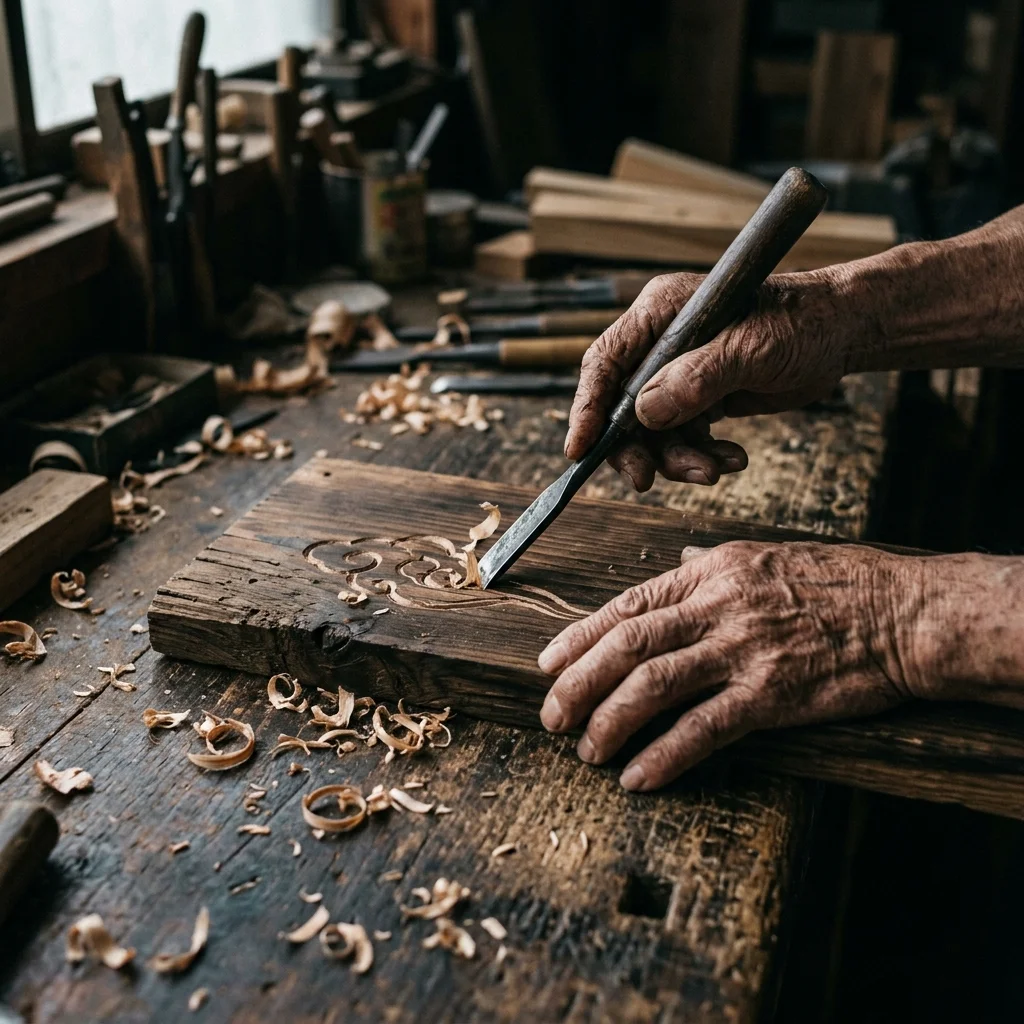
The weathered hands of an elderly master woodcarver holding a traditional steel chisel, carving a cloud motif into cedar wood.
Cultural Concept

TAKUMI

匠 / たくみ

The weathered hands of a master artisan carving cedar wood, representing the lifelong dedication and supreme focus of Takumi.

Linguistic Definition (TL;DR)

Takumi is the legendary Japanese concept of the master craftsman who dedicates tens of thousands of hours to refining a physical discipline. Rooted in medieval artisan guilds and preserved in modern high-precision industries, this philosophy celebrates supreme manual focus, material reverence, and the spiritual pursuit of functional perfection.

Etymology & Linguistic Analysis

// 01

The ancient and highly respected Japanese cultural noun Takumi (匠) is a single-character logograph that carries a rich etymological history dating back to the earliest structures of East Asian civilization. To truly comprehend the technical, spiritual, and artistic weight of this term, we must analyze its structural composition and historical linguistic shifts in detail.

The kanji character is etymologically classified as a compound ideograph. In ancient oracle bone and bronze scripts, the character was composed of two distinct components: the outer enclosure, known as the radical Hako-gamae (匚), which historically depicted a solid box, chest, or protective measuring square, and the inner character Yau (斤), which represents an axe, chisel, or sharp metal hand tool. Together, these two symbols represent the fundamental tools and the boundary of the master builder. The outer box symbolizes the strict, unyielding rules of geometric measurement, spatial logic, and structural safety, while the inner axe represents the physical capacity to cut, shape, and master raw natural materials. Together, they translate literally to 'the master carpenter who operates within the square', or 'the artisan who possesses both the tool of transformation and the boundary of discipline'. In ancient classical Japanese, the term was pronounced as /takumi/, carrying a sharp, rhythmic cadence that mimics the steady, echoing strike of an axe against timber, turning a simple description of a trade into a profound title of lifetime dedication.

Over centuries of cultural refinement, the definition of Takumi expanded far beyond carpentry to describe any supreme master who has achieved the absolute peak of manual skill, representing a standard of performance where the tool, the hand, and the soul of the maker operate as a single, flawless entity.

Deep Philosophical Foundations

// 02

At its deepest philosophical core, the concept of Takumi far transcends simple technical skill or professional competence; it is a profound material manifestation of Japan’s dual spiritual heritage: **Zen Buddhism** and **Shinto animism**, serving as a somatic path to self-realization and cosmic alignment.

In the Zen Buddhist tradition, any physical labor—whether sweeping paths, cooking grain, or carving timber—is not viewed as a chore or a secular distraction from spiritual practice. Instead, labor is celebrated as the primary vehicle for achieving **Mindfulness (Nensho)** and realizing the inherent Buddha-nature within all of us. The Zen philosophy of craft, often referred to as *Shokunin Kishitsu* (the artisan spirit), teaches that by focusing one’s entire mind and body on a single, repetitive manual action for decades, the illusion of the separate ego slowly dissolves. The craftsman no longer feels separate from the wood, the clay, or the metal; they enter a state of absolute non-separation where the tool moves with unforced grace, guided by the natural flow of the universe. The pursuit of functional perfection in a wooden joint or a ceramic bowl becomes a silent, moving meditation of the soul, proving that spiritual enlightenment is not a distant, abstract state but a physical reality that can be carved, hammered, and polished into existence.

Complementing this Zen perspective is the Shinto animistic belief in the sacred resonance of our physical actions on natural materials. Shinto teaches that the landscape is inhabited by the Kami, and that raw materials—especially ancient cedar trees, natural river clay, and raw iron ore—possess their own unique spiritual voice and life force (Ki). The Takumi master does not approach these materials as a superior conqueror seeking to force them into a synthetic shape. Instead, they approach the material with absolute humility, reverence, and gratitude. Before making a single cut, they listen to the wood, studying its grain, its density, and its hidden vulnerabilities. The process of creation is viewed as a collaborative dialogue between the spirit of the craftsman and the spirit of the material, protecting the sacred wafer of the land. By honoring the raw wood's voice, the master ensures that the final product is a pure, balanced, and harmoniously integrated work of art.

Historical Evolution

// 03

The historical journey of the Takumi spans from the early imperial construction guilds of the Asuka period to the highly structured, family-run artisan workshops of the Edo period, and finally into the advanced automation laboratories of modern Japan.

During the Asuka and Nara periods (538–794), the arrival of Buddhism and advanced continental architecture required the establishment of highly specialized, state-sponsored construction guilds. The master builders who designed and erected massive wooden temples like Horyu-ji (the oldest wooden structure in the world, surviving for over 1,300 years) were officially designated as *Takumi*. These early masters developed complex, glueless joinery techniques (known as *Kigumi*) that allowed wooden joints to shift dynamically during earthquakes, absorbing seismic shocks without cracking. They established a oral tradition of structural secrets, passing down sacred geometric formulas and tool maintenance techniques from master to apprentice through generations.

During the long peace of the Edo period (1603–1867), as urban commerce grew rapidly under the Tokugawa Shogunate, these intense guild rules were formalized into the comprehensive *Shokunin* code. Artisans organized themselves into strict family workshops, specializing in specific crafts like sword forging, lacquerware, weaving, and woodblock printing. A young apprentice spent their first five years merely sweeping the workshop, washing clay, and studying the master's movements without ever touching a tool. This long, silent training period was designed to quieten the ego, cultivate intense visual focus, and build the physical endurance needed for lifetime specialization. This historical baseline of uncompromising devotion to manual detail laid the groundwork for Japan's modern high-precision engineering, proving that the ancient code of the Shokunin could adapt and thrive within the context of global industrialization.

Cultural Case Studies

// 04

To observe how the philosophy of Takumi manifests in the physical world, we can examine two extraordinary Japanese models: the legendary **Lexus Origami Test** in modern manufacturing and the sensory, timeless craft of **Raku Ceramic Ware**.

1. The Non-Dominant Origami Test of Lexus Takumi Masters: In modern industrial Japan, the ancient code of the Shokunin is not treated as a historic museum piece; it is the absolute standard of quality control. At the high-end Toyota Lexus plant in Miyata, only a tiny elite of veteran workers (accounting for less than one percent of the workforce) are awarded the official title of **Takumi Master**. To maintain their status and qualify for assembly inspection, these masters must pass a rigorous, mathematical physical test every single morning: they must fold a traditional paper crane (*Origami*) using only their non-dominant hand in under **twenty seconds**, making sure all folds are perfectly crisp and sharp. This test ensures that their fingers maintain absolute sensory dexterity, micro-muscle control, and tactile memory, demonstrating that even in a factory filled with advanced robotic systems, the ultimate judge of precision is the highly trained, sensitive human hand.

2. The Tactile Dialogue of Raku Ceramic Ware: In the historic workshops of Kyoto, the Raku family has produced hand-formed tea bowls for over fifteen generations, following the exact aesthetic principles formulated by Sen no Rikyu. A Raku master does not use a mechanical potter’s wheel; they shape every single bowl using only their bare hands (the technique of *Te-tsukune*). The master spends hours sitting in a quiet, dark room, pressing their fingers into raw, gritty mountain clay, checking its density and moisture by touch alone. They adjust the thickness of the bowl's walls to create an uneven, organic texture that fits the human hand perfectly, providing a warm, comforting grip. The bowl is fired at extreme temperatures, pulled from the kiln while glowing red hot, and allowed to cool rapidly in the open air, resulting in unpredictable glaze variations that celebrate the transient beauty of nature, illustrating the perfect integration of human devotion and organic chance.

Practical Guide for Foreigners

// 05

For international visitors to Japan and modern professionals, adopting the spirit of Takumi is a powerful way to reduce burnout, discover deep professional purpose, and bring a standard of manual excellence to your daily work.

**How to Spot Takumi in Japan:** When traveling through historic towns like Kyoto, Kanazawa, or Tokyo's Jinbocho, take a moment to look closely at the small, family-run workshops. Watch a veteran knife sharpener who sits before a revolving whetstone for hours, checking the edge of a steel blade with their thumb every three seconds, adjusting their pressure by a fraction of a millimeter. Observe the traditional sliding-door maker who slides a finished cedar screen into its frame, ensuring it glides with absolute silence and stops precisely at the center. These quiet, focused citizens are the living national treasures of Japan, executing their roles with extraordinary care. Show respect for their focus by quietening your own voice and appreciating the silent, timeless dedication of their craft.

**Applying Takumi to Your Workspace:** You can easily practice Takumi in your own daily routine by choosing one simple, specialized tool or task and committing to executing it to your highest standard of excellence. If you are a software engineer, do not simply rush to finish a feature; spend thirty minutes refactoring your code, ensuring every line is clean, organized, and elegantly structured. If you cook at home, select a high-quality hand tool—like a carbon steel kitchen knife—and commit to keeping it perfectly clean and sharpened on a wet stone, showing deep respect for both the tool and the ingredients. This simple practice helps break the loop of modern distraction, quieten your thoughts, and restore a sense of personal pride and professional dignity to your daily work, transforming simple tasks into paths of Zen mindfulness.

Dialogue Scenarios

// 06

To understand how the subtle codes of Takumi are spoken and navigated in traditional workshops, review this bilingual dialogue scenario between an apprentice woodcarver and a senior Takumi master.

Scenario A: Training in the Kamakura Workshop (鎌倉の木彫工房で)
A young apprentice questions a veteran Takumi master about why he was criticized despite drawing a highly detailed, symmetrical cloud motif on cedar wood.

Apprentice: Master, I don't understand. I spent hours drawing this cloud motif, and it is perfectly symmetrical! Why did you tell me my design has no life?
Master: 左右対称に描くことは素晴らしい技術だ。しかし、この絵には「木の声」が聞こえない。君は定規の線だけに囚われて、杉の木目のうねりや、節の動きを見るのを忘れてしまっている。これでは「匠」の仕事とは言えない。
(Drawing symmetrically is a wonderful technique. However, in this design, the 'voice of the wood' cannot be heard. You were trapped only by the ruler's lines, forgetting to look at the curves of the cedar's grain and the movement of the knots. In that, it cannot be called the work of a Takumi.)
Apprentice: I see. So the wood isn't just a flat surface? I thought my job was to force the cloud design onto the cedar block.
Master: とんでもない。木は生きているのだよ。杉の木目一つ一つが、何十年もの風や光を吸い込んでできた年輪だ。我々の役割は、その木目が自然と雲の形に見えるように、木に寄り添って彫るだけなのだ。刃物は力ではなく、木の心と対話するために使うのだよ。
(Absolutely not. The wood is alive. Every single line of the grain is a ring made by absorbing decades of wind and light. Our role is merely to carve alongside the wood, letting that grain naturally look like a cloud. The tool is used not for force, but to converse with the heart of the wood.)
Apprentice: That is a deep realization. So the blank grain is actually what gives the carving its spiritual value? It's like leaving a trace of my mind in the wood.
Master: その通りだ。戻ってきたら、もう一度削ってみなさい。次は定規を捨て、自分の指先で木目のカーブを感じながら、ゆっくりと刃を進めるのだよ。
(Exactly. When you return, carve once more. Next time, throw away the ruler, and while feeling the curve of the grain with your fingertips, advance the blade slowly.)

Modern Ecological & Social Relevance

// 07

In our modern globalized society, the ancient ethical code of the Takumi has emerged as a critical element in environmental sustainability, biophilic design, and combating professional burnout.

As the global scientific community faces the severe ecological threats of climate change, microplastic pollution, and resource depletion, our modern industrial economies are realizing that the old model of cheap, rapid production and careless consumption is no longer viable. Adopting a Takumi perspective offers a powerful, sustainable alternative. By encouraging us to design buildings and products that are built to last for generations—handcrafted from natural, organic materials and designed with precise mechanical joinery that can be easily repaired—Takumi breaks the cycle of throwaway consumerism. It helps us develop a deep respect for raw materials, prompting us to view objects as valuable companions rather than temporary commodities, protecting the earth's limited resources naturally.

In the parallel realm of mental health and social psychology, the philosophy of Takumi is playing an increasingly vital role in combating the growing epidemic of digital anxiety and professional burnout. Modern professional life is saturated with digital platforms that project rapid, highly abstract streams of information, putting constant pressure on individuals to multitask and rapidly switch their attention between screens. This extreme fragmentation of focus is a major driver of chronic anxiety and a loss of personal meaning. Takumi acts as a soothing, compassionate refuge. It reminds us that true mental peace and professional satisfaction come from the slow, dedicated mastery of a single physical craft, and that finding pride in the tactile, real-world details of our daily work is the most sustainable path to emotional resilience and a meaningful, satisfying life, protecting our minds from the chaos of the digital world.

Practical Mastery

Actionable Cultural Skills

Integrate the philosophical wisdom of Takumi into your everyday lifestyle through these practical, hands-on Japanese technical disciplines.

Wood Grain Analysis and Directional Carving

木目の見極めと彫刻作法
中級 (Intermediate)⏱️ 1 Hour

Mastering the sensory art of identifying wood grain directions and executing clean, fluid cuts without splintering the fiber.

Coarse cedar blockHandheld carving chiselSoft brush
📋 Practical Steps
  1. 01.Hold your cedar block in both hands, closing your eyes to trace your fingers slowly across the raw surfaces to detect the natural rising grain lines.
  2. 02.Position your carving chisel at a shallow fifteen-degree angle, aligning the edge with the natural downward slope of the wood fibers to prevent tears.
  3. 03.Apply a steady, forward pushing pressure with your dominant palm while using your thumb to guide the blade, creating long, clean wooden curls.

Tool Edge Honing and Sharpening on Whetstone

砥石による刃物研磨技術
上級 (Advanced)⏱️ 45 Minutes

Sharpening high-carbon steel carving tools using natural water whetstones to achieve a mirror-finish edge that cuts effortlessly.

Traditional steel chisel (Nomu)Dual-grit water whetstone (1000/6000 grit)Mineral water bowl
📋 Practical Steps
  1. 01.Submerge your dual-grit whetstone in water for fifteen minutes until air bubbles stop rising, then place it firmly on a damp cotton base.
  2. 02.Hold the bevel of the chisel blade flat against the 1000-grit stone, lock your wrists, and glide the steel forward and backward in smooth strokes.
  3. 03.Switch to the 6000-grit polishing stone, applying light pressure to remove the micro-burr, polishing the steel edge until it reflects light cleanly.

Traditional Joinery (Kumiko) Friction Test

組子細工の微細嵌合試験
初級 (Beginner)⏱️ 30 Minutes

Practicing the assembly of complex wooden lattices without glue or nails, using raw friction and precise physical tolerances.

Pre-cut hinoki wood slatsSmall wooden hammer
📋 Practical Steps
  1. 01.Clean the joint grooves of your hinoki slats with your brush, ensuring no dust particles block the tiny physical channels.
  2. 02.Align the tongue and groove cuts of the two wood pieces at a ninety-degree angle, pressing them together gently with your fingers.
  3. 03.Use your wooden hammer to tap the pieces into place, listening carefully for a clean, solid click that confirms a seamless friction fit.