Back to Glossary
Concept Glossary

Hara Hachi Bu: Mindful Moderation & The 80% Longevity Rule

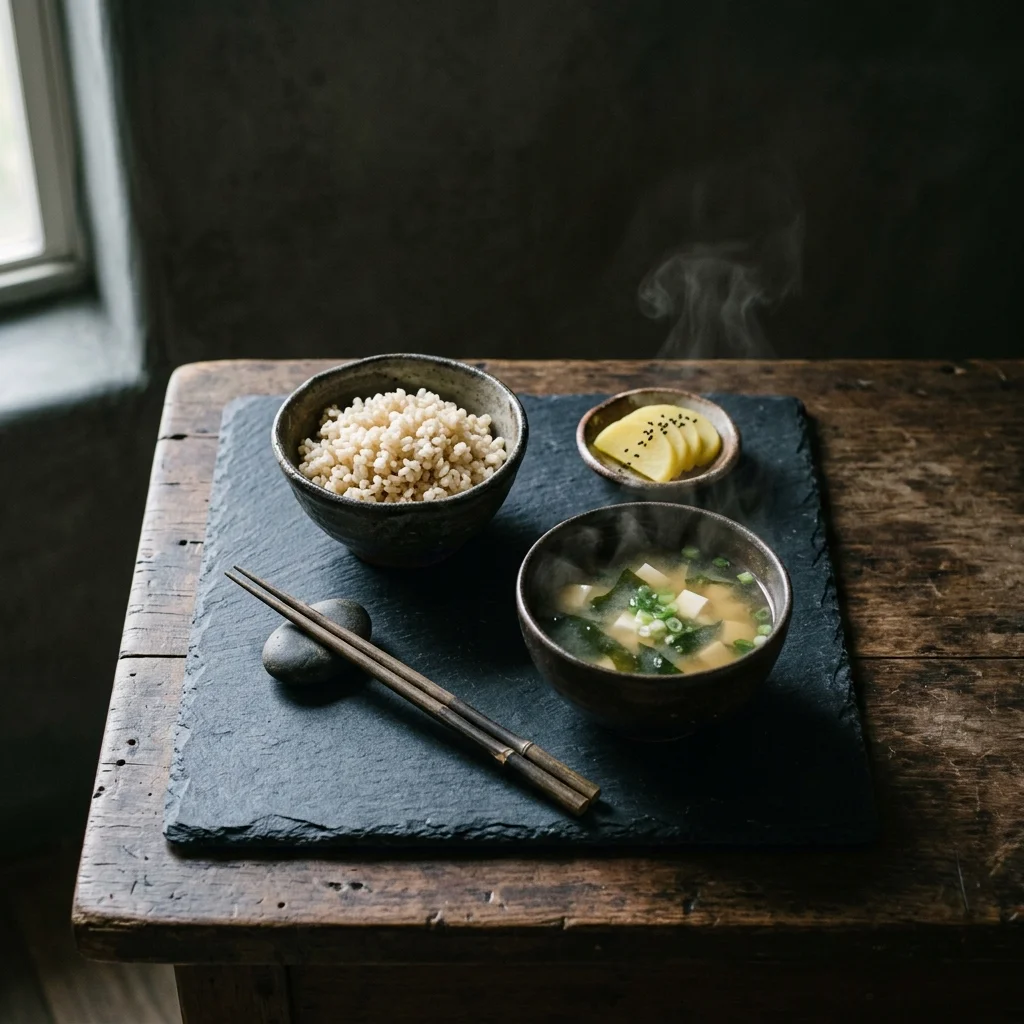
A minimalist Japanese meal served on a dark slate tray, containing brown rice, clear miso soup, pickled radish, and bamboo chopsticks on a stone rest.
Cultural Concept

HARA-HACHI-BU

腹八分 / はらはちぶ

A minimalist, balanced single-serving meal served on a slate tray, illustrating the physical moderation and longevity of Hara Hachi Bu.

Linguistic Definition (TL;DR)

Hara Hachi Bu is the traditional Japanese longevity and wellness philosophy of eating until you are eighty percent full. Originating from Okinawan centenarians and formalized in historical medical health texts, this mindful eating habit cultivates deep sensory awareness, metabolic balance, and respectful moderation in our daily physical consumption.

Etymology & Linguistic Analysis

// 01

The beautiful and practical Japanese idiomatic phrase Hara Hachi Bu (腹八分)—historically spoken in full as *Hara Hachi Bunme* (腹八分目)—is a profound four-character compound that describes a highly structured approach to physical moderation. To truly grasp the etymological and scientific precision of this phrase, we must analyze the linguistic roots of each individual kanji character in detail.

The first character, Hara (腹), represents the stomach, the abdomen, the womb, or the physical center of the body. Historically, in ancient Japanese medicine, the *Hara* was viewed not merely as a biological digestive bag, but as the seat of deep emotion, personal character, and physical energy (Ki). The second character, Hachi (八), represents the number eight, which in ancient Japanese numerology was celebrated as a highly positive symbol of gradual expansion, balance, and natural prosperity (due to the character's wide, spreading shape). The final character, Bu (分), translates directly to 'parts', 'tenths', or 'the boundary of measurement'. Together, *Hara Hachi Bu* translates literally to 'eight parts of the stomach', or 'to fill the physical center of your body to exactly eighty percent of its absolute capacity'.

Spoken with a firm, centered rhythm—pronounced /hah-rah-hah-chee-boo/—the word carries a steady, meditative cadence, serving as a verbal physical anchor that reminds the speaker to listen to their body's internal signals, transforming a simple nutritional rule into a profound guide to daily balance.

Deep Philosophical Foundations

// 02

At its deepest philosophical core, Hara Hachi Bu is not a commercial weight-loss diet or a set of restrictive nutritional rules; it is the primary physical expression of Japan’s dual spiritual heritage: **Confucian ethics** and **Zen Buddhist mindfulness**, serving as a somatic path to self-discipline and cosmic balance.

In the traditional Confucian worldview, the primary key to personal virtue and social stability is the cultivation of **Moderation (Chuyo)** and self-discipline. Confucianism teaches that human desires—including the desire for food, wealth, and power—are natural, but that left unchecked, they inevitably lead to chronic greed, bodily disease, and social conflict. Hara Hachi Bu is the somatic manifestation of this moderation. It suggests that eating is not an act of aggressive consumption, but a sacred responsibility to maintain our physical bodies in a state of optimal balance. By stopping before physical fullness, the practitioner exercises their moral character, refusing to indulge in the animal impulse of gluttony. This practice is linked to the Zen concept of Chisoku (knowing satisfaction)—the deep realization that true happiness is found not in endless accumulation, but in appreciating what is already sufficient, protecting our minds from the chronic dissatisfaction of the modern world.

Complementing this Confucian baseline is the Zen Buddhist concept of **Mindful Eating (Zen-mi)**. Zen teaches that every single bite of food is a direct gift from the universe, representing the labor of the farmer, the sun, the rain, and the wind. In Zen monasteries, meals are eaten in absolute silence, using a set of nested bowls known as *Oryoki*. The monk coordinates their breathing with every bite, chewing thirty times to appreciate the raw flavor of the ingredients. Rushing or overeating is seen as a direct spiritual failure that brings impurity (*Kegare*) to the body and disrespects the earth. Hara Hachi Bu is the active execution of this respect. By leaving twenty percent of the stomach empty, the practitioner allows the physical space for digestion, keeping the mind clear, alert, and fully receptive to the present moment.

Historical Evolution

// 03

The historical journey of Hara Hachi Bu spans from the early medical manuals of the Edo period to the ancestral longevity traditions of the Ryukyu Kingdom (Okinawa), and finally into the contemporary global scientific studies of caloric restriction.

The philosophy was first officially popularized and documented during the peaceful **Edo period (1603–1867)** by the legendary neo-Confucian scholar and physician **Kaibara Ekiken (1630–1714)**. In his famous 1713 health manual, the **Yojikun** (Regulations on Life-Nurturing), Ekiken outlined a comprehensive guide to longevity based on natural balance. Ekiken wrote: 'To cultivate health, one must keep the stomach eighty percent full. Overeating generates stagnant energy (*Ki*), which clogs the blood vessels and brings disease to the body.' He warned that those who filled their stomachs to one hundred percent would inevitably cut their lives short, formalizing *Hara Hachi Bu* as a standard of preventative medicine that was widely read by all classes of Japanese society.

In the southern islands of Okinawa, this medical advice was integrated into the local language and daily dining rituals of the Ryukyu people. For centuries, before starting any meal, Okinawans would chant the phrase: *'Hara Hachi Bu'*. This ritual chant served as a powerful physical anchor, reminding them to check their speed and portion sizes before dining. During the post-war era, as global longevity researchers began to study why Okinawans had the highest concentration of centenarians in the world, they realized that this simple cultural habit was the primary key to their extraordinary health, transforming a historic Japanese custom into a globally recognized standard of longevity.

Cultural Case Studies

// 04

To observe how the philosophy of Hara Hachi Bu manifests in the physical world, we can examine two extraordinary models: the traditional longevity diet of **Ogimi Centenarian Village** in Okinawa and the highly structured, seasonal menus of **Shojin Ryori (Buddhist Temple Cuisine)**.

1. The Caloric Moderation of Ogimi Centenarian Village: Ogimi, located in northern Okinawa, is celebrated globally as the 'Village of Longevity', boasting the highest ratio of centenarians on earth. In this community, citizens in their nineties and hundreds continue to harvest wild sweet potatoes, walk mountain paths, and maintain active social networks. When global researchers conducted a detailed food audit of Ogimi, they discovered that the residents consumed approximately twenty percent fewer calories than average citizens, despite maintaining a high-nutrient diet filled with organic tofu, bitter melon (*Goya*), and local seaweeds. Crucially, the centenarians practiced Hara Hachi Bu as a daily social ritual: they utilized small, ten-centimeter ceramic bowls, chewed their food extremely slowly, and shared their meals in quiet communal circles (*Moai*), proving that moderate consumption combined with close social connections is the ultimate key to a long, healthy life.

2. The Spatial Balance of Shojin Ryori (Buddhist Temple Cuisine): In the quiet Zen monasteries of Kamakura and Kyoto, Shojin Ryori is the traditional vegetarian cuisine prepared by the temple cooks (*Tenzo*). Shojin Ryori is a profound sensory experience designed to cultivate spiritual mindfulness. The menu is governed by the **Rule of Five**: it must feature five colors (white, black, yellow, red, green) and five flavors (sweet, sour, salty, bitter, umami). The food is arranged in small, nested lacquer bowls, leaving ample visual negative space inside each vessel to represent the Zen concept of emptiness (*Ma*). The monk does not eat until they feel heavy or full; they consume only what is physically necessary to sustain their meditation. This minimalist presentation forces the diner to slow down, focus on the unique, subtle flavors of each seasonal vegetable, and practice absolute moderation, reflecting the Zen core of Hara Hachi Bu.

Practical Guide for Foreigners

// 05

For international visitors to Japan and modern professionals, adopting the spirit of Hara Hachi Bu is a powerful way to bring metabolic balance, mental clarity, and mindful portion control into your daily life.

**How to Experience Mindful Eating in Japan:** When dining in Japan, pay close attention to how meals are served in traditional restaurants. You will rarely find massive, single plates piled high with food. Instead, you will receive a beautiful array of multiple small dishes (*Kobachi*), each containing a single, high-quality bite: a small pickled plum, a thin slice of grilled fish, or a tiny portion of mountain vegetables. The chopsticks are rested on a small stone base (*Hashi-oki*), and the guest is expected to put their chopsticks down after every bite. This elegant presentation is designed to force you to slow down, look closely at the food, and check your physical fullness, making it easy to practice Hara Hachi Bu naturally. Pay close attention to these small details, showing respect for the host's focus by quietening your own movements.

**Practicing the Eighty Percent Rule at Home:** You can easily practice Hara Hachi Bu in your own dining routine by choosing a simple, modest portion of brown rice and hot miso soup served on a slate tray. Inhale slowly and drink a full glass of warm mineral water ten minutes before your meal to relax your stomach. Replace your large modern dinner plates with small traditional ceramic bowls, and chew every bite exactly thirty times before setting your chopsticks down flat on the stone rest. Once you finish your meal, sit with your spine straight, close your eyes, and perform slow nasal breathing for five minutes, allowing your body to digest the food naturally. This simple practice helps break the modern loop of distraction, quieten your thoughts, and nurture deep, resilient peace in your daily life, transforming simple tasks into paths of Zen mindfulness.

Dialogue Scenarios

// 06

To understand how the subtle codes of Hara Hachi Bu are spoken and navigated in Okinawan villages, review this bilingual dialogue scenario between an elderly farmer and an international nutritionist.

Scenario A: Sitting in the Okinawan Garden (大宜味村の縁側で)
An elderly farmer, Matsu, welcomes an international nutritionist, Sarah, to his sunny wooden porch, discussing his daily eating habits.

Nutritionist: Mr. Matsu, I am amazed by your energy! You are ninety-eight years old, yet you were just working in your garden for two hours, and you look so healthy. What is your secret? Is it your special Okinawan purple sweet potato?
Farmer: サラさん、温かいお言葉をありがとう。さつまいもはもちろん体に良いものですが、本当に重要なのは「何を食べるか」ではなく、「どのように食べるか」ですよ。私は毎回の食事の前に、心の中で「腹八分」と唱えるのです。
(Sarah-san, thank you for your warm words. The sweet potato is of course good for the body, but what is truly important is not 'what to eat', but 'how to eat'. Before every single meal, I chant 'Hara Hachi Bu' in my heart.)
Nutritionist: Oh, I've heard that phrase! But how does it actually work in daily life? How do you know when you are exactly eighty percent full? It sounds like you need to calculate calories or weigh your food.
Farmer: とんでもない。計算など必要ありませんよ。箸を一口進めるごとに、一度箸置きに戻し、ゆっくりと三十回噛む。そして、胃の中に「あと二割の風が通る隙間」が残っていると感じる瞬間に、そっとお椀を置くのです。まだ食べられると思うところで止めるのが極意ですよ。
(Absolutely not. No calculation is needed. Every time you take a bite, return your chopsticks to the rest, and chew slowly thirty times. And at the exact moment you feel there is 'room for twenty percent of the wind to pass' inside your stomach, gently place your bowl down. Stopping when you think you can still eat more is the secret.)
Nutritionist: That is a beautiful way to describe it! 'Room for the wind to pass'—it sounds so light and refreshing, rather than feeling heavy and sluggish.
Farmer: その通りです。満腹になると体は重くなり、心も曇ってしまいます。お腹に二割の余白を残しておくことで、体は軽くなり、午後も元気に畑へ出かけられるのです。余白は「足りない」のではなく、「命の軽やかさ」なのですよ。
(Exactly. When you are full, your body becomes heavy, and your mind becomes cloudy too. By leaving a twenty percent margin in the stomach, the body becomes light, and you can energetically go out to the garden in the afternoon too. The margin is not 'not enough', but it is the 'lightness of life'.)

Modern Ecological & Social Relevance

// 07

In our modern globalized society, the ancient philosophy of Hara Hachi Bu has emerged as a critical element in global environmental sustainability, metabolic health, and combating overconsumption.

As the global scientific community faces the severe ecological threats of climate change, massive food waste, and agricultural resource depletion, our modern industrial food systems are realizing that the old model of high-yield farming and infinite caloric supply is no longer viable. Adopting a Hara Hachi Bu perspective offers a direct path toward global ecological balance. By encouraging individuals to reduce their daily consumption by twenty percent, Hara Hachi Bu lowers the demands on global agriculture, reduces food waste, and cuts down on the carbon emissions generated by food transport. It helps us develop a deep respect for agricultural resources, prompting us to view food as a precious gift rather than a cheap, disposable commodity, protecting the earth's ecosystems naturally.

In the parallel realm of metabolic health and preventative medicine, Hara Hachi Bu is playing an increasingly vital role. Modern society is saturated with highly processed, hyper-stimulating foods that override our natural satiety signals, putting constant pressure on individuals to consume larger portions. This extreme overconsumption is the primary driver of global epidemics of diabetes, cardiovascular diseases, and metabolic syndrome. Hara Hachi Bu acts as a soothing, compassionate refuge. It reminds us that true health and professional energy come from the slow, mindful moderation of a balanced diet, showing that finding pride and purpose in the smallest details of our daily meals is the most sustainable path to physical longevity and a peaceful society.

Practical Mastery

Actionable Cultural Skills

Integrate the philosophical wisdom of Hara-hachi-bu into your everyday lifestyle through these practical, hands-on Japanese technical disciplines.

Mindful Chewing and Satiety Signal Monitoring

三十回咀嚼と満腹度感知法
初級 (Beginner)⏱️ 30 Minutes

Mastering the sensory discipline of chewing every bite exactly thirty times, allowing your brain's satiety signals to catch up with your stomach.

A simple bowl of brown riceBamboo chopsticks
📋 Practical Steps
  1. 01.Lift a single, modest portion of brown rice with your chopsticks, place it in your mouth, and immediately set your chopsticks down flat on the stone rest.
  2. 02.Close your eyes and chew the rice systematically exactly thirty times, focusing your mind on the changing sweetness and grain texture.
  3. 03.Swallow slowly, and take one full diaphragmatic breath before lifting your chopsticks again, monitoring your physical fullness after every third bite.

Pre-Meal Water Serving & Bowl Size Reduction

小皿配膳と白湯による胃容調整
初級 (Beginner)⏱️ 15 Minutes

Reducing visual portion sizes by selecting smaller ceramic vessels and priming the digestive tract with warm water before dining.

A small ceramic tea bowl (ten-centimeter diameter)A glass of warm mineral water
📋 Practical Steps
  1. 01.Inhale slowly and drink a full glass of warm mineral water ten minutes before your meal, relaxing your stomach muscles and clearing your palate.
  2. 02.Replace your large modern dinner plates with small traditional ceramic bowls, filling them with only a single, aesthetically balanced layer of food.
  3. 03.Arrange your food asymmetrical to leave ample visual negative space inside the bowl, creating a visual sense of abundance despite smaller portions.

Post-Meal Five-Minute Silent Digestive Breath

食後五分間の静寂消化呼吸
初級 (Beginner)⏱️ 10 Minutes

Restoring autonomic balance after eating by sitting in absolute silence, helping your body transition smoothly into digestive rest.

A quiet dining chair or tatami seat
📋 Practical Steps
  1. 01.As soon as you finish your meal, place your chopsticks back on the stone rest and push your slate tray slightly forward to indicate completion.
  2. 02.Sit with your spine straight, rest your hands lightly on your thighs, and close your eyes to shut out any stimulating visual inputs.
  3. 03.Perform slow, deep nasal breathing for five minutes, allowing your parasympathetic nervous system to activate fully and digest your food naturally.