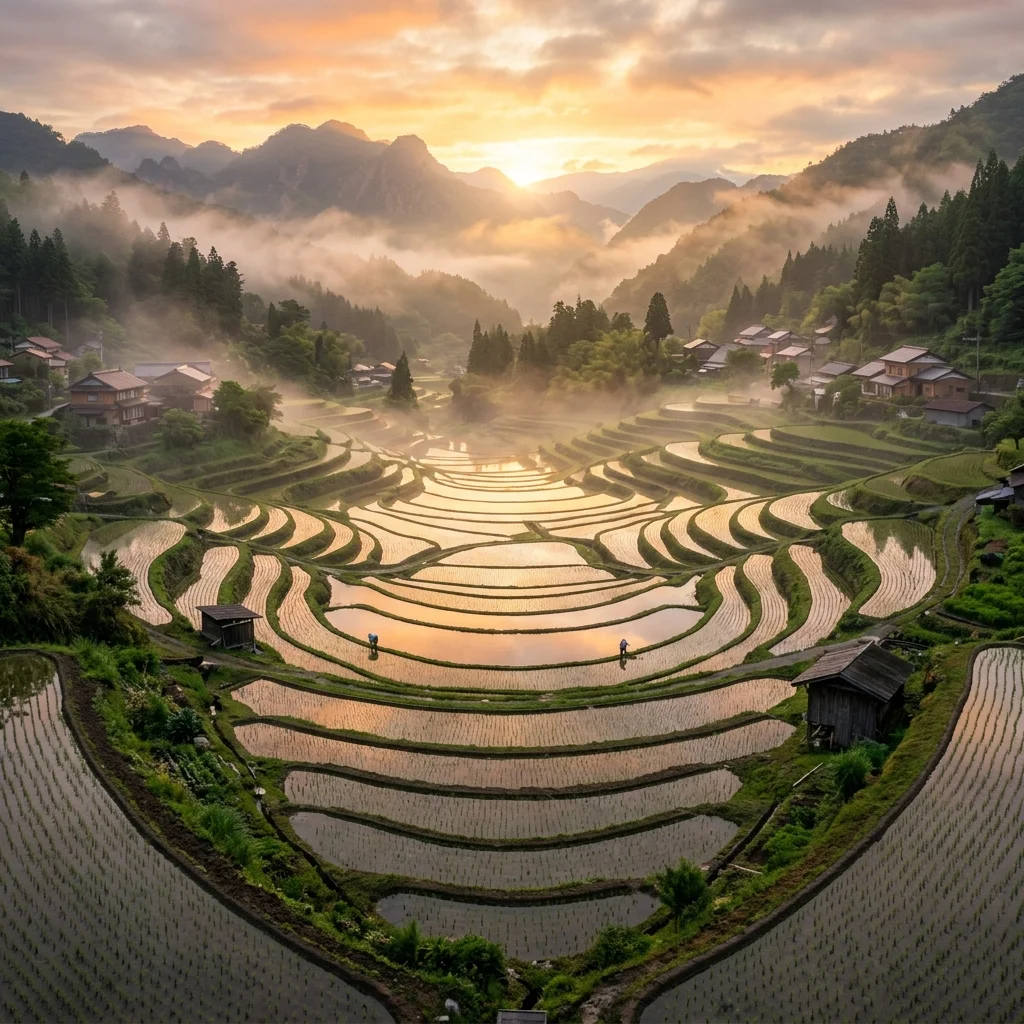
The practical brilliance of Satoyama can be observed across three key agricultural and ecological systems: **Tanada (Terraced Rice Paddies)**, **Yashikirin (Homestead Windbreak Forests)**, and the global **United Nations Satoyama Initiative**.
1. Tanada as Artificial Wetlands: The terraced rice paddies that carve the slopes of Satoyama are not simple commercial croplands; they are highly efficient artificial wetlands. The dry-stone walls that hold the terraces are constructed without mortar, allowing water to filter through naturally. During heavy summer typhoons, the *Tanada* act as massive storage basins, reducing peak downstream flood volumes and preventing severe landslides. Concurrently, these flooded fields serve as vital habitats for endangered aquatic insects, frogs, and migratory birds, showing how human agriculture can enrich biological diversity.
2. Yashikirin (Windbreak Protection): Traditional rural farmhouses in northern Japan are enveloped by a dense, horseshoe-shaped grove of evergreen trees known as *Yashikirin*. Typically composed of massive cryptomeria, cedar, and bamboo, these homestead forests serve a double purpose: they shield the wooden houses from freezing winter blizzards and summer typhoons, and they provide a continuous supply of fallen branches for firewood and bamboo shoots for dining. The *Yashikirin* acts as a micro-Satoyama directly surrounding the home, showing an intimate integration of domestic ergonomics and botany.
3. The United Nations Satoyama Initiative: In 2010, during the Convention on Biological Diversity held in Nagoya, Japan, the Japanese Ministry of the Environment and the United Nations University launched the **Satoayama Initiative (IPSI)**. Recognizing that global industrial farming has caused severe soil degradation and loss of species, the initiative promotes the Satoyama model worldwide. From terraced agroforestry in the Andes to traditional home gardens in Southeast Asia, the Satoyama model is being scaled globally to restore damaged landscapes, preserve local agricultural heritage, and build resilient, localized food systems.