Etymology & Linguistic Analysis
// 01The term Shinrin-Yoku (森林浴) is a highly evocative Japanese phrase that translates literally to 'forest bathing' or 'absorbing the forest atmosphere'. Coined in 1982 by Tomohide Akiyama, the Director-General of the Agency of Agriculture, Forestry, and Fisheries of Japan, the word was designed to encourage citizens to reconnect with the country's vast woodlands for natural stress relief.
To understand the poetic and sensory depth of the word, we must break down its individual kanji characters:
- Shin (森): The first character is composed of three identical radicals representing 'tree' (木). In Japanese written characters, combining three trees symbolizes a deep, dense, and wild forest—a place where the canopy closes over you, creating a protected sanctuary.
- Rin (林): The second character is composed of two 'tree' radicals, symbolizing a grove, a woodland, or the edge of a forest where human paths and nature meet. Together, Shinrin (森林) represents the entire complex ecosystem of Japan's ancient, mountainous woodlands.
- Yoku (浴): The third character, representing 'bath' or 'bathe', contains the left-side radical for 'water' (氵) joined with 'valley' (谷). Rather than referring to a physical bath with hot water and soap, Yoku here represents a spiritual and sensory immersion—cleansing one's mind and body by bathing in the ambient sounds, lights, scents, and colors of the living forest.
Phonetically pronounced as /sheen-reen-yo-koo/, the word carries a soft, rustling sound that mimics the gentle movement of wind through the cedar canopy, inviting the speaker to take a deep, slow breath and step into the silent sanctuary of the trees.
Deep Philosophical Foundations
// 02At its deepest level, Shinrin-Yoku is not a modern fitness trend or a simple secular wellness exercise; it is a direct material extension of Japan's ancient spiritual heritage: **Shinto animism** and **Zen Buddhist mindfulness**.
In the Shinto tradition, nature is not a resource to be conquered or dominated; it is the sacred home of the Kami (divine spirits). Mountains, ancient mossy stones, and towering trees are viewed as elder living beings that command respect and reverence. The towering Hinoki (cypress) and Sugi (cedar) trees are considered direct channels between the earth and the heavens, and entering a dense forest is treated as entering a natural shrine. Shinrin-Yoku is the physical act of showing respect to these ancient spirits. By walking silently and mindfully through the forest, the practitioner cleanses themselves of the spiritual impurities (Kegare) accumulated in the chaotic, modern urban world, returning to a state of natural purity and clean energy.
Complementing this is the Zen Buddhist concept of **Mindfulness (Nensho)** and the realization of non-separation. Zen teaches that the illusion of a separate self is the primary source of human suffering. Humans often look at the world as if they are separate from nature, leading to a sense of isolation and anxiety. When practicing Shinrin-Yoku, the boundary between the observer and the observed slowly dissolves. As you breathe in the forest scent and touch the mossy bark, you realize that your lungs are directly exchanging air with the trees. This realization is linked to the Zen concept of San-Sui (mountains and rivers as the body of Buddha), helping the practitioner find profound peace in their deep, natural connection to the universe.
Historical Evolution
// 03The historical evolution of Shinrin-Yoku is a fascinating story of a traditional cultural appreciation for mountains and forests being validated by modern clinical research during a period of intense national stress.
For centuries, the mountainous terrain of Japan was viewed by urbanites as a mysterious, sacred realm. Ascetic monks known as Yamabushi would climb high into the peaks to practice intense meditation under waterfalls and walk long distances through dense forests, believing that direct contact with the wild wilderness was the only way to build true spiritual power. During the Edo period, city dwellers from Tokyo would make pilgrimages to sacred forest temples like Mount Takao and Mount Koya, seeking a temporary escape from the heat and congestion of city life.
However, the modern practice of Shinrin-Yoku was officially born in 1982. During this era, Japan was undergoing a massive, highly stressful technological boom. Salarymen were working extreme hours in congested, gray office blocks, leading to a massive rise in lifestyle diseases, mental burnout, and stress-related illnesses. The government realized that they needed an affordable, accessible, and natural solution to secure public health. Coined by Tomohide Akiyama, the Shinrin-Yoku campaign was launched, encouraging citizens to visit the country's vast, government-protected national forests to relax their nervous systems.
To prove that this was not merely a subjective, romantic concept, the Japanese government funded extensive clinical research. Food scientists and medical researchers at Nippon Medical School, led by Dr. Qing Li, conducted multi-year clinical trials. They discovered that walking in forests produced measurable physiological changes compared to walking in urban environments—proving that direct contact with nature was a highly effective form of preventive medicine and laying the groundwork for forest therapy to be integrated into modern healthcare systems.
Cultural Case Studies
// 04The physical manifestation of Shinrin-Yoku can be observed in three unique Japanese practices: the designated **Forest Therapy Bases**, the preservation of the **Akasawa Forest**, and the science of **Phytoncides**.
1. Forest Therapy Bases (Rinryo-Base): To ensure that citizens can practice Shinrin-Yoku effectively, Japan established a rigorous scientific certification system. The country now contains over sixty designated 'Forest Therapy Bases'. To receive this certification, a forest must undergo strict medical testing. Researchers measure the air quality, the concentration of beneficial volatile organic compounds, and the physiological responses of test subjects walking the trails. These bases are equipped with certified forest therapy guides who design specialized sensory walks for patients suffering from high blood pressure, chronic stress, or emotional burnout.
2. Akasawa Natural Recreational Forest: Nestled in Nagano Prefecture, Akasawa is celebrated as the birthplace of modern Shinrin-Yoku. Home to majestic, three-hundred-year-old Kiso Hinoki (cypress) trees, this ancient woodland was historically protected by the local Owari clan during the Edo period under strict conservation laws (where cutting down a single tree was punishable by severe penalties). Today, the forest features eight beautifully maintained, universally accessible wooden boardwalk trails designed to let visitors walk silently beneath the towering canopy, experiencing the clean forest air and therapeutic pine aromas in their purest state.
3. The Science of Phytoncides: The primary chemical trigger behind the physiological benefits of Shinrin-Yoku is **Phytoncides**. These are volatile antimicrobial organic compounds released by trees (especially conifers like Hinoki and Sugi) to protect themselves from harmful insects, fungi, and bacteria. When humans walk through the forest and breathe in these compounds, their bodies respond by rapidly increasing the production of **Natural Killer (NK) cells**—specialized white blood cells that target virus-infected cells and tumors. Clinical studies prove that a single two-day forest trip can boost NK cell activity by up to 50%, with the immune benefits lasting for over thirty days, demonstrating that the forest air is a physical medicine.
Practical Guide for Foreigners
// 05For international travelers and busy urban residents, mastering the simple steps of Shinrin-Yoku is a powerful way to heal your nervous system and build a deep, mindful connection to nature.
How to Practice Shinrin-Yoku: The most important rule of forest bathing is to leave all electronic devices—smartphones, cameras, and fitness trackers—completely turned off or inside your bag. These devices keep your mind bound to virtual networks, preventing sensory immersion. Walk into the forest without any specific destination or speed. You are not hiking for exercise; you are bathing in the atmosphere. Walk slowly, stop frequently, and let your body guide your movements.
Activating Your Five Senses: To begin your immersion, systematically activate each of your sensory channels:
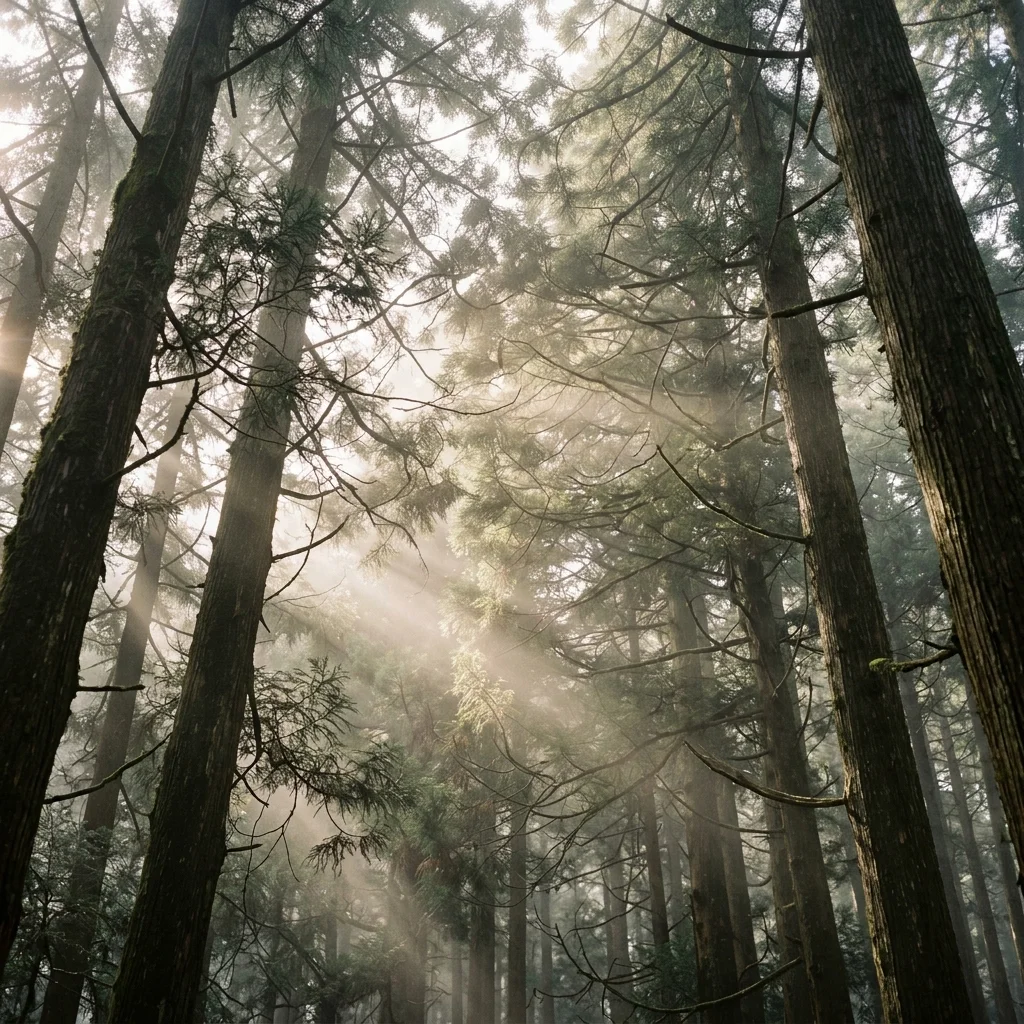
- Sight: Look closely at the delicate moss patterns on a wet rock, the complex branching of the cedar trees, and the shifting green colors of the leaves as sunlight filters through the canopy (a beautiful natural phenomenon known as Komorebi).
- Sound: Close your eyes and listen to the layers of sound—the high-pitched birds, the deep wind through the pine needles, and the soft crackle of twigs beneath your feet.
- Touch: Place your palms flat against the rough bark of an old tree, feel the cool texture of river stones, or walk barefoot on the soft, organic forest soil.
- Smell: Take deep, slow breaths through your nose, inhaling the rich, earthy scent of wet soil and the sharp, clean pine aroma of conifer needles.
Mindful Etiquette: When visiting Japan's sacred forests, maintain a quiet, respectful presence. Avoid shouting, playing music, or leaving trash on the trails, showing active respect for the resident Shinto spirits and the other visitors seeking healing. By showing this quiet reverence, you will find that the forest opens up to you, offering a deep, restorative peace.
Modern Ecological & Social Relevance
// 07In our modern globalized society, the practice of Shinrin-Yoku has emerged as a critical element in environmental sustainability, global health, and green urban planning.
As the world faces the severe ecological pressures of climate change and mass urbanization, more than half of the human population now lives in congested, concrete-heavy cities. This complete disconnection from the natural world has led to a major rise in mental health disorders, chronic stress, and systemic physical ailments. Shinrin-Yoku offers an affordable, non-invasive, and highly effective nature therapy that can be integrated into modern healthcare systems to reduce medical costs and improve quality of life. By validating the health benefits of forests, this practice provides a powerful economic and social justification for protecting ancient woodlands from industrial logging and urban sprawl, proving that living forests are highly valuable public health assets.
In the parallel realm of modern urban design, Shinrin-Yoku is inspiring a global movement toward **Biophilic Cities**. Urban planners and architects are integrating these principles directly into municipal designs—constructing pocket forests in dense urban centers, planting green rooftops, and using natural wood materials to bring the sensory benefits of the forest into hospitals, offices, and schools. By bringing the healing atmosphere of the forest into our everyday urban lives, Shinrin-Yoku stands as a timeless design philosophy, showing that human health and environmental conservation are deeply, inextricably linked.