Back to Glossary
Concept Glossary

Onigiri: The Rice Ball - Cozy Domestic Comfort, Portable Energy, and Hand-Pressed Love

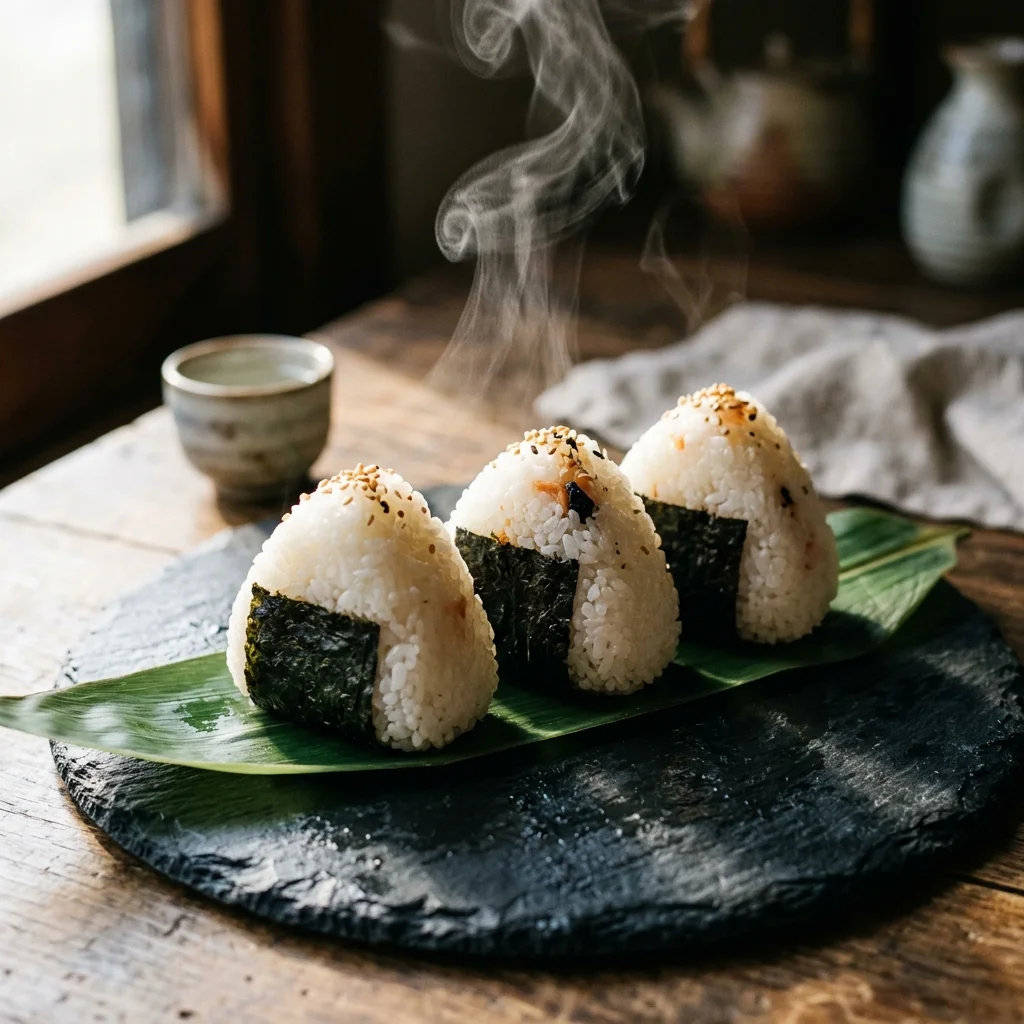
Three freshly hand-pressed triangular onigiri rice balls wrapped with crisp dark nori seaweed, resting on a green bamboo leaf.
Cultural Concept

ONIGIRI

おにぎり / おむすび

The ultimate Japanese comfort food: Freshly hand-pressed triangular Onigiri wrapped in crisp nori, representing the perfect merge of Shinto gratitude and portable nutrition.

Linguistic Definition (TL;DR)

Onigiri, also known as Omusubi, represents the ultimate Japanese comfort food—a hand-pressed rice ball. Rooted in Shinto offerings and historical travel rations, this simple staple features seasoned steamed rice shaped into triangles or spheres, often filled with savory ingredients and wrapped in crisp nori seaweed.

Etymology & Linguistic Analysis

// 01

The names of Japan's most beloved comfort food—Onigiri (おにぎり) and Omusubi (おむすび)—represent a fascinating linguistic map of regional identity, Shinto theology, and classical court manners. To understand the deep emotional warmth of these terms, we must analyze how they evolved from their active verbs into the supreme synonyms for portable dining harmony.

The first term, Onigiri, is a noun derived from the active verb Nigiru (握る), meaning 'to grasp, squeeze, clutch, or press with the bare hands'. The prefix O acts as an honorific of domestic respect, while the first character features the radical for hand (*Te*) on the left, and a symbol representing unity or locking together on the right. Therefore, the literal translation of Onigiri is 'the honorable hand-grasp' or 'that which is pressed together by hands'. Phonetically pronounced as /oh-nee-ghee-ree/ with a crisp, rhythmic cadence, it is the primary term used in eastern Japan (Kanto region) and across modern convenience store commercial networks.

The second term, Omusubi, is a noun derived from the classical verb Musubu (結ぶ), meaning 'to tie together, to collaborate, or to form a sacred bond'. Structurally, the kanji features the radical for thread (*Ito*) on the left, representing the weaving together of disparate strands. Historically, this term was coined during the Heian period as *Nyobo-kotoba* (court lady slang)—a highly refined, soft, and polite vocabulary utilized by imperial palace ladies to discuss everyday domestic items. Therefore, the translation of Omusubi is 'the honorable tie' or 'the sacred connection'. Phonetically pronounced as /oh-moo-soo-bee/ with a soft, breathing, and highly poetic flow, it is the preferred term in western Japan (Kansai region) and carries a warm, emotional connotation of maternal connection, linking the heart of the packer directly to the eater.

Deep Philosophical Foundations

// 02

At its deepest philosophical level, Onigiri is not a simple rice ball, a cheap convenience snack, or a fast-food ration; it is a profound extension of **Shinto mountain worship**, **tactile heat transfer (Te-shio)**, and the Zen-animistic respect for **elemental simplicity**.

In the Shinto animistic tradition, the grand mountains of Japan—such as Mount Fuji—are worshipped as the physical bodies of powerful *Kami* (divine spirits) who control the rainfall, the water supply, and the agricultural yield of the fields. To show active gratitude to these mountain spirits, ancient Japanese farmers shaped their rice offerings into **perfect triangles (Omusubi)**, representing the three-dimensional geometry of sacred peaks. The triangular rice ball was not created for convenience; it was a physical prayer, a small mountain of grain sculpted by human hands to house the spirit of nature's blessing. This spiritual connection explains why *Omusubi* are traditionally shaped into triangles, ensuring that eating the rice ball is a sacred act of physical and spiritual communion with the land, directly nourishing the soul.

This philosophy directly feeds into the concept of **Te-shio (手塩 - hand-salt)**. In Japanese culture, a mother or chef does not press onigiri with plastic wrap or factory molds; they press it with their **bare, wet, and salted hands**. This physical touch is crucial. As the hot, steamed rice is cradled in the palms, the physical heat, the natural salinity of the skin, and the emotional intent (*Ki*) of the creator are transferred directly into the grain. The salt is not just a flavor enhancer; it is a Shinto purifying element (*Kiyome*) that sterilizes the rice, protects it from decay, and seals it with love. An onigiri pressed with bare hands is considered a 'living object' that carries the unique, comforting warmth of the creator's hands—an emotional E-E-A-T credential that can never be replicated by a sterile, cold machine.

Furthermore, Onigiri represents the Zen aesthetic of **extreme elemental simplicity**. It consists of only three raw elements: short-grain rice, salt, and nori seaweed. There are no heavy sauces, no complex spices, and no artificial flavorings. The genius of the design lies in the purity of its extraction. The sweet, clean flavor of the steamed rice is perfectly balanced by the sharp salinity of the sea salt and the earthy, crisp umami of the toasted nori. It is a wabi-sabi food—unpretentious, honest, and completely connected to the earth and sea, proving that the most profound culinary satisfaction is achieved by stripping away the unnecessary decorations, focusing instead on the absolute essence of the grain.

Historical Evolution

// 03

The historical journey of Onigiri spans from the carbonized rice lumps of the Yayoi period to the traveling banquet rations of Heian-period courtiers, the iron military rations of Sengoku samurai, and finally to the high-tech, plastic-wrapped convenience store culture of modern global cities.

The earliest physical evidence of Onigiri dates back to the **Yayoi period (300 BC–300 AD)**. In the late 20th century, archaeologists excavating the Chanobatake ruins in Ishikawa Prefecture discovered a fossilized, carbonized lump of pressed short-grain rice that had been wrapped in a leaf and baked. The specimen featured clear marks of human finger indentations, proving that the practice of hand-pressing rice into portable portions is over two thousand years old, serving as the foundational travel food of early Japanese civilization.

By the Heian period (794–1185), as courtly aristocrats built complex banquet traditions, a specialized travel food arose known as **Tonjiki (頓食)**. During outdoor banquets, imperial excursions, or when hosting large numbers of palace guards, court ladies packed massive, oval-shaped balls of pressed sticky rice (*Mochigome*). These *Tonjiki* were stacked on large cedar trays and distributed as practical, high-calorie rations that could be eaten quickly without plates. The practice is famously recorded in Sei Shonagon's *Pillow Book* and Murasaki Shikibu's *Tale of Genji*, establishing Onigiri as a vital element of courtly hospitality and travel logistics.

During the Sengoku period (1467–1603), under the continuous warfare of the Samurai, Onigiri became the ultimate **military iron ration (Bansho)**. Samurai soldiers carried a container of **Umeboshi Onigiri** wrapped in dry bamboo sheaths (*Takenoko-no-kawa*) tied to their waists. The extreme acidity of the pickled plum and the high salt content of the hand-pressed rice prevented the food from spoiling during long, hot summer marches. The nori seaweed wrap, which was introduced during the mid-Edo period as seaweed cultivation boomed in Tokyo Bay, was a revolutionary design improvement. Prior to the Edo period, onigiri was sticky and messy to hold; the addition of a crisp, dry strip of nori acted as a natural, edible wrapper, ensuring that farmers and workers could eat their lunch with dirty field hands without contaminating the rice, launching a modern street-food revolution.

In the late 20th century, the global rise of the Japanese convenience store (*Konbini*) revolutionized Onigiri packaging. In 1978, a packaging engineer designed a revolutionary **three-layered plastic wrapping system** that separated the crisp nori seaweed from the moist steamed rice, preventing the seaweed from becoming soggy during storage. When the consumer pulled a central red tab, the plastic slid away, allowing the toasted nori to wrap around the rice ball instantly, delivering a perfectly crisp, fresh, and hand-pressed texture at any hour of the day, transforming this ancient Shinto offering into a multi-billion dollar global slow-food icon.

Cultural Case Studies

// 04

The practical application of Onigiri can be analyzed through three iconic case studies: the culinary design of the **Hinomaru Umeboshi Filling**, the regional shapes of **Kanto vs Kansai**, and the community solidarity during **modern disaster relief**.

Historical Case Study: Umeboshi and the Chemistry of Preservative Design

The traditional **Umeboshi Onigiri** is a masterpiece of organic chemical engineering and culinary design. At the center of the white short-grain rice ball sits a single, sour-salty pickled plum (*Umeboshi*). This is not just a flavor profile; it is a highly functional safety shield. The plum is saturated with high concentrations of **citric acid and salt**, which act as a powerful, natural antibacterial agent. When placed in the center of the warm rice, the citric acid slowly diffuses outward, killing bacteria (such as *Staphylococcus aureus*) and preventing the rice from fermenting or spoiling, even when stored in a warm bento box for eight hours. Furthermore, the intense sourness triggers immediate salivation in the diner, which releases digestive enzymes and improves stomach efficiency, proving that traditional culinary design is built on the exact same functional laws as modern food safety chemistry.

Artisan Experience: Kanto Triangle vs Kansai俵型 (Tawara-gata)

The visual shape of Onigiri varies strictly across Japan, reflecting regional histories and urban constraints:

  • Kanto (Eastern Japan/Tokyo): The standard shape is a sharp **Triangle (Sankaku)**. This is a direct heritage of Shinto mountain worship and the fast-paced, high-focus lifestyle of Edo's merchants who demanded portable, self-standing food that could be grabbed quickly.
  • Kansai (Western Japan/Kyoto & Osaka): The traditional shape is a **Cylinder/Bale (Tawara-gata)**, resembling a straw bag of rice. In Kyoto's aristocratic and theater culture, ladies preferred this shape because it could be sliced into neat, bite-sized portions and eaten delicately without smearing heavy makeup or opening the mouth too wide.
These regional differences demonstrate that even the simplest food is shaped by local architectural, dramatic, and social histories, celebrating a wabi-sabi diversity underfoot.

Design Metaphor: Disaster Relief and the Comfort of the Rice Ball

During the catastrophic **Great East Japan Earthquake of 2011** and the recent Noto Peninsula earthquakes, Japan's high-tech infrastructure—electricity, gas, gas stations, water lines—collapsed overnight, cut off from commercial supply chains. In the cold, dark evacuation centers, survivors suffered from extreme anxiety, cold, and hunger. The first and most critical food aid that arrived was not high-tech military rations or canned goods; it was **freshly hand-pressed Onigiri** made by volunteer groups using portable gas cookers. For the survivors, holding the warm, salted rice ball in their cold hands was a profound emotional experience. The physical heat of the rice, the taste of the salt, and the knowledge that another human being had pressed this ball by hand conveyed an immediate sense of safety, community solidarity, and absolute comfort that eliminated panic, proving that the ultimate shield of human resilience is the warm, simple craft of the hand-grasp.

Practical Guide for Foreigners

// 05

For international home cooks, travelers, and outdoor lovers, adopting the spirit of Onigiri is a beautiful, highly effective way to pack clean, healthy, and portable slow food for hikes, lunchboxes, and busy workdays.

Choosing the Right Rice: The absolute secret to a perfect, non-collapsing onigiri is using **traditional Japanese short-grain rice (Urumimai)**. Never attempt to make onigiri with long-grain rice (like Jasmine or Basmati) or parboiled rice; these varieties lack the essential starch (*amylopectin*) required to stick together, causing the ball to collapse into a loose pile of dry grains instantly. Cook the short-grain rice in a rice cooker with slightly less water than usual, ensuring the grains remain firm, distinct, and plump.

Mastering the Bare-Hand Salt Pressing technique: To transfer the essential warmth and salinity to the rice, bypass plastic wrap and press with your bare hands using these four steps:

  • #1: Wet Your Palms: Submerge both hands in a bowl of clean cold water. Shake off the excess—your hands should be wet, but not dripping wet.
  • #2: Apply the Salt: Dip your wet fingers in fine sea salt and rub your palms together. The salt should dissolve into a thin, uniform brine coating your skin.
  • #3: Place the Filling: Scoop 150g of warm steamed rice into your left palm. Create a small hole, insert your filling (salmon, tuna-mayo, or umeboshi), and fold the rice over to cover it.
  • #4: Press the Triangle: Cup your right hand at a sharp 90-degree angle over the rice. Squeeze gently—do not crush the grains!—and rotate the ball three to four times. The goal is a firm outer shell with a soft, fluffy interior.

Avoiding the Nori Mistake: When wrapping your onigiri with nori seaweed, pay attention to the timeline. If you are packing the onigiri for a hike three hours later, do not wrap the seaweed around the hot rice immediately. The steam will make the seaweed soggy, tough, and rubbery. Instead, wrap the bare rice balls in a clean bamboo leaf or wax paper, and carry the toasted nori strips in a separate dry container. Wrap the nori around the rice just before you bite into it, enjoying the magnificent, high-end sensory contrast of the hot, soft rice and the crisp, crackling seaweed.

Dialogue Scenarios

// 06

Review these bilingual dialogue scenarios to understand how family members, travelers, and friends discuss the preparation, shapes, and emotional comfort of Onigiri in daily conversation.

Scenario A: A mother teaching her child how to press their first rice ball (家庭の台所で)
A mother shows her young daughter the tactile secrets of hand-salt ratios.

Daughter: Mom, my rice ball is falling apart! Every time I try to shape it into a triangle, the rice grains stick to my fingers and it turns into a messy white lump. Why?
Mother: 手が乾いているからだよ。おにぎりを握る前は、まず手を水でしっかり濡らして、余分な水気を払ってから。そして指先に塩をちょんとつけて、両手をしっかり擦り合わせるの。この「手塩(Te-shio)」が、ご飯をくっつかなくして、味をグッと引き締めるんだよ。
(It's because your hands are dry. Before you press onigiri, first wet your hands thoroughly with water and shake off the excess. Then, put a little salt on your fingertips and rub your palms together. This 'Te-shio' keeps the rice from sticking, and brings out the flavor beautifully.)
Daughter: (trying again) Wow! The rice doesn't stick to my skin at all now! But how hard should I squeeze?
Mother: 強く握りつぶしちゃダメ。ご飯粒の間に空気を閉じ込めるように、優しく包み込むの。右手で屋根(三角の角)を作って、左手で土台を支えながら、くるくると回す。外はしっかり、中はふんわり。これが美味しいおむすびの秘密だよ。
(You must not squeeze too hard. Wrap it gently, as if locking air between the rice grains. Make a roof—the triangular corner—with your right hand, support the base with your left hand, and turn it. Firm on the outside, fluffy on the inside. This is the secret to delicious Omusubi.)

Scenario B: Two friends hiking in the mountains sharing lunch (山の山頂で)
An international hiker tastes a homemade onigiri at a mountain peak on a cold autumn day.

Friend A: Wow, this climb was freezing! My fingers are so cold, but this triangular lunch you wrapped in bamboo is still so warm and heavy. What's inside?
Friend B: それは私が今朝、素手で握った「鮭と梅干しのおにぎり」だよ。アルミホイルじゃなくて本物の竹の皮で包んでいるから、ご飯がベチャベチャにならずに、杉のような良い香りがするでしょう?
(That is a 'salmon and umeboshi onigiri' I pressed with my bare hands this morning. Because it is wrapped in a real bamboo sheath instead of aluminum foil, the rice isn't soggy, and it has a nice pine-like fragrance, right?)
Friend A: (biting in) Oh my god, the seaweed is so crisp, and the rice is incredibly sweet and comforting! The sourness of the plum in the center is like an electric shock that warms my entire body instantly.
Friend B: そうでしょう。山の山頂で食べる温かいおにぎりは、ただの食べ物じゃなくて、体と心を温める「ソウルフード」なんだよ。塩味と酸味が、登山の疲れを一気に吹き飛ばしてくれるさ。
(Right? A warm onigiri eaten at a mountain peak isn't just food; it's a 'soul food' that warms your body and mind. The saltiness and sourness blow away the fatigue of climbing instantly.)

Modern Ecological & Social Relevance

// 07

In our modern, high-speed 21st-century global society, the traditional Shinto philosophy of Onigiri has transitioned from a localized comfort food into a critical, revolutionary strategy for global environmental sustainability, sustainable agriculture, and mental health.

The modern global food industry relies on a highly destructive model of **heavy agricultural processing, chemical preservation, and massive carbon-intensive logistics**. Millions of tons of hyper-processed fast foods—pre-packaged wheat burgers, deep-fried snacks—are shipped across oceans in plastic packaging, loaded with chemical additives, and consumed in haste, driving global greenhouse gases and chronic metabolic illness. Onigiri offers a radical, elegant alternative. By championing **elemental simplicity and local agriculture**, Onigiri asserts that the most satisfying, healthy portable meal requires only three raw, organic ingredients: short-grain rice, salt, and seaweed. By supporting local rice farming cooperatives and organic seaweed harvesters, the consumer directly reduces their agricultural carbon footprint, cutting down the energy, processing water, and synthetic additives required for modern fast-food, establishing a clean, circular loop of natural nutrition.

In the parallel realm of mental healthcare and social well-being, Onigiri serves as a vital shield against the global epidemic of chronic anxiety, depression, and workplace isolation. We live in an era dominated by hyper-connected digital screens, where professionals frequently eat their lunches in haste, swallowing processed meals in front of keyboards. This absolute lack of pacing drains our emotional reserves, leading to digestive illness, high stress, and team isolation. The practice of Onigiri offers a path of quiet release. By protecting a simple lunch hour, wetting our palms, and hand-pressing our own warm rice balls wrapped in clean nori, we engage in a **tactile ritual of mindfulness**. The physical warmth of the steamed rice, the smell of the toasted seaweed, and the simple rhythmic rotation of our palms ground our senses, bringing a quiet wabi-sabi peace to our daily routines and proving that human happiness is not sustained by complex, expensive luxuries, but by the humble, daily embrace of the warm soul of the grain.

By shifting our relationship with daily nutrition from passive commercial consumption to active, mindful hand-craftsmanship, Onigiri stands as a timeless gift of Japanese culinary and spiritual wisdom, showing that true health, community resilience, and ecological balance do not require massive, high-tech innovations, but rather the humble, daily sharing of the warm circle of the hand-grasp.

Practical Mastery

Actionable Cultural Skills

Integrate the philosophical wisdom of Onigiri into your everyday lifestyle through these practical, hands-on Japanese technical disciplines.

Hand-Pressing an Authentic Triangular Onigiri

手塩の三角おむすび
初級 (Beginner)⏱️ 20 Minutes

Mastering the traditional, tactile art of hand-pressing hot rice into a structurally perfect triangle using the precise salt-water ratio.

Fresh warm steamed short-grain rice (150g)A small bowl of fresh mineral waterFine sea salt (half a teaspoon)A strip of crisp nori seaweed (3x12cm)Your favorite savory filling (e.g., flaked grilled salmon or umeboshi)
📋 Practical Steps
  1. 01.Wet both your bare hands thoroughly in the bowl of mineral water, shaking off the excess to prevent the rice from sticking to your skin.
  2. 02.Dip your wet fingertips in the sea salt, rubbing your palms together to distribute the salt crystals evenly across both hands.
  3. 03.Scoop the warm steamed rice into your left hand, create a small indentation in the center, and place your savory filling inside.
  4. 04.Cup your right hand at a sharp 90-degree angle to act as a mold. Rotate the rice ball in your palms three to four times, pressing gently to form a perfect triangle, then wrap the base with nori.

Curing Traditional Salt-Pickled Umeboshi Filling

梅干しの仕込み
上級 (Advanced)⏱️ 1 Month

Cultivating the ultimate, sour-salty traditional bento and onigiri filling using ancient lacto-fermentation and sun-drying methods.

Fresh, ripe yellow-green plums (Ume) (1kg)Coarse sea salt (150-200g, 15-20% of plum weight)Fresh red shiso leaves (100g) for color and antiseptic depthA sterilized glass fermentation jar with a matching heavy press stone
📋 Practical Steps
  1. 01.Wash the plums thoroughly, remove the tiny black woody stems with a toothpick, and dry the outer skin completely to prevent mold.
  2. 02.Layer the plums and coarse sea salt alternately inside the glass jar, placing the heavy press stone on top to compress the plums.
  3. 03.Allow the plums to ferment in a cool, dark space for two weeks. Once the juice rises, add salted, kneaded red shiso leaves for deep red color.
  4. 04.Extract the plums in mid-summer, lay them on bamboo trays under direct, intense sunlight for exactly three days to sun-dry, then store.