Back to Rituals
Practical Guide

The Art of the Guest: Tatami Room Protocols, Fusuma Sliding & Sacred Boundaries

Prerequisites / Mental Preparation

Before stepping onto the delicate green straw grid of a traditional Japanese tatami room, take a moment to perform a vital physical and mental transition. Don a pair of pristine, solid white cotton socks or traditional tabis; bare feet are strictly forbidden as human skin oils damage the fragile organic rushes over time. Remove all heavy metal ornaments, watches, and rings that might catch or tear the woven surfaces. As you approach the entrance, slow your breathing, empty your mind of external speed, and prepare to treat the physical architecture of the room not as a simple room, but as a series of sacred boundaries (kekkai) designed to facilitate mutual respect, quietude, and profound wabi-sabi harmony between host and guest. Take a deep breath to align your posture, drop your shoulders, and prepare to practice complete somatic mindfulness (shosa) in every step, ensuring you honor the delicate historical lineage of the space. Mentally pledge to respect the sacred silence of the household, aligning your internal rhythm to the slow, historic pace of traditional Japan. Avoid carrying heavy baggage that could scratch the shoji or sliding paper partitions, establishing a completely pure, clean and unblemished boundary of entry.

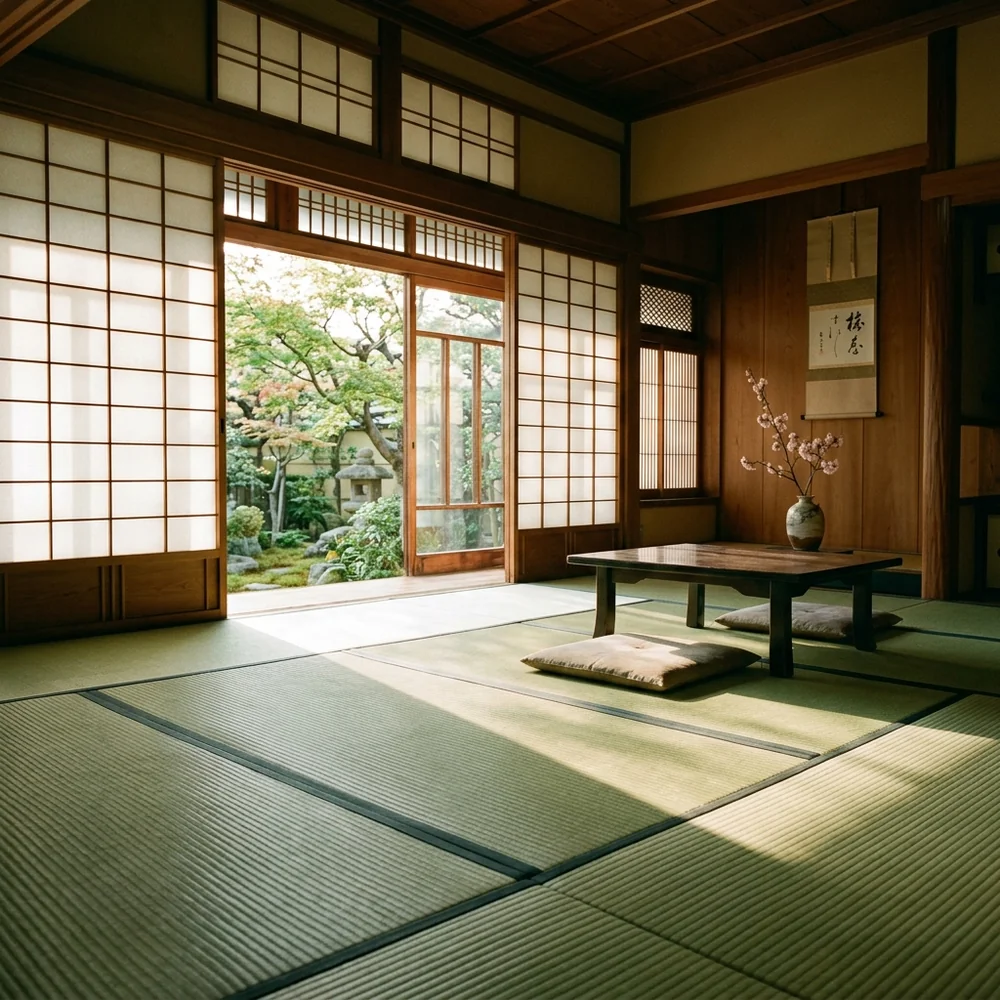
Cinematic photograph of a traditional Japanese tatami room with warm morning sunlight filtering through shoji screens casting grid shadows.

Warm morning sunlight filtering through translucent paper Shoji screens onto raw tatami straw mats, highlighting the serene, negative space and spatial alignment of a traditional Japanese guest room.

Crossing the Threshold: Step Over the Shikimi & Respect the Heri

// 01

Entering a tatami room (Washitsu - 和室) is a transition across deep historical and physical boundaries. The gateway of the room is marked by a heavy cedar wooden frame, where the horizontal base runner is known as the Shikimi (敷居). In Japanese residential design, the Shikimi is not merely a track for sliding paper doors; it is a profound metaphysical border separating the transitional corridor from the inner sanctuary of hospitality. To cross this boundary correctly, you must square your shoulders, align your hips, and execute a mindful step. You must step completely over the Shikimi beam without your socks ever making physical contact with the wood. Step over with your left foot first if entering from the left side, or your right foot if entering from the right, ensuring your body remains gracefully oriented toward the center of the room. Touching the Shikimi is considered a severe breach of manners, showing a careless lack of physical focus and directly insulting the host by symbolically stepping on the head of their house.

Once over the threshold, your gaze must immediately descend to the floor layout. The tatami mats are woven from soft, fragrant rush grass (*Igusa*) and bound along their long sides by high-quality fabric bands known as the Heri (縁). These margins, often dyed in deep indigo, forest green, or embroidered with family crests, represent individual micro-boundaries within the room. A strict, non-verbal protocol dictates that you must never step on the Heri margins. Walk only on the green straw surfaces, matching your strides to the rectangular grid of the mats. The reason is both physical and historical: stepping on the borders wears down the delicate fabric, ruins the alignment of the floor, and in ancient samurai residences, stepping on the Heri was highly dangerous, as assassins hiding beneath the floorboards would slide thin blades between the gaps. By keeping your steps centered on the straw grass, you maintain absolute physical poise, protect the organic fibers, and demonstrate respect for the host's carefully prepared environment.

To ensure a deep understanding of the spatial alignment, one must observe the physical coordinates of the feet. Walk with a low, sliding stride (Suri-ashi - 摺り足), keeping your heels barely elevated above the straw surface. This sliding motion prevents sudden, heavy impacts that compress the straw fibers, preserving the gentle elasticity of the tatami. As you walk, keep your hands lightly joined in front of your belt, with your elbows tucked close to your ribs, maintaining a compact, centered silhouette that does not invade the negative space of the room. By lowering your center of gravity and focusing your weight in the lower abdomen (Tanden - 丹田), you glide smoothly across the mats like a veteran tea master, transforming simple movement into a silent, flowing dance of spatial respect. This absolute control of weight ensures that the fragile rush grass does not generate any loud, scraping friction, preserving the pristine, wabi-sabi peace of the Washitsu.

Furthermore, one must consider the botanical structure of the Igusa rush itself. Each individual tatami mat contains roughly 130,000 hollow rush straws that expand and contract to regulate room humidity, absorbing atmospheric carbon dioxide while releasing a sweet, woody fragrance. Stepping directly on the Heri borders forces dust and structural dirt into the fabric fibers, which leads to early rot and decay of the underlying cedar core. By consciously lifting your feet and aligning your footprints precisely with the centers of the rectangular mats, you participate directly in the long-term conservation of the room's physical structure, ensuring it remains clean and fresh for future visitors over decades of quiet use. In doing so, you demonstrate that your somatic actions are aligned with the physical preservation of traditional materials, turning a simple walk into an active conservation efforts.
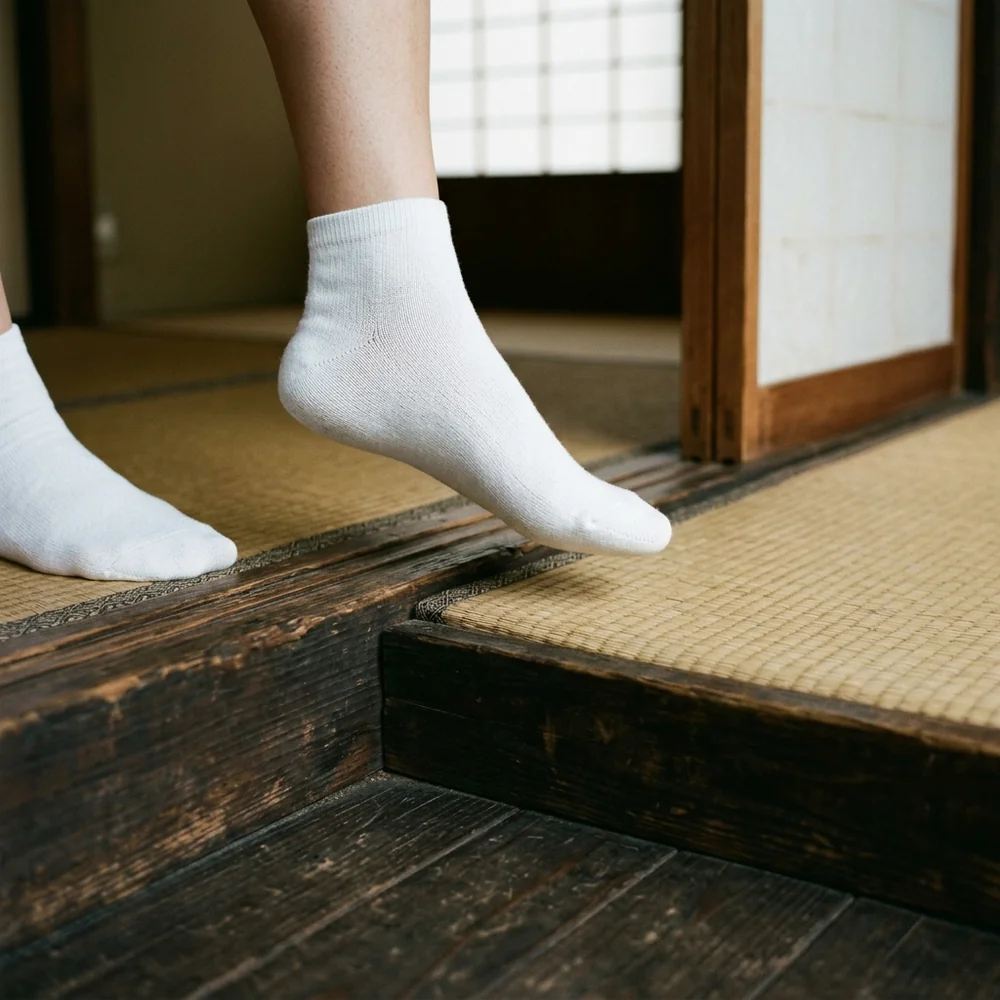
A visitor wearing pristine white socks stepping carefully over a cedar Shikimi threshold beam onto dynamic green tatami mats.
Stepping over the wooden threshold (Shikimi) and avoiding the indigo fabric margins (Heri) to maintain complete physical respect.

The Three-Movement Fusuma Slide: The Protocol of Sliding Screens

// 02

Traditional Japanese rooms are separated not by heavy, locking timber doors, but by lightweight sliding paper screens known as Fusuma (襖). These screens are constructed from fragile cedar lattices covered in multiple layers of premium washi paper, designed to filter sound and light while maintaining a fluid, customizable layout. Because the Fusuma is delicate, opening or closing it requires complete control of your finger placements and speed. The protocol is governed by a strict, three-movement sequence (Sante - 三手) that prevents the screen from generating any sudden, vibrating clicks or slamming against the outer frame.

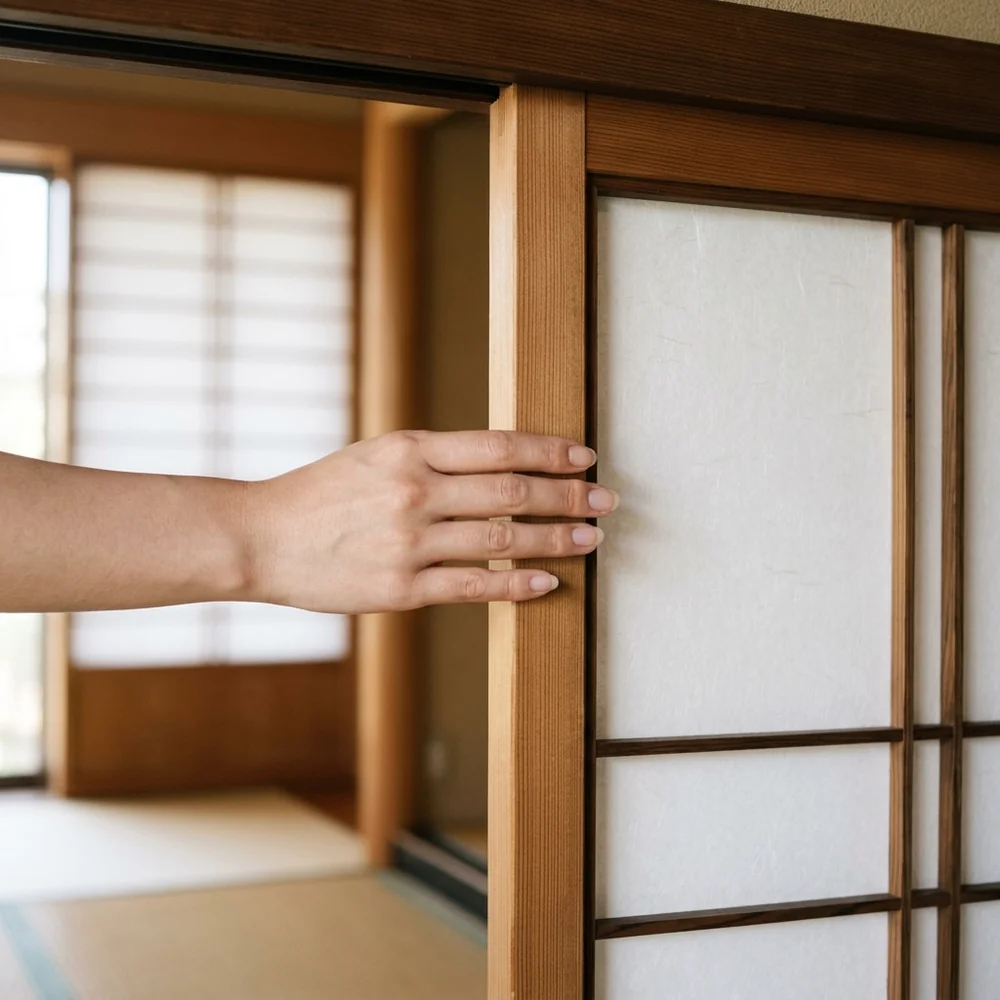
To open a Fusuma screen from the outside, kneel down in the formal Seiza posture directly in front of the sliding door. Grasp the small, round metal or lacquer indentation—known as the Hikite (引き手)—using only the thumb and index finger of your hand closest to the opening direction. Slide the screen open smoothly by approximately 10 centimeters. This initial short slide is crucial; it breaks the static friction of the track silently without shaking the delicate paper panels. Next, remove your fingers from the Hikite indentation. Place the tips of your three middle fingers flat against the vertical wooden border (Kamaichi) of the screen, approximately chest-height. Use the gentle pressure of your arm to slide the door open until it is wide enough for your shoulders to pass through easily. Never push the door completely into the wall pocket; leave a small 3-centimeter margin of the border visible to ensure the screen can be closed with ease.

When closing the Fusuma, the exact same three-movement sequence is executed in reverse, demonstrating complete symmetry and discipline. Slide the screen closed by grasping the vertical wooden border, bringing the panel within 10 centimeters of the frame. Then, switch your hand to the Hikite indentation, sliding it slowly and gently until the screen is within 5 millimeters of the wooden post. Finally, using the soft pads of your fingertips, guide the screen to a silent, absolute shut. Letting a Fusuma screen slide quickly and slam against the frame with a loud clap is a severe breach of shosa, indicating a lack of inner calm and generating an aggressive acoustic vibration that instantly shatters the quiet sanctuary of the home.

To achieve absolute mastery of this sliding screen protocol, the practitioner must pay strict attention to the mechanical tracks (Shikimi runners) lining the floor. These tracks are historically lubricated with natural candle wax to ensure zero resistance. Pushing the paper panel with sudden, uneven vertical force causes the wooden frame to warp and scrape against the ceiling track, generating an unpleasant wooden squeak. Maintain a completely horizontal vector of force: keep your elbow aligned with your wrist at a strict 90-degree angle, slide from your shoulder rather than your fingers, and ensure your breath is slowly exhaled during the movement. This guarantees the washi paper panel glides as silently as oil on silk, preserving the sonic sanctity of the host's inner rooms.

Additionally, this three-step sliding method reflects the Japanese artistic concept of Yohaku (the beauty of white, empty space). By leaving a tiny sliver of the frame exposed rather than shoving the panel flush into the wall pocket, you create a visual transition zone that prevents the room from feeling completely exposed or aggressively shut. It establishes a soft, spatial boundary that honors the transition between the dark hallway and the warm interior of the Washitsu, showing that every micro-movement is calculated to maintain aesthetic balance. Every single touch on the Fusuma must remain light and deliberate, reflecting a profound internal discipline that treats paper and wood as sacred elements of living architecture.

A person kneeling in Seiza posture sliding a fragile Washi paper screen with soft three-movement finger placements.
The elegant three-step slide of the Fusuma screen, ensuring the lattice panel glides silently without direct wooden collision.

Zabuton Cushion Entry: Seiza Seating & Kneeling Slide (Shikkou)

// 03

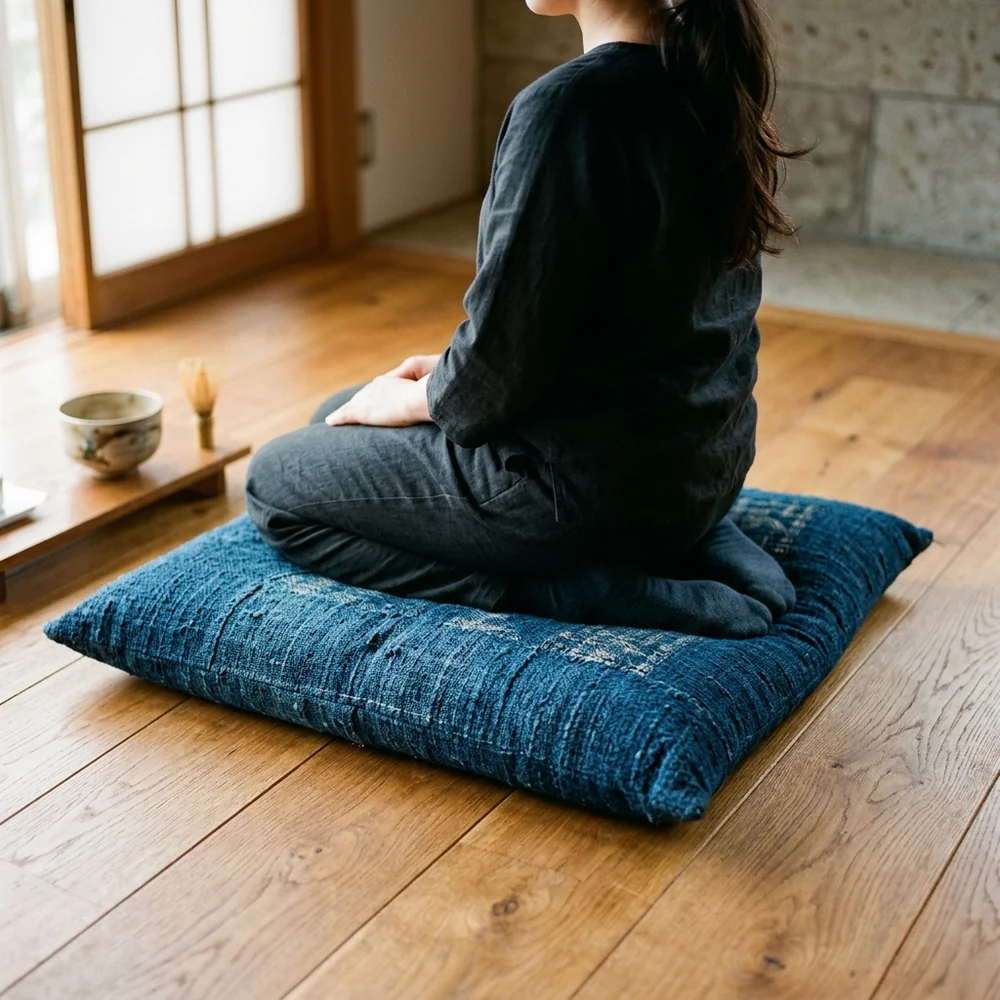
In a tatami room, the guest is honored with a large, plush, hand-woven cushion filled with natural cotton, known as the Zabuton (座布団). The Zabuton is placed directly in front of the low wooden dining table, aligned with the room's alcove (Tokonoma), where seasonal scroll paintings and flowers are displayed. The Zabuton represents the host's physical offering of comfort and hospitality, and the way you approach and sit on the cushion must reflect complete humility and gratitude. You must never step on the cushion with your feet, nor should you drop onto it from a standing position. Stepping on a Zabuton is treated as stepping on the host's face, showing a total disregard for their hospitality.

To sit on the Zabuton correctly, approach the cushion from the back or the side, walking quietly along the tatami grid. Kneel down in the formal Seiza posture on the raw tatami straw mats directly adjacent to the side of the cushion, keeping your knees parallel to the fabric edge. Place both palms flat on the tatami floor in front of you, keeping your weight supported. Using your core muscles and a physical sliding motion known as Shikkou (膝行 - kneeling slide), move your knees sideways onto the Zabuton cushion one by one. Slide your lower shins and thighs smoothly onto the cushion, gradually shifting your weight until your knees are centered on the fabric. Once positioned, sit back on your heels, keeping your spine completely straight, your shoulders relaxed, and your hands resting flat on your thighs.

As the host serves tea, you must maintain this stable, dignified posture. If you need to adjust your seating position due to physical fatigue, do not stand up or shift aggressively. Instead, place both palms flat on the tatami mats outside the cushion to support your weight, and quietly slide your knees slightly backwards or sideways, transitioning to a relaxed, side-sitting posture (Yokozuwari) or cross-legged posture (Agura), but only after the host explicitly invites you to make yourself comfortable (どうぞ楽にしてください). When preparing to leave the room, execute the kneeling slide in reverse: place your palms on the tatami floor, slide your knees sideways off the cushion onto the straw mats, and only then stand up slowly from the tatami surface, leaving the Zabuton completely neat, flat, and undisturbed as a physical sign of your deep gratitude.

To ensure a flawless execution of this seating transition, one must examine the anatomy of the Seiza posture. Keep your spine perfectly perpendicular to the floor, pull your chin in, and align your ears directly over your shoulders. Overlapping your feet underneath your buttocks is governed by a precise physical protocol: place your right big toe lightly over your left big toe, creating a soft, curved nest that supports your tailbone without cutting off blood circulation to your lower limbs. By distributing your body weight evenly across your shins and the outer margins of your thighs, you minimize joint pressure, allowing you to remain completely still and attentive during long cultural dialogues.

Furthermore, when transitioning onto the cushion, your breath must be drawn deep into the abdomen, utilizing the diaphragmatic breathing pattern of Zen meditation (Zazen). Shifting your weight while keeping your hips low avoids generating any rustling noise from the cotton filling, showing that you are in perfect control of your motor systems. By treating the Zabuton not as a lazy chair but as an altar of silent dialogue, you elevate the simple act of sitting into a profound expression of mutual respect and mindfulness. Keep your mind completely centered on the present moment, observing the physical coordinates of the room with absolute calmness, letting the wabi-sabi spirit guide your every breath.

A guest executing the Shikkou kneeling slide transition sideways onto a plush cotton Zabuton cushion.
Transitioning onto the seasonal Zabuton cushion using the Zen Shikkou slide technique, leaving the fabric completely undisturbed.