Back to Rituals
Practical Guide

Samu: The Zen Art of Mindful Cleaning and Spatial Cleansing

Prerequisites / Mental Preparation

Wear comfortable, loose cotton clothing that allows free physical movement. Prepare a wooden bucket of fresh, cold water, a hand-woven cotton cloth (Zoukin), and a traditional bamboo broom. Set a quiet, focused mental state: view the cleaning not as a household chore, but as a primary form of active meditation to cleanse the mirror of the mind.

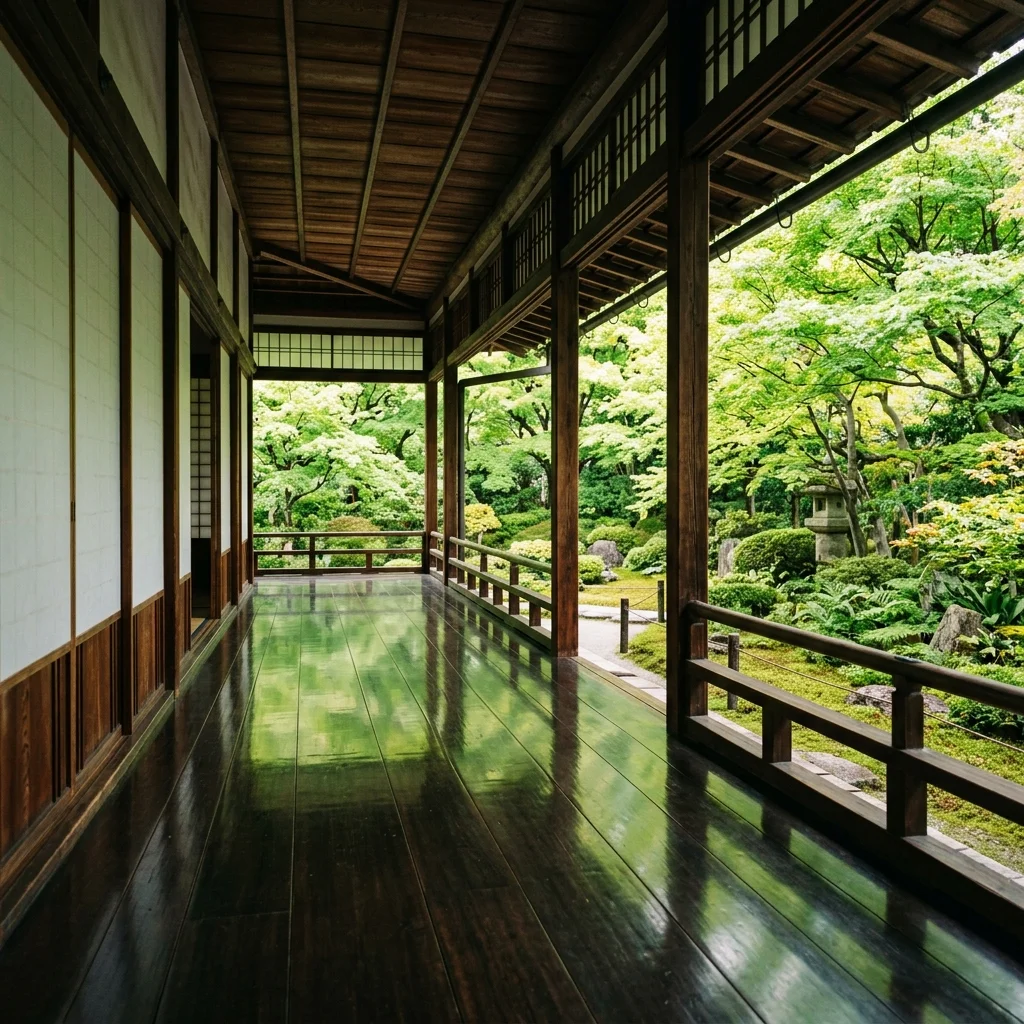
A quiet, highly polished dark wooden corridor of a Zen temple reflecting the lush green maple leaves of the garden outside.

A pristine Zen temple corridor, where the highly polished wood serves as a physical reflection of a mind completely swept clean of clutter and mental debris.

The Zoukin-Gake: The Physical Art of Floor Wiping

// 01

In Zen Buddhist monasteries, cleaning is not a chore performed to achieve a clean room. It is a fundamental, active meditation known as **Samu (作務)**. Zen master Dogen taught that the act of scrubbing, sweeping, and polishing is a physical manifestation of Zen practice itself—a process of polishing the internal mirror of the mind. The most famous and physically demanding Samu ritual is **Zoukin-gake (雑巾がけ)**: the wiping of wooden floors using a simple, hand-woven cotton cloth (*Zoukin*) and cold water. This act requires complete synchronization of physical posture, core dynamics, and focused breathing.

To perform Zoukin-gake correctly, you must adopt a precise physical posture. Fill a wooden bucket with fresh, cold water. Dip the cotton *Zoukin* into the water and wring it out with extreme force using both hands, twisting in opposite directions until the cloth is barely damp. Fold the cloth neatly into fourths to create a firm, square pad. Crouch down at the far edge of the wooden corridor, placing both palms flat on top of the folded cloth. Raise your hips completely off the floor, keeping your legs bent and your weight balanced on the balls of your feet. This is the starting coordinate of the *Zoukin-gake* sprint.

Using your core abdominal muscles and the physical drive of your thigh muscles, push the cloth straight forward along the wooden planks in a steady, unbroken line. Do not stand up; maintain the low, crouching posture as you move. Keep your gaze focused exactly 1 meter ahead on the wood grain. As you push forward, breathe out in a slow, steady stream, and breathe in as you pause at the end of the corridor. Shift your position to the adjacent plank and push back in the opposite direction, creating a rhythmic, overlapping grid. The physical effort forces your mind to ground itself entirely in the tactile friction, the cool water, and the muscle memory, dissolving mental chatter into absolute physical presence.
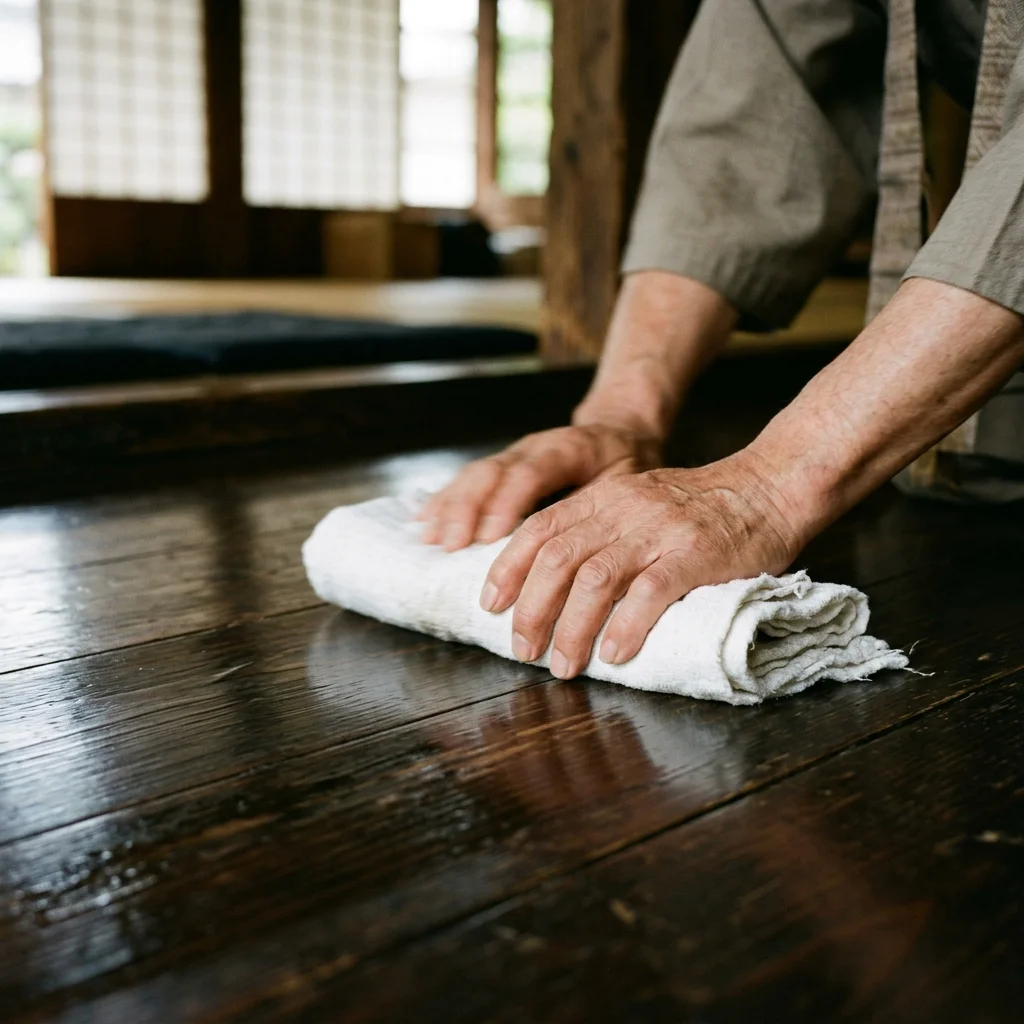
Close-up of a Zen practitioner's hands firmly gripping a folded white cotton Zoukin cloth, pushing it straight along a highly polished dark wooden floor.
The physical art of Zoukin-gake: crouching low and pushing the cotton cloth with core dynamics, treating the wood surface as a mirror of the mind.

The Sweeping of Mind: Rhythm of the Bamboo Broom

// 02

Sweeping the stone paths and mossy gardens of a Zen temple is a highly meditative art. The tool used is a traditional **Takabouki (竹箒)**—a long, lightweight broom hand-crafted from thin bamboo twigs bound around a thick bamboo handle. Sweeping with a Takabouki is not an act of aggressive clawing or frantic scraping. It is a soft, graceful, and rhythmic dance that requires complete coordination of the shoulders, wrists, and breath. The goal is to clear fallen leaves and dust while maintaining the pristine boundary of the underlying moss and stone.

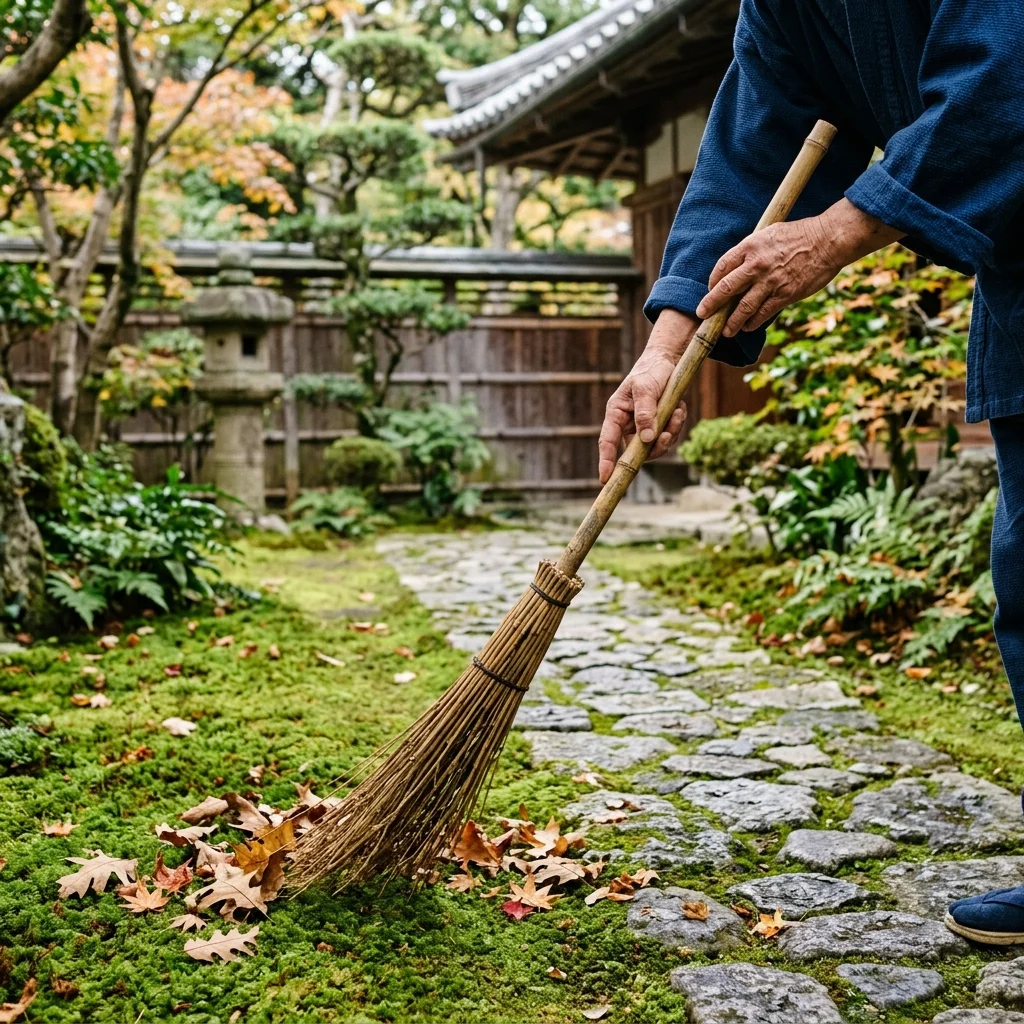
To sweep mindfully, grasp the bamboo handle with both hands: place your dominant hand approximately 30 centimeters down the handle, and your non-dominant hand near the top. Stand with your feet shoulder-width apart, knees slightly bent to maintain a low, stable center of gravity. Hold the broom at a 45-degree angle to the ground. Rather than utilizing stiff, short arm strokes that tire the body quickly, initiate the movement from your hips and torso. Slide the bamboo twigs along the ground in a wide, circular, and smooth sweeping arc, breathing out as the twigs slide forward, and breathing in as you return to center.

Focus your complete visual and auditory attention on the exact boundary where the bamboo twigs meet the earth. Listen to the dry, rhythmic whisper of the leaves sliding across the stone. Keep your strokes light; if you sweep too hard, you will tear the fragile moss and gouge the sand, disrupting the natural harmony. The act of sweeping is an exercise in letting go: as you sweep the dry leaves into neat piles, visualize your mind sweeping away accumulated worries, regrets, and intellectual clutter. When a gust of wind blows a few leaves back onto the path, do not feel frustrated. Smile, accept the impermanence of the moment (*Mujo*), and quietly resume the rhythm of the stroke.

A Zen practitioner in blue robes holding a long bamboo Takabouki broom, sweeping golden autumn leaves along a moss-lined stone garden path.
The rhythm of the Takabouki broom: sweeping the stone path in a wide, graceful arc, clearing mental clutter with every dry whisper of the leaves.

Kyakka-Shoko: The Mind Mirror of shoe Alignment

// 03

The ultimate test of Zen mindfulness is found not in the grand halls of meditation, but at the humble threshold of the entrance. In Zen monasteries, visitors and monks are greeted by a prominent wooden placard carrying four calligraphic kanji characters: **Kyakka-Shoko (脚下照顧)**. This phrase translates literally to "Reflect on your steps" or "Look beneath your feet." It is a direct reminder that the state of your inner mind is immediately revealed by how you place your footwear when stepping into a space.

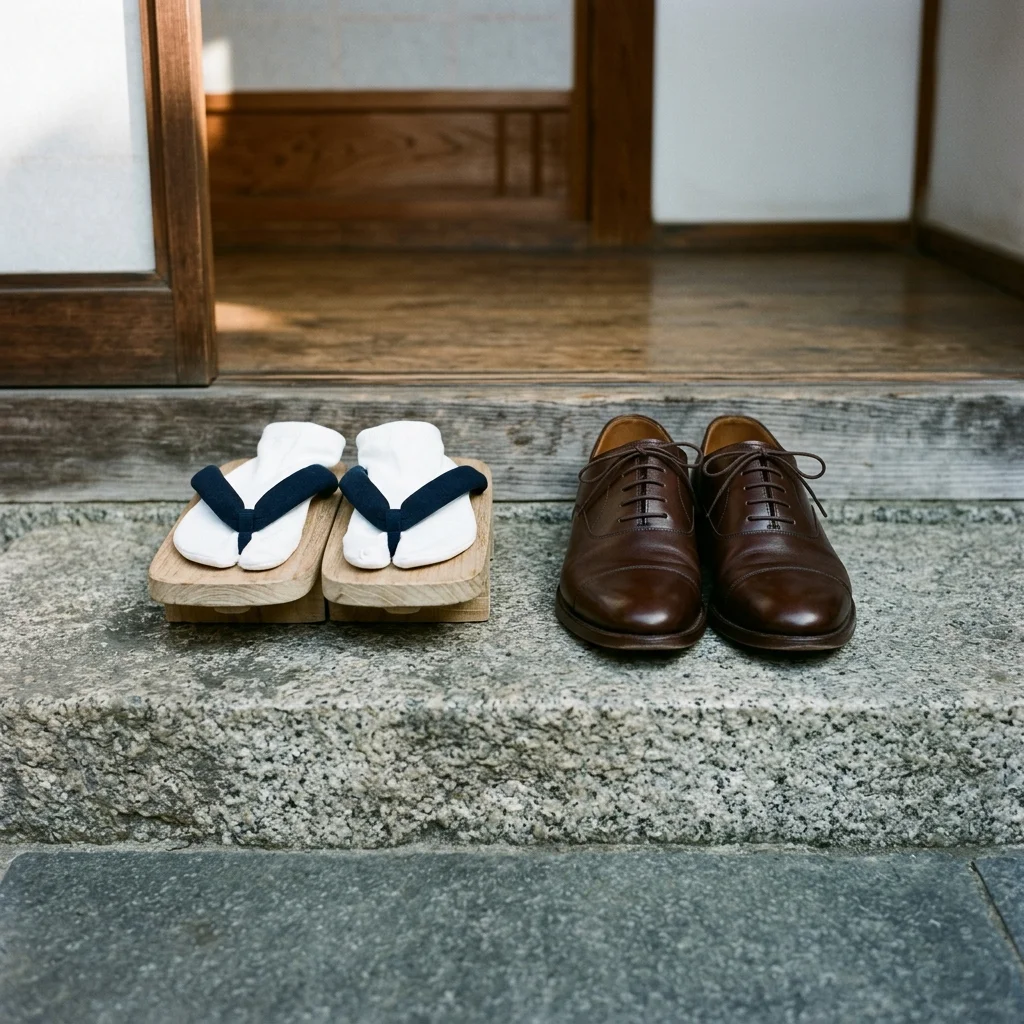
When entering a Zen temple, home, or tatami room, you must slide off your shoes at the stone entrance threshold, known as the **Genkan (玄関)**. The physical protocol of shoe alignment is a sacred, final step of the Samu cleaning ritual: - **Step 1: Step Over the Threshold:** Step off your shoes directly onto the raised wooden floor, keeping your feet clean and avoiding touching the lower stone floor with your bare feet or socks. - **Step 2: Turn and Align:** Kneel down on the wooden floor, turn around to face the stone threshold, grasp your shoes with both hands, and rotate them 180 degrees so that the toes point directly outward toward the street. - **Step 3: Parallel Fit:** Align the shoes perfectly side-by-side, parallel to each other and perpendicular to the wooden edge, placing them neatly at the center of the threshold.

This simple physical act is a direct mirror of the soul. Disorganized, scattered shoes tossed carelessly at the entrance are a physical diagnosis of a mind filled with chaos, speed, and disregard for the host and the environment. Aligning your shoes perfectly shows absolute presence of mind, respect for the space, and a commitment to leave your footprints in perfect order. Shinto and Zen masters teach that if you wish to see if a temple or household is truly pure, you do not look at the altar; you look at the shoes at the door. By aligning your footwear, you align your transition from the chaotic external world to the sacred, quiet boundary of the home, completing the circle of mindfulness.

A set of traditional wooden Japanese Geta sandals and dark brown leather oxford shoes perfectly aligned side-by-side on a stone Genkan threshold.
Kyakka-Shoko (Look beneath your feet): arranging your shoes perfectly aligned and facing outward at the door, mirroring an ordered, quiet inner mind.