Back to Rituals
Practical Guide

How to Visit a Japanese Buddhist Temple: The Rituals of Sanmon, Jokoro, and Gassho

Prerequisites / Mental Preparation

Approach the Buddhist temple with a mind focused on quietude, ancestral reflection, and self-purification. Dress in clean, modest clothing. Speak in low, hushed tones, and remember that temples are sacred monasteries and burial grounds where you seek to align your inner Buddha-nature.

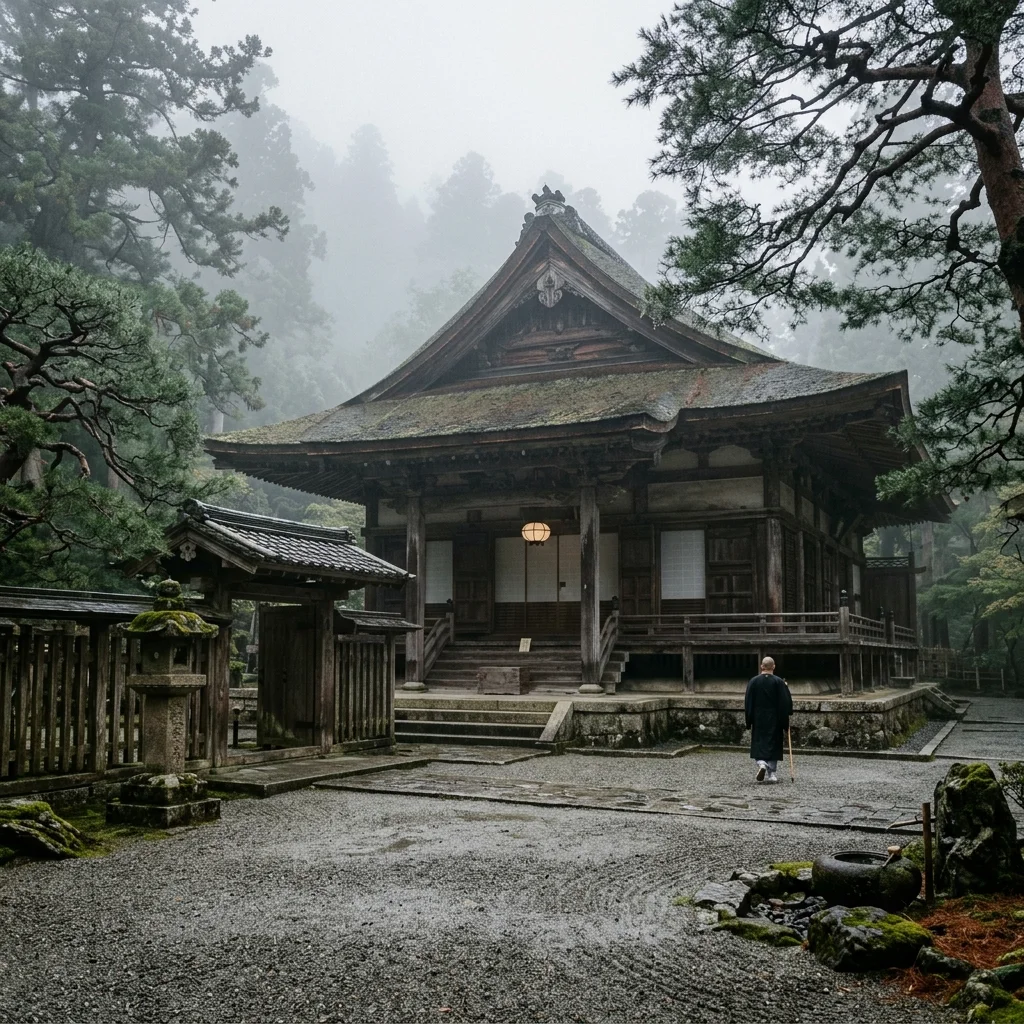
A majestic, weather-beaten dark cedar wood Zen temple hall surrounded by tall green pine trees and a meticulously raked white gravel courtyard.

The serene Main Hall (Hondo) of a Zen temple, representing a sanctuary of absolute silence, self-contemplation, and physical and spiritual peace.

Pass the Sanmon Gate: Bowing at the Threshold

// 01

Approaching a Japanese Buddhist temple (Otera - お寺) requires a transition into a space of profound historical, ancestral, and meditative focus. Unlike Shinto shrines which celebrate the vibrant, raw forces of natural life, Buddhist temples are places of profound silence, introspection, and communion with the cosmos and the spirits of ancestors. The entrance to this sacred domain is marked by a monumental, double-storied wooden gate known as the **Sanmon (山門)**. The Sanmon gate represents a physical and spiritual threshold: it symbolizes the three gates of liberation in Buddhist philosophy—emptiness (*Ku*), formlessness (*Musou*), and desirelessness (*Mugan*). Stepping through is a commitment to leave your worldly desires and daily anxieties outside the gate.

To cross the Sanmon threshold correctly, you must observe a precise physical protocol. Stop in front of the gate, align your feet, and execute a respectful, light bow of approximately 15 degrees, known as **Eshaku (会釈)**, with your hands placed flat against your thighs or held lightly in front of your stomach. As you step forward, look down at the massive wooden threshold beam, known as the **Shikimi (敷居)**, which runs along the ground between the stone pillars. **You must step completely over the Shikimi; never step on it**. In temple architecture, the threshold beam represents the neck of the temple's guardian spirits, and stepping on it is considered a severe act of disrespect that damages the structural and spiritual boundary of the gateway.

Additionally, Zen monks instruct that when passing through the Sanmon gate, you should step over the Shikimi with your left foot first if you are entering on the left side of the gate, or your right foot if you are entering on the right. This physical alignment ensures that your shoulders remain squared and parallel to the temple's main axis as you transition, preventing your back from turning toward the sacred altar inside. Maintain a slow, deliberate walking cadence, letting the quiet crunch of the gravel paved approach ground your thoughts in the present moment.
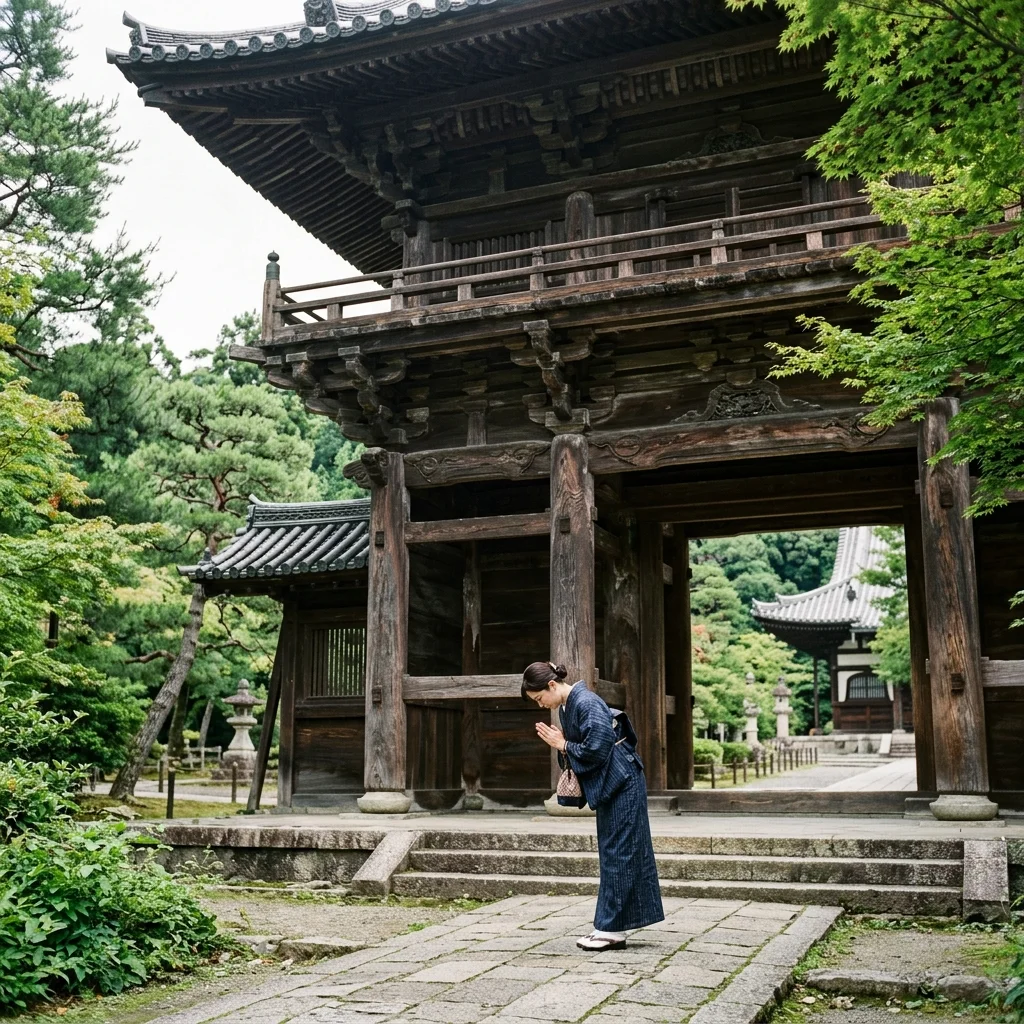
A female visitor in a dark blue cotton kimono bowing respectfully in front of a majestic, weathered dark wooden Sanmon temple gate.
Pausing to execute a light bow before stepping over the wooden threshold beam of the Sanmon gate, entering the sanctuary of Zen liberation.

Bathing in the Smoke: Cleansing Impurities at the Jokoro

// 02

Before approaching the main altar to speak with the Buddhas and ancestors, you must purify your physical body and mental faculties. In Buddhist practice, this purification is not performed with water alone, but through the sacred medium of burning incense. As you enter the main courtyard, you will encounter a large, ancient bronze incense burner buried in a stone stand, known as the **Jokoro (常香炉)**. The rising white smoke (*Osenko*) generated by the incense serves a dual purpose: it acts as a sweet-scented physical offering to the Buddhas, and as a powerful organic antiseptic that purges the mind and body of spiritual impurities, physical illnesses, and mental confusion.

To participate in the incense ritual correctly, you must approach the nearby kiosk and purchase a small bundle of incense sticks. Light the bundle using the communal candle provided at the stand. Let the tips catch fire, producing a small orange flame. **Do not blow out the flame with your mouth**. In Buddhist manners, the human breath is considered physically and spiritually impure, carrying the dust and gossip of daily life. Blowing on the sacred fire is a severe taboo. Instead, extinguish the flame with a gentle, swift wave of your right hand or by slicing the air in a downward motion. Place the smoldering incense bundle upright into the bed of ash inside the Jokoro, ensuring it is secure.

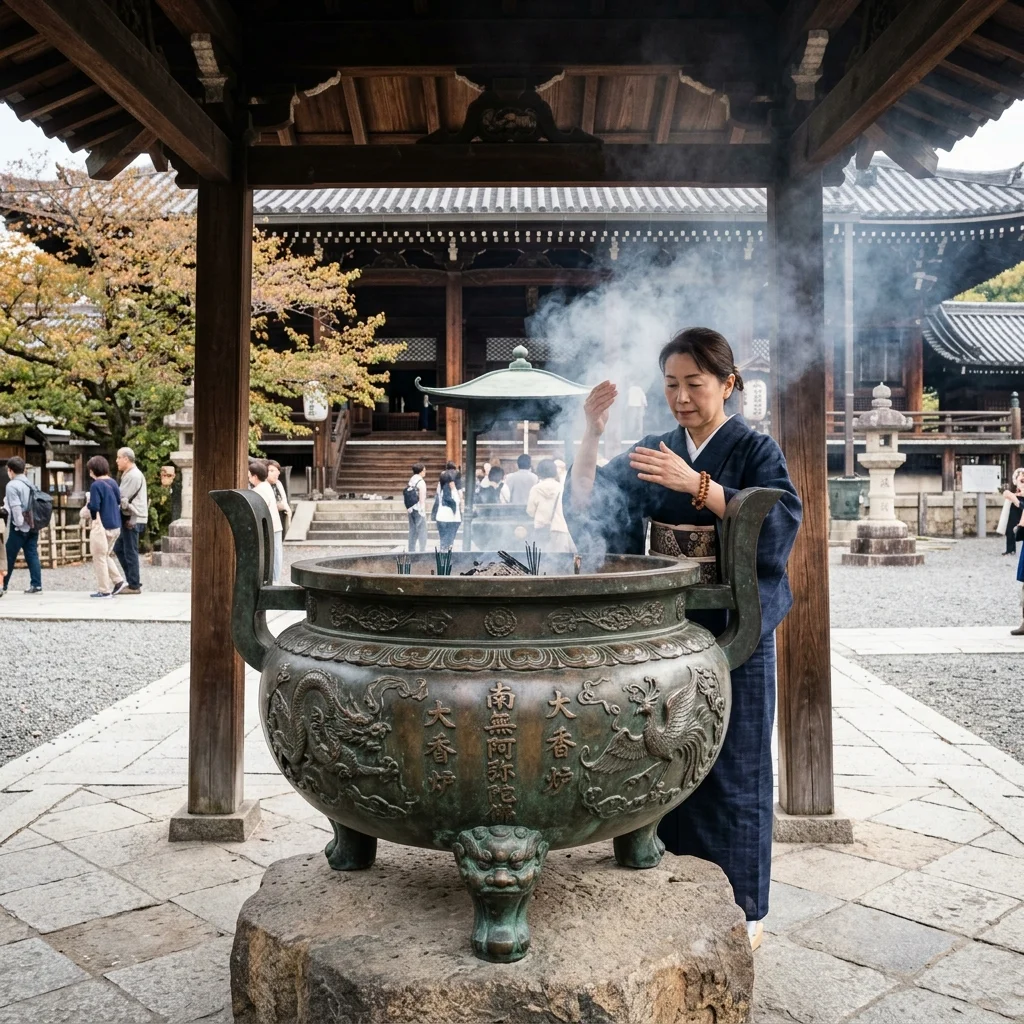
Once the incense is placed, step close to the bronze burner and allow the thick, sweet-scented white smoke to envelope you. Using both hands with palms cupped toward your chest, gently scoop and wave the rising smoke toward your body. Shinto and Buddhist traditions instruct that you should guide the smoke to specific coordinates of your body that require healing or enhancement: wave the smoke over your head to invite wisdom and clarity of thought, over your chest to soothe a heavy heart or physical breathing issues, or over your limbs to ease joint pain and fatigue. As you breathe in the volatile cedar and sandalwood aromas, visualize the smoke dissolving your inner anxieties, leaving your mind clean, empty, and focused.

A female visitor waving dense, fragrant white smoke from a massive bronze incense burner Jokoro toward her face inside a temple courtyard.
Waving the sacred incense smoke toward the head and body to purge daily stagnation, inviting physical healing and absolute mental clarity.

The Silent Gassho: Liturgy of the Buddhist Altar

// 03

At the steps of the Main Hall (Hondo - 本堂), you enter the immediate presence of the historic Buddhas and Bodhisattvas. The interior is a beautiful, dim space filled with golden lanterns, the scent of sandalwood, and ancient wooden icons. Approach the large offering box (Saisenbako). Cast a 5-yen coin gently into the box as a physical gesture of detachment and commitment. If a thick, braided rope and a bronze gong or bell (Rin - 鈴) are suspended above, grasp the wooden striker and ring the bell once or twice. The deep, resonant metallic vibration serves to clear the air of negative thoughts and align your physical frequency with the cosmic order.

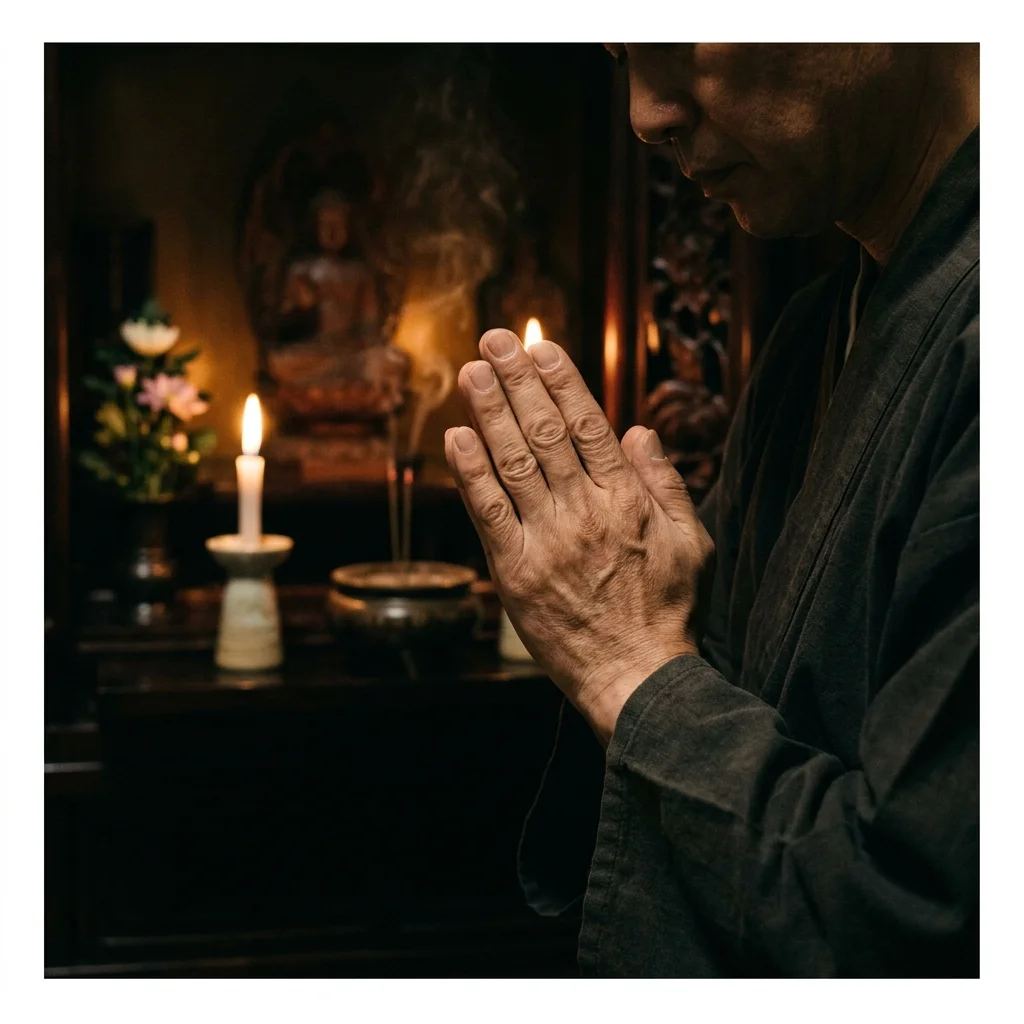
After ringing the bell, the formal Buddhist liturgy of prayer begins. **This is where you must avoid the most common tourist error: NEVER clap your hands at a Buddhist temple altar**. Clapping is strictly a Shinto ritual used to call Shinto spirits. At a Buddhist temple, Shinto clapping is considered loud, aggressive, and a severe theological error. Instead, you must pray in absolute, silent reverence using the **Gassho (合掌)** hand posture. Bring your palms together in front of your chest at heart level. Align your fingers perfectly, pointing them upward at a 45-degree angle. Keep your elbows slightly out, creating a clean, hollow space between your palms.

In Buddhist cosmology, the Gassho posture represents the ultimate union of opposites: the left hand represents the self (the relative, physical world), while the right hand represents the Buddha (the absolute, spiritual universe). Pressing them flat together is a physical declaration of non-duality—the realization that the self and the Buddha are one. Close your eyes, bow your head slightly at a 15-degree angle, and engage in silent contemplation or repeat a simple mantra (such as *Namu Amida Butsu*). Once your silent prayer is finished, hold the Gassho posture and execute a deep bow of gratitude of approximately 45 degrees. Lower your hands quietly, step backward with quiet grace, and maintain a quiet, respectful presence as you exit.

Close-up of a visitor's hands clasped flat together in Gassho prayer inside a dim temple hall, with a glowing candle and a Buddha statue in the background.
The silent Gassho prayer: pressing palms flat to unite the self with the absolute, praying in profound, non-clapping silence in front of the Buddha.