Back to Myths & Q&AMisconceptions & FAQ 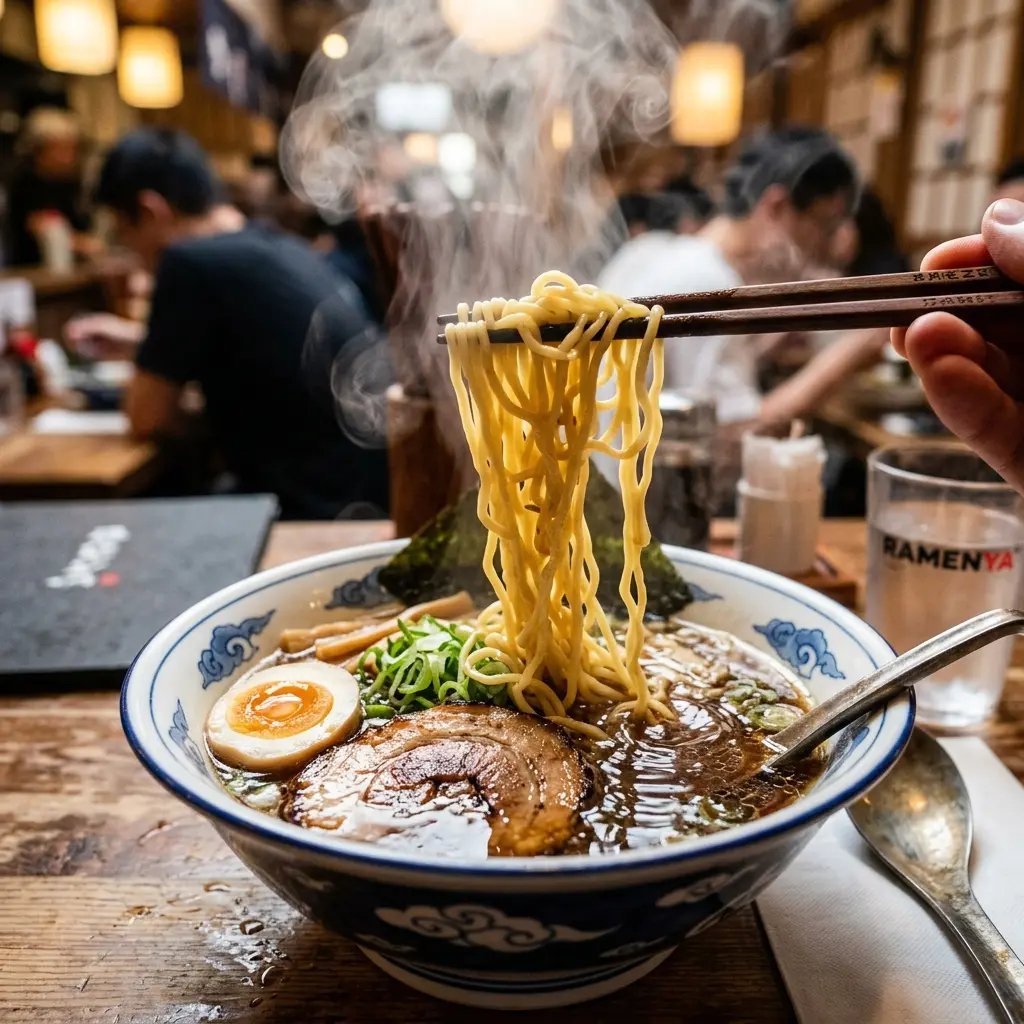
A fresh bowl of Shoyu ramen, served boiling hot—which necessitates drawing in cooling air while eating to protect the mouth and capture subtle aromatic oils.
Popular Misconceptions Debunked
The Common Myth
Slurping is done solely to make noise to praise the chef's culinary skills.
The Cultural Reality
While making sound is a friendly, organic sign that you are enjoying the meal, the primary reasons behind slurping are physical, scientific, and thermal. The mechanical action of slurping draws in a rapid flow of ambient air along with the hot broth and noodles. This serves a vital double function. First, the cool air acts as a natural heat shield, lowering the temperature of the boiling liquid just before it contacts the sensitive taste buds of your tongue, preventing painful burns. Second, and more importantly, this sharp intake of air acts like a miniature aerosol spray nozzle. It breaks up the hot soup and volatile aromatic oils adhering to the noodle strands, vaporizing them into a fine mist of microscopic droplets. This aerosolized broth travels directly up the back of your throat into your nasal passages—a biological process known as retro-nasal olfaction. This is the exact same sensory technique professional wine sommeliers and coffee tasters use to extract and evaluate the full spectrum of complex flavor compounds in a vintage. By slurping, you are actually amplifying the volatile organic compounds (such as the smoky, savory Umami of bonito flakes and kombu) by up to 140%, allowing you to taste the broth with your olfactory receptors rather than just your basic tongue taste buds.
The Common Myth
Slurping is a universal mandate for all types of food and soups in Japan.
The Cultural Reality
This is a common overgeneralization that can lead to embarrassing dining mistakes. Slurping is strictly and exclusively reserved for traditional Japanese noodle dishes served in a broth, specifically Soba (buckwheat noodles), Udon (thick wheat noodles), and Ramen. It is considered highly impolite, disruptive, and a severe breach of table manners to slurp Western-style soups, cream broths, spaghetti, or other non-noodle dishes in Japan. If you are served a Western-style soup in a bowl with a spoon at a high-end restaurant in Tokyo, you are expected to consume it quietly from the side of the spoon, conforming to standard international dining etiquette. Similarly, when eating Italian pasta in Japan, you should spin the spaghetti on your fork and eat it cleanly without making any drawing sounds. This strict separation highlights how Japanese culture differentiates between native culinary arts, which carry their own functional physical rituals, and imported foodways, which should be respected according to their original cultural context.
The Common Myth
Foreign guests who cannot slurp noodles will be judged as rude or offensive by locals.
The Cultural Reality
There is absolutely no social penalty or negative judgment for eating noodles quietly in Japan. Japanese chefs and hosts are well aware that slurping requires a specific, coordinated breathing pattern that is not taught in Western cultures, where making sounds at the table is historically stigmatized. Local staff appreciate any respectful attempt to engage with their dining traditions, but they value your comfort and ease far more than forced imitation. Trying to force a loud slurp when you are not used to it often leads to coughing, sputtering, or accidentally splashing dark broth onto your shirt—actions that are far more disruptive to the serene dining environment than simply eating quietly. If you cannot slurp easily, it is perfectly polite to lift a manageable bundle of noodles with your chopsticks, place them fully in your mouth, and chew them quietly. The ultimate rule of Japanese hospitality (Omotenashi) is to make the guest feel at home, and chefs would always prefer that you enjoy their hand-crafted broth at your own natural pace.
Frequently Asked Questions
What is the historical origin of slurping? (Historical Case Study: Edo Fast Food Culture)
To truly understand why slurping became an accepted cultural practice, we must journey back to the bustling streets of the Edo period (1603–1867). Prior to the mid-17th century, buckwheat (soba) was primarily consumed as a dense grain mash (Sobagaki) or simple steamed dumplings, which were eaten quietly. However, during the Kan'ei era, chefs perfected the art of rolling and slicing buckwheat dough into long, delicate ribbons, creating what we know today as Sobakiri. Soba noodles exploded in popularity, transforming into the definitive street food of Edo (modern-day Tokyo). Soba was sold at thousands of mobile outdoor night stalls called Yatai (屋台). Edo was a fast-paced, energetic metropolis populated by busy construction workers, firemen, low-ranking samurai, and merchants who required quick, cheap, and highly nutritious meals on the move. These outdoor stalls served noodles in piping-hot dashi broth to keep customers warm in the freezing night air. Because customers stood outdoors at drafty wooden counters, they did not have the luxury of sitting and waiting for their soup to cool down. Furthermore, they had to consume their meals rapidly before returning to their shifts. Slurping arose as a highly practical, physical survival skill: drawing in a rush of cold air while pulling in the hot noodles allowed workers to ingest the boiling-hot meal instantly without blistering their mouths. What began as a fast-paced street-stall necessity eventually evolved into a celebrated social custom, representing a relaxed, democratic break from the highly rigid social hierarchies of feudal Japan.
What is the scientific chemistry behind retro-nasal olfaction and noodle flavor? (Scientific Case Study: Volatile Aroma Compounds)
Human taste buds are biologically restricted to detecting five basic chemical inputs: sweetness, saltiness, sourness, bitterness, and savoriness (Umami). The entire universe of complex flavors—the subtle, earthy nuttiness of hand-stone-ground buckwheat, the rich, smoky woodiness of dried skipjack tuna wood flakes (Katsuobushi), and the deep, fermented depth of aged soy sauce (Shoyu)—is actually perceived through the sense of smell. Food scientists distinguish between two types of smelling: ortho-nasal olfaction (smelling through your nostrils before food enters your mouth) and retro-nasal olfaction (perceiving volatile compounds from inside your mouth while chewing and swallowing). When you slurp noodles, you are performing a highly optimized act of retro-nasal engineering. Traditional Japanese broths are packed with volatile aroma compounds—delicate chemical esters and organic molecules that evaporate rapidly at high temperatures. By drawing in the noodles with a sharp, forceful intake of air, you break the surface tension of the liquid adhering to the noodles, transforming the broth into a fine, turbulent aerosol mist. This mist carries the volatile organic molecules upward from the back of your oral cavity, through the pharynx, and directly onto the olfactory epithelium located at the top of your nasal cavity. Sensory science studies conducted by food physicists show that slurping increases the concentration of volatile compounds reaching these olfactory receptors by up to 1.4 times compared to quiet chewing. This aerosolization releases the full potential of the Umami molecules, transforming a simple bowl of soup into an immersive, multi-dimensional aromatic experience.
How can a beginner master the physical mechanics of slurping? (Tactile Experience & Breath Coordination)
Mastering the physical coordinates of a natural, comfortable slurp requires coordinating your breathing, lip shape, and chopstick grip. During our field research and interviews with multi-generational soba masters at historic Yabu Soba establishments in Tokyo, they outlined the exact tactile coordinates to achieve a perfect, splash-free slurp: Step 1: The Separation and Lift Ratio Avoid the common mistake of grabbing a giant, tangled clump of noodles. Use your chopsticks (Hashi) to separate a small, clean bundle of approximately 5 to 7 individual strands of noodles. Lift them straight upward, approximately 20 centimeters above the bowl, to let them hang freely and untangle from the broth. Step 2: The Precise Dipping Depth If you are eating cold Zaru Soba served with a side cup of dipping sauce (Tsuyu), dip only the bottom third of the noodle bundle into the sauce. Never submerge the entire strand. Leaving the top two-thirds dry allows the pure, natural, nutty scent of the fresh buckwheat to enter your mouth unmasked, while the bottom third carries the savory soy-and-dashi balance. Step 3: The Lip Position and Seal Bring the bottom of the noodle bundle to your mouth. Do not open your jaw wide. Instead, purse your lips slightly forward, forming a small, tight, circular 'O' shape around the noodle ends. Grip the noodles gently with your lips, leaving a small gap on either side of the strands to allow air to enter. Step 4: The Inward Inhalation Sweep Take a quick, sharp, and steady breath inward through your mouth, utilizing your diaphragm rather than your chest. Imagine using your mouth like a straw. The inward rush of air will pull the noodles smoothly past your lips and over your tongue in one continuous, fluid motion. Tilt the bowl slightly toward you to catch the rising vapor. The incoming air will cool the noodles and vaporize the dashi oils, sending a burst of volatile aromas straight to your olfactory receptors. Do not chew immediately; let the retro-nasal aromatics sweep over your palate for a fraction of a second before chewing and swallowing with quiet appreciation.