Back to Myths & Q&AMisconceptions & FAQ 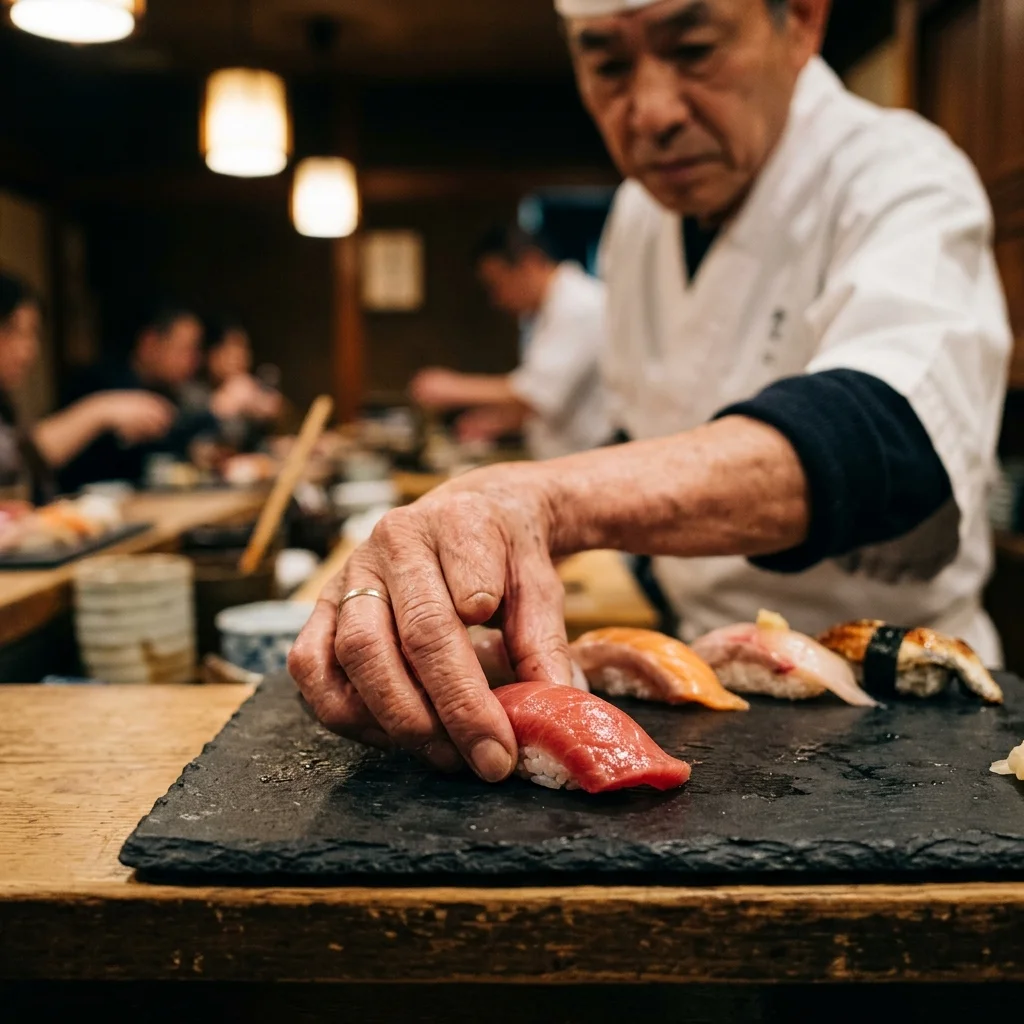
Authentic edomae nigiri served at a counter, where the rice (Shari) is maintained precisely at body temperature (~37°C) to allow the vinegar aromas to vaporize instantly on the palate.
Popular Misconceptions Debunked
The Common Myth
Sushi rice should be served cold, similar to refrigerated raw fish.
The Cultural Reality
This is perhaps the most widespread and damaging misconception of Western conveyor-belt and supermarket sushi. In authentic high-end Japanese sushi—referred to as **Edomae sushi (江戸前寿司)**—the rice base, known as **Shari (シャリ)**, is never served cold. Instead, it is meticulously maintained by the chef at **body temperature—precisely between 36°C and 37°C (96°F to 98°F)**. This specific thermal coordinate is driven by organic chemistry and sensory physics. When rice is cooled below room temperature, the starches in the grain undergo retrogradation, locking up into a stiff, waxy, and dense mass that blocks your taste buds. More importantly, warm Shari allows the volatile acetic acid and ethyl acetate esters within the seasoned rice vinegar (*Suzu*) to vaporize cleanly the moment the sushi touches your warm palate, releasing a delicate cloud of sweet, fermented aromas up the back of your throat. Furthermore, the warm rice contrasts beautifully with the cool, aged fish (*Neta*), which is typically served at cellar temperature (15°C to 20°C). This thermal gradient is a deliberate engineering feat: the warm, loose rice melts the delicate, high-unsaturated monounsaturated fatty acids (oleic acid) inside the fish slice, releasing a rich, creamy, and savory Umami coating across your tongue that cold rice would simply freeze solid.
The Common Myth
Chopsticks are the only proper tool, and you must soak the rice in soy sauce.
The Cultural Reality
This is a dual error that disrupts the physical structure and flavor balance of the sushi. In traditional Japanese dining, **eating Nigiri sushi with clean, bare fingers is highly encouraged** and remains the preferred method for connoisseurs at high-end counters. When a master chef shapes a piece of Nigiri, they use a highly specialized, minimal-contact finger technique (*Te-gumi*) to pack the Shari loosely, trapping microscopic pockets of air between the individual rice grains. If you grasp this loose, delicate structure with hard wooden chopsticks, you are highly likely to crush the air pockets or cause the rice bundle to split apart and fall into your bowl. By using your thumb, index, and middle fingers to gently cradle the sides of the Nigiri, you can lift it with minimal pressure. Furthermore, the absolute rule of seasoning is: **never soak the rice in soy sauce (Shoyu)**. Shari is highly porous; if dipped directly into Shoyu, the rice acts like a sponge, absorbing an excessive amount of salty liquid that completely drowns the delicate flavor of the fish and causes the loose grain structure to instantly disintegrate. Instead, you should rotate the Nigiri upside down, lightly brushing only the tip of the fish (*Neta*) against the surface of the soy sauce, keeping the rice pristine, dry, and structurally intact.
The Common Myth
Wasabi should be mixed directly into the soy sauce dish to create a green slurry.
The Cultural Reality
Mixing wasabi directly into your soy sauce dish is considered a severe dining error (*Buri-yoke*) that destroys the unique chemical profile of both ingredients. Authentic Japanese wasabi, derived from the grated rhizome of the **Wasabia japonica** plant, relies on an exceptionally volatile, water-soluble chemical compound called **allyl isothiocyanate** for its characteristic sinus-clearing kick and sweet, herbal fragrance. This compound is highly unstable; when completely dissolved and diluted in a watery pool of salty soy sauce, the delicate volatile molecules are rapidly hydrolyzed and deactivated, leaving you with a flat, murky slurry that tastes bitter and lacks any herbal complexity. At the same time, the suspended wasabi particles ruin the pure, clean Umami flavor of the aged Shoyu. To appreciate the chemistry of wasabi, you must let it work in isolation. The chef already places the optimal amount of wasabi between the Shari and the Neta. If you desire additional heat, you should use your chopsticks to place a tiny speck of raw grated wasabi directly onto the top of the fish slice, allowing the volatile compounds to vaporize directly on your palate while keeping your soy sauce dish clean and clear.
Frequently Asked Questions
What is the historical origin of Nigiri? (Historical Case Study: Edo Fast Food)
Modern Nigiri sushi was invented in Edo (modern-day Tokyo) during the early 1820s by a legendary street-food vendor named **Hanaya Yohei (華屋与兵衛)**. Prior to this, sushi was a slow, months-long preservation method known as *Narezushi*, where raw fish was packed in salted rice to ferment, after which the sour, rotting rice was thrown away and only the fish was consumed. Yohei realized that by mixing fresh rice with newly commercialized red vinegar (*Akazu*) made from fermented sake lees, he could instantly duplicate the sour, fermented taste of slow-aged rice. He paired this quick, seasoned rice with fresh, local fish caught directly from Tokyo Bay (Edomae), creating a rapid, hand-pressed fast food designed for the busy, fast-paced workers of the Edo metropolis. Yohei operated a mobile night cart (*Yatai*) along the Sumida River, serving customers who stood outdoors. The Nigiri was eaten rapidly with bare fingers, accompanied by strong green tea to cleanse the palate. This fast-food origin is why authentic sushi retains its loose, immediate structure and finger-friendly format today, representing a democratic, high-speed culinary revolution that transformed the Tokyo streetscape.
What is the science behind Akazu red vinegar? (Scientific Case Study: Umami Synergy)
High-end traditional sushi bars season their Shari with **Akazu (赤酢 — Red Vinegar)** rather than standard white rice vinegar. Akazu is made by fermenting sake lees (*Sakekasu*) that have been aged in dark cedar casks for three to ten years. During this extensive aging process, the proteins inside the yeast cells undergo autolysis, breaking down into a rich cocktail of organic amino acids, primarily **glutamic acid** (the chemical foundation of Umami). Akazu has a deep amber color and a rich, sweet, and highly complex flavor profile. When mixed into warm Shari, the glutamic acid in the vinegar chemically interacts with the **inosinic acid** abundant in the raw fish slice (*Neta*). In sensory science, this interaction is known as **Umami synergy**: combining glutamic acid with inosinic acid multiplies the perceived savory flavor on the human palate by up to eight times. This synergy is why Edomae sushi does not require heavy cooking or sauces; the warm, red-vinegared Shari acts as a powerful biochemical amplifier that elevates the natural, raw flavor of the fish to extraordinary heights.
How should a beginner navigate a high-end Omakase counter? (Tactile Coordinates & Etiquette)
Dining at a high-end sushi counter under the **Omakase (お任せ — Trust the Chef)** format is a highly interactive, choreographic experience that requires observing a few key physical coordinates: Coordinate 1: Eat the Nigiri Instantly When the chef places a piece of Nigiri on your slate, you must consume it within 10 seconds. The chef has calibrated the temperature of the Shari, the moisture of the fish, and the loose air packing to be consumed at that exact moment. Letting it sit ruins the thermal gradient and causes the loose rice structure to settle and dry out. Coordinate 2: Do Not Separate Neta and Shari Never pull the slice of fish off the rice to eat them separately or dip them individually. Separating them is considered a major insult to the chef's craftsmanship, as the Nigiri is designed as a unified physical interface where the proportions of fat, acidity, temperature, and salt are perfectly balanced. Coordinate 3: Trust the Chef's Seasoning Do not ask for extra wasabi, ginger (*Gari*), or pour a massive pool of soy sauce. The chef brushes each piece with a custom reduction of soy sauce, sake, and mirin, known as **Nikiri (煮切り)**, just before serving. The sushi is already fully seasoned; simply lift it, place it in your mouth upside-down so the seasoned fish contacts your tongue first, and chew slowly to let the thermal chemistry unfold.