Back to Myths & Q&AMisconceptions & FAQ 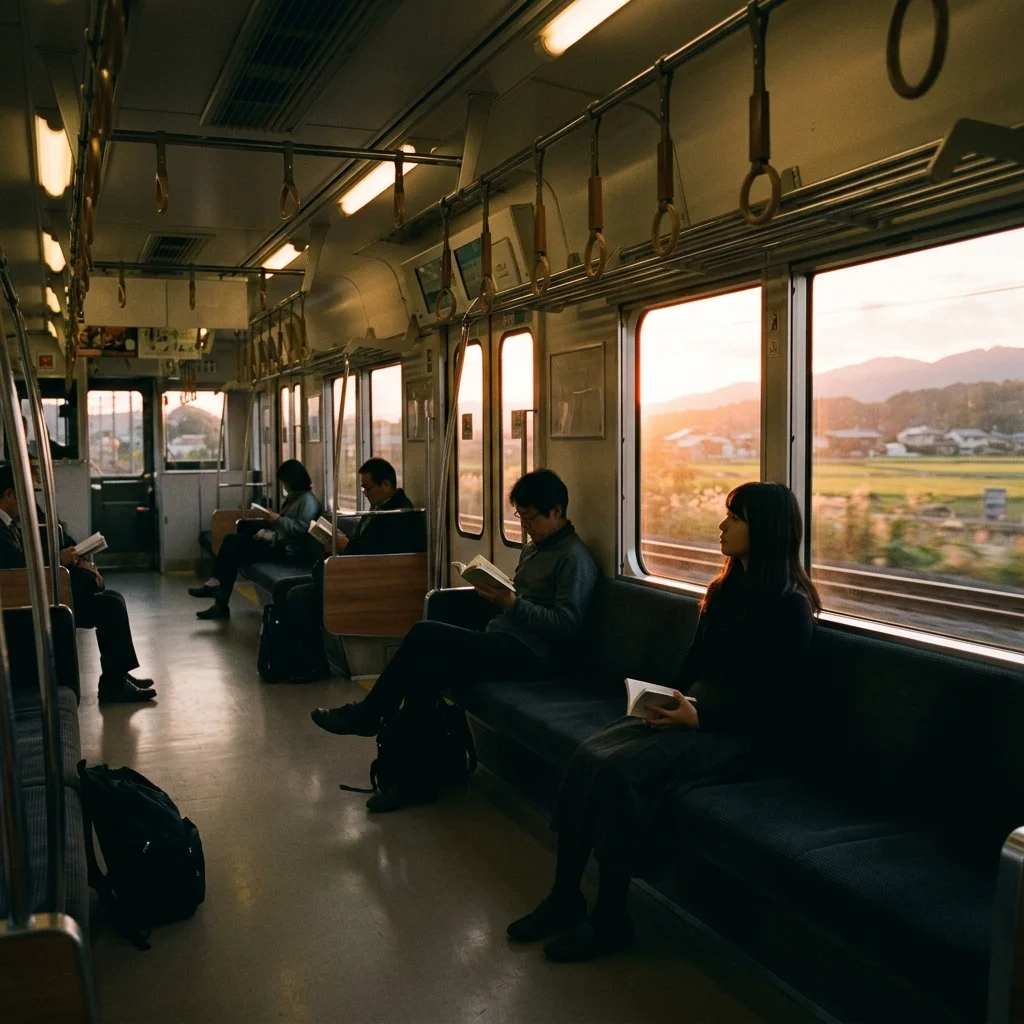
A serene, quiet commuter train carriage in Tokyo during sunset, showcasing a voluntary communal space where passengers maintain a strict boundary of silence to respect others.
Popular Misconceptions Debunked
The Common Myth
The absolute quiet on Japanese trains is enforced by police, laws, or strict fines.
The Cultural Reality
This is a common misconception of international visitors who observe the near-silent atmosphere of a Tokyo subway packed with thousands of commuters. There are absolutely no laws, police officers, or municipal fines that mandate silence on Japanese public transport. The quietness is a purely voluntary, highly structured social contract driven by two fundamental Japanese concepts: **Meiwaku (迷惑 — causing trouble to others)** and **Omoiyari (思いやり — active empathy)**. In Japanese civic philosophy, a public train carriage is not viewed as an open, free-for-all public square; instead, it is treated as a shared, highly temporary communal living room where everyone has an equal right to physical and mental peace (*Ma*). Commuters in Tokyo use their travel time to sleep, read, study, or decompress from intense work shifts. Making loud sounds, playing music through leaking headphones, or engaging in animated discussions is viewed as a form of spatial theft—an aggressive act of taking up more than your fair share of the shared auditory environment. The silence is maintained not out of fear of authority, but through a mutual, polite self-restraint where everyone protects the quiet space of their neighbors, expecting the same respect in return.
The Common Myth
Talking or making any sound is strictly forbidden, and the rules are cold and rigid.
The Cultural Reality
This is an overgeneralization that portrays Japanese society as an overly sterile, robotic environment. Talking is not legally or socially banned on trains. It is common to see friends or students conversing in low, muted voices (*Sasa-yaki*) on their way home, and nobody will object as long as the sound does not project beyond their immediate physical seating block. The strict, absolute taboo is specifically directed against **speaking on mobile phones**. Shinto and Buddhist cultural roots favor silent internal alignment, and railway operators continuously broadcast messages requesting passengers to set their phones to 'Manner Mode' (silent) and refrain from voice calls. This phone-call taboo is actually supported by advanced cognitive psychology. When you hear two people talking in a normal face-to-face conversation, your brain easily processes the exchange and can choose to ignore it. However, when you are exposed to a one-sided mobile phone conversation—a phenomenon cognitive scientists call a **'half-logue'**—your brain's auditory processing centers are placed under involuntary cognitive load. Because you only hear half of the conversation, your brain is forced to actively and exhaustively predict the missing half of the dialogue, making it incredibly difficult to ignore or filter out the sound. Refraining from phone calls is an act of supreme *Omoiyari*: it prevents forcing your fellow commuters' brains into an unwanted cognitive prediction loop during their quiet recovery time.
The Common Myth
Train pushers (Oshiya) represent an aggressive, dehumanizing system of labor exploitation.
The Cultural Reality
To the outside world, viral videos of train pushers—known professionally as **Oshiya (押し屋 — passenger agents)**—shoving commuters into packed carriages seem like an aggressive, chaotic, and dehumanizing symptom of overpopulation and corporate cruelty. In reality, the Oshiya system is a highly calculated, precise, and safe engineering feat that is vital to the functional efficiency of Tokyo's transit infrastructure. Oshiya are professional, highly trained railway safety officers (often university students or off-duty conductors) wearing clean uniforms, white cotton gloves, and carrying specialized radio equipment. Their primary function is not to force people into trains like livestock, but to **execute structural crowd control and door safety clearance**. In Tokyo, urban rail lines operate with a precision where trains arrive every 90 seconds, and a delay of even 10 seconds at a single station can cause a massive chain-reaction gridlock across the entire metropolitan network. The biggest cause of door delays is clothing, bag straps, or umbrellas getting caught in the safety sensors of the train doors. When the doors close and an item is trapped, the sensor halts the train, requiring the doors to reopen and recycle. The Oshiya stand at the doors to gently and systematically tuck in loose straps, guide passengers' shoulders to ensure safe clearance, and push the crowd just enough so the door sensors register a clean, seamless seal on the first attempt. It is a highly cooperative, respectful interaction between the railway staff and a cooperative public, ensuring that 40 million daily commuters reach their destinations with a 99.9% on-time efficiency record.
Frequently Asked Questions
What is the historical origin of Tokyo's train pushers? (Historical Case Study: Shinjuku Station)
The professional role of the Oshiya was created at **Shinjuku Station in Tokyo during the mid-1960s**. During this period, Japan was undergoing a massive post-war economic boom, leading to rapid urbanization where millions of workers migrated from rural prefectures into Tokyo. The railway infrastructure could not keep pace with the sudden explosion of commuters, and the congestion rate on the Chuo Line reached an astonishing **300% of maximum designed capacity**. Trains were so packed that doors frequently buckled, and commuters regularly lost shoes and bags in the crush. To prevent fatal falls and keep the trains moving, the Japanese National Railways hired temporary staff—originally called 'passenger arrangement staff' (*Ryokaku-seiri-gakusei*)—primarily composed of robust athletic university students working part-time. Their presence stabilized the platforms, introduced orderly queuing lines, and ensured safe door clearance. Today, while modern train lines have expanded capacity and Congestion Rates have dropped to a manageable 120-150%, the Oshiya remain as refined guardians of urban flow, embodying Tokyo's transition from post-war congestion to a world-class standard of quiet, high-speed structural engineering.
What is the cognitive psychology behind commuter quietness? (The Concept of Ma and Personal Space)
In Japanese spatial aesthetics, personal mental space is governed by the concept of **Ma (間 — the active gap or empty space)**. In crowded Western cities, personal space is typically defined as a physical bubble of air surrounding the body; when this physical bubble is breached, people feel uncomfortable and defensive. In hyper-dense Tokyo, maintaining a physical space bubble is physically impossible inside a packed train carriage. To survive this high-density environment without psychological distress, Japanese society utilizes *Ma* to create **invisible mental boundaries**. Commuters close their eyes, avoid direct eye contact, turn down their headphone volumes, and remain completely silent. By doing so, they voluntarily withdraw their personal presence from the shared physical space. This silence acts as an invisible shield: it allows everyone to maintain a complete, private mental territory even when pressed shoulder-to-shoulder with strangers. By keeping the car quiet, you are actively respecting the *Ma* of others, allowing them to remain mentally isolated and at peace despite the physical packing. This delicate, collective psychological engineering is what makes Tokyo's dense transit system feel calm, safe, and profoundly civil.
How can a traveler navigate Japanese trains with perfect manners? (Actionable Commuter Guidelines)
Navigating Japan's railway network with perfect etiquette requires observing three primary, actionable guidelines: Guideline 1: Manage Your Backpack Location When boarding a packed train, you must immediately remove your backpack and wear it backward on your chest (*Mae-kake*), or place it on the overhead metal luggage rack. Leaving a heavy backpack on your back is a severe breach of *Meiwaku* avoidance: as you turn, the bag hits other passengers, blocking the narrow aisles and disrupting their personal space. Guideline 2: Refrain from Eating and Drinking With the exception of long-distance bullet trains (Shinkansen) which feature tray tables and garbage bins, eating and drinking on local commuter trains is strictly avoided. The volatile aromas of hot food, the risk of spilling liquids during sudden stops, and the accumulation of sticky garbage are considered a severe disruption to the clean, shared space. If you must hydrate, take a quick, silent sip from a sealable bottle and immediately store it in your bag. Guideline 3: Perfect the Silent Manner Mode Before stepping onto the platform, ensure your mobile phone is set to 'Manner Mode' (silent) and all keyboard click sounds are turned off. If your headphones leak even a faint, tinny sound, turn down the volume. When exiting, wait for the train to come to a complete stop, move toward the doors in an orderly queue, and say a soft, polite 'Sumimasen' (excuse me) to let others know you need to pass, avoiding any physical shoving.