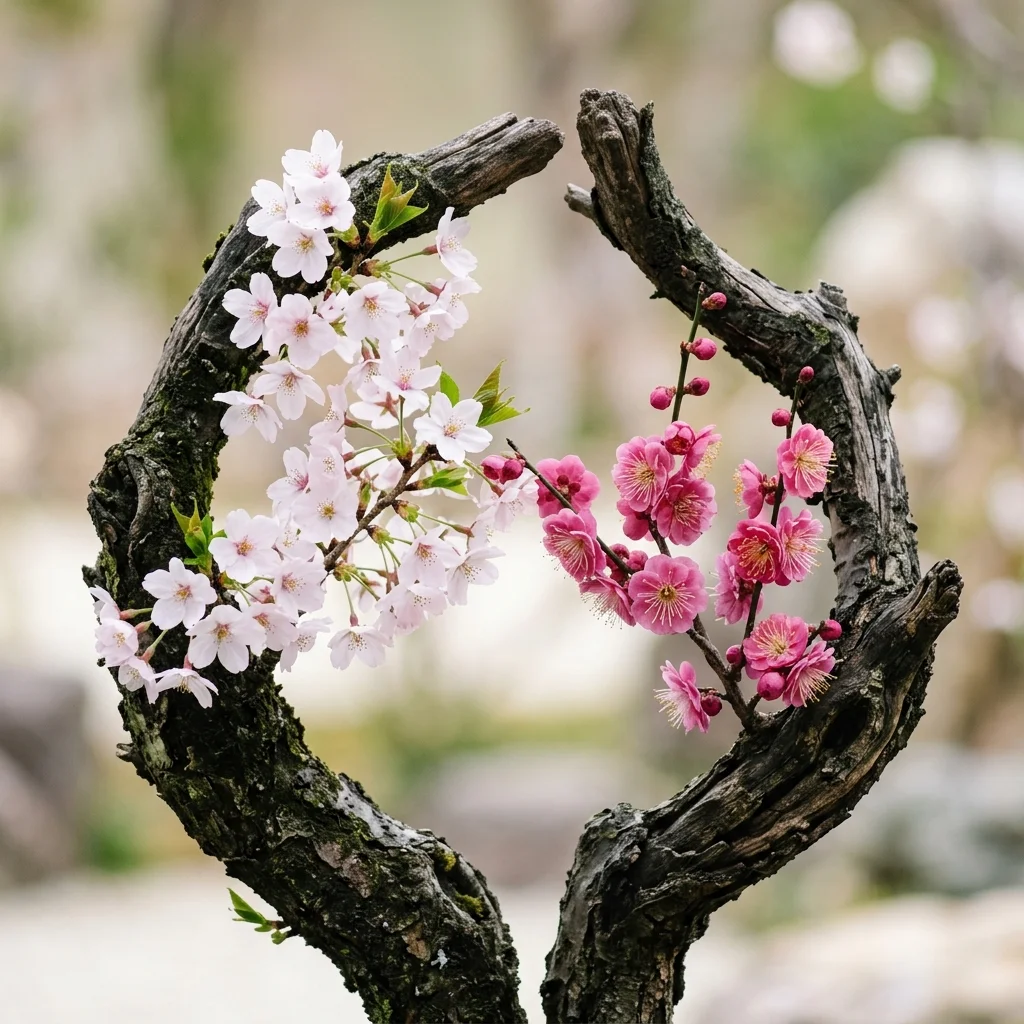
The word Oubaitori (桜梅桃李) is a highly evocative, poetic four-character idiomatic compound (known as a Yojijukugo) that etymologically serves as a beautiful botanical metaphor for human diversity and self-acceptance. The word is composed of four distinct kanji characters, each representing a celebrated spring-blooming tree of the rose family (Rosaceae): the first, Ou (桜), represents the Cherry blossom (Sakura); the second, Bai (梅), represents the Plum blossom (Ume); the third, Tou (桃), represents the Peach blossom (Momo); and the fourth, Ri (李), represents the Apricot or Asian Plum blossom (Sumomo). Literally translated, the phrase represents 'cherry, plum, peach, and apricot' or the 'doctrine of non-comparison'.
Phonetically pronounced as /oh-bye-toh-ree/, the word carries a gentle, flowing rhythm. Its earliest conceptual origins trace back to the 13th century, specifically formulated in the classical Buddhist texts of the **Nichiren** school. Nichiren wrote in his treatise Ongi Kuden (The Record of the Orally Transmitted Teachings) that the cherry, the plum, the peach, and the apricot each possess their own unique entity without undergoing any change, and that each blooms beautifully in its own seasonal timing. Unlike Western philosophical concepts of individualism that often encourage aggressive self-promotion, *Oubaitori* is an organic, ecological model: it shows that true harmony is achieved not by forcing everyone to conform to a single standard of beauty, but by allowing each unique life to express its own inherent nature, establishing a beautiful baseline of mutual respect and self-compassion.