Back to Glossary
Concept Glossary

Datsuzoku: The Escape from Convention - Releasing the Soul from Rigid Structures

Datsuzoku: The Escape from Convention - Releasing the Soul from Rigid Structures
Cultural Concept

DATSUZOKU

脱俗 / だつぞく

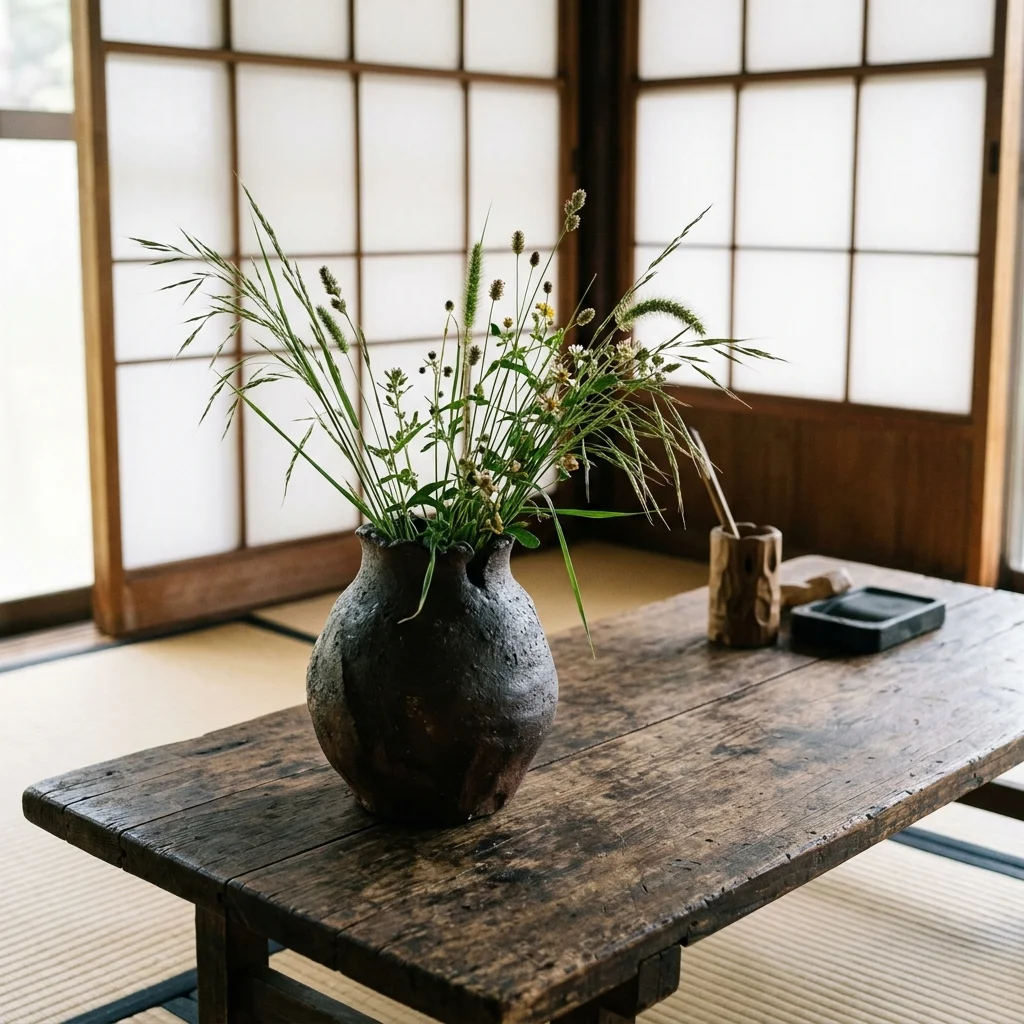
The calm of Datsuzoku: an asymmetrical, rustic hand-built vase holding wild grasses in a clean Zen study, breaking rigid formatting to let nature breathe.

Linguistic Definition (TL;DR)

Datsuzoku is the Zen philosophical and aesthetic concept representing the intentional transcendence of social conventions, rigid rules, and repetitive patterns. As one of the seven Zen design principles, it demands the breaking of symmetry and standard forms, allowing creators to cultivate raw, formless originality and inner spiritual liberation.

Etymology & Linguistic Analysis

// 01

The word Datsuzoku (脱俗) is a highly sophisticated, philosophically dense two-character compound that etymologically outlines the act of spiritual escape and creative liberation from the codes of mundane society. The word is composed of two distinct kanji characters: the first, Datsu (脱), is an active verb meaning 'to escape', 'to slip out of', 'to shed', 'to strip off', or 'to peel away'; and the second, Zoku (俗), represents the mundane world, vulgar customs, established conventions, or the repetitive rules of everyday society. Taken as a whole, the phrase literally translates to 'shedding the mundane', 'escaping the worldly', or 'freedom from rigid convention'.

Phonetically pronounced as /daht-soo-zoh-koo/, the word carries a sharp, decisive rhythm that matches the bold, creative action it describes. Etymologically, the term has been used in Zen Buddhist texts since the Song Dynasty import to describe a monk who has successfully shed all worldly attachments. In the 20th century, the term was codified by the prominent aesthetician and philosopher Shin'ichi Hisamatsu in his seminal work Zen and the Fine Arts as one of the seven core Zen design principles (alongside Kanso/simplicity, Fukinsei/asymmetry, Shibui/understated beauty, Shizen/naturalness, Yugen/profound grace, and Seijaku/stillness). Unlike modern Western concepts of rebellion or destructive anarchy, *Datsuzoku* is a highly disciplined, transcendent act: it is the purposeful, aesthetic breaking of rules by a master who understands the rules completely, establishing a space of profound, formless originality.

Deep Philosophical Foundations

// 02

At its philosophical core, Datsuzoku is the practical application of the Zen Buddhist doctrine of Ku (Emptiness / Void) and the attainment of Satori (Spiritual Enlightenment). It represents the belief that all social structures, linguistic labels, and aesthetic rules are temporary, empty mental constructs, and that true spiritual liberation requires the active, mindful shedding of these boundaries.

In the Zen worldview, human beings are continuously conditioned by their environment, absorbing repetitive patterns of behavior, thought, and style that form a protective but deadening shell around the soul. *Datsuzoku* is the intentional shattering of this shell. In design, it manifests as the breaking of rigid symmetry, the introduction of bold, irregular shapes, and the use of raw, unrefined materials that defy expectations. In life, it represents the courage to step outside the prescribed career ladders, speak immediate truths, and live with spontaneous, uncalculated freedom (*Mushin*). This philosophy balances rigorous self-discipline and radical liberation, showing that true sanity and creativity require a willing submission to the void, free from worldly attachments.

This philosophy directly supports the spirit of Wabi-Sabi (finding beauty in the irregular, asymmetrical, and transient). A traditional hand-formed Raku-yaki tea bowl—with its uneven rim, warped walls, and rough, dark-glaze patches—is the absolute materialization of *Datsuzoku*. It rejects the sterile, perfect symmetry of machine-made porcelain, celebrating instead the unique, spontaneous marks of the artisan's fingers and the chaotic chemistry of the firing kiln, turning structural imperfection into a monument of spiritual freedom.

Historical Evolution

// 03

The historical codification of Datsuzoku spans from the early ink paintings of the Southern Song dynasty imports to the radical tea ceremony reforms of Sen no Rikyu during the Azuchi-Momoyama period, and its subsequent integration into the Zen aesthetic lineage.

During the 13th and 14th centuries, Zen monks returning from China imported highly dynamic **Ink Wash Paintings (Sansuiga / Sumi-e)**. Unlike the rigid, symmetrical court paintings of the Heian aristocracy, which depicted stylized figures with high visual weight, these Zen paintings were characterized by massive empty spaces (*Yohaku*) and bold, chaotic brushstrokes executed in a matter of seconds. The monks utilized asymmetrical compositions—such as a single, gnarled plum branch sweeping across a blank white silk scroll—to represent the concept of *Datsuzoku*. They sought to capture the inner spiritual essence of the plant rather than its realistic surface details, establishing a visual tradition where empty space and irregular lines were linked to spiritual awakening.

By the Azuchi-Momoyama Period (1573–1603), Sen no Rikyu codified *Datsuzoku* as the primary aesthetic and social force of the tea ceremony. Prior to Rikyu, the ruling samurai elite vied for prestige by displaying perfect, highly symmetrical golden tea utensils imported from China. Rikyu systematically rejected this worldly vanity. He introduced rough, asymmetrical, unglazed Bizen-yaki water jars and hand-built, irregular black Raku tea bowls. He designed the tea room alcove (*Tokonoma*) to hold not a perfect, expensive vase of domestic flowers, but a single, wild mountain weed placed in a rough bamboo tube. This radical aesthetic disruption was a direct political statement of *Datsuzoku*: it demonstrated that true wealth and spiritual authority lay not in the wealth-driven codes of the military class, but in a complete, disciplined escape from those codes into the raw simplicity of nature. This historical revolution ensured that *Datsuzoku* was permanently etched into the DNA of Japanese pottery, garden design, calligraphy, and architecture, preserving a biological and geological sanctuary of creative freedom that survived the industrial age.

Cultural Case Studies

// 04

In contemporary global society, the Zen logic of Datsuzoku is driving major movements in experimental architecture, progressive software design, and alternative lifestyle models, serving as a crucial blueprint for creative disruption.

1. Experimental Asymmetrical Architecture: Premier Japanese architects (such as Kengo Kuma and Tadao Ando) utilize the aesthetics of *Datsuzoku* to design highly unique public buildings. Rather than constructing standard, box-like concrete skyscrapers that dominate the urban horizon, they design structures with irregular, flowing curves, uneven wood lattice facades, and organic interior courtyards. In these spaces, concrete walls intersect at asymmetrical angles, and raw, unpolished basalt stones are left exposed inside. This architectural design breaks the rigid, mechanical geometry of the modern city, creating a serene, forest-like sanctuary that invites users to escape the conventions of urban stress and connect with their inner self.

2. Creative Software and Interface Disruption: Progressive software designers and digital artists in Tokyo utilize *Datsuzoku* to combat the sterile uniformity of modern web and mobile interfaces. As global platforms converge toward flat, identical layouts designed around high-potency behavioral loops, these designers construct alternative, minimalist interfaces. By using hand-drawn typography, spacious layout grids, and organic scrolling physics, they break the rigid conventions of modern UI/UX design. These digital products do not seek to maximize time-on-screen; instead, they respect the user's attention, cultivating a quiet, present-focused experience that stands as a work of interactive art.

3. The Rural Revitalization Movement: Across rural prefectures like Niigata, Tokushima, and Okayama, a growing generation of young urban professionals is practicing a radical form of lifestyle *Datsuzoku*. Abandoning the high-stress, corporate career ladders of Tokyo, they migrate to remote mountain villages (*Satoyama*). They restore traditional transition farmhouses (*Minka*), launch organic agricultural collectives, and establish decentralized renewable energy networks. By stepping completely outside the conventional consumer society, they prove that a modern, high-quality existence can be sustained in deep harmony with the earth, showing a successful scale of creative lifestyle disruption.

Practical Guide for Foreigners

// 05

For international artists, designers, and professionals, incorporating the spirit of Datsuzoku into your creative and personal practice offers a profound path to break creative blocks, discover your authentic voice, and cultivate inner freedom.

Mindful Breaking of Creative Habits: If you are a designer, writer, or artist, identify the repetitive patterns and rules that govern your work. If you typically design with perfect mathematical symmetry, force yourself to construct an asymmetrical layout where a massive white space balances a single gnarled line. If you write with rigid, formal structures, draft a raw, stream-of-consciousness essay. By systematically and mindfully breaking your established habits, you bypass the critical ego and open the stage for raw, formless creativity.

Mindful Digital Disconnect: Establish a dedicated 'Datsuzoku Ritual' once a week. Turn off all digital devices, step completely outside your daily routine, and spend a day in raw, unmanaged nature. Hike a mountain trail, sit by a riverbed, or wander through a quiet town without a map or schedule. Let your mind empty of worldly worries and social expectations. This periodic escape from the codes of mundane society is the essential foundation for cultivating inner peace and creative vision.

Embrace Material and Personal Imperfection: Apply the wisdom of *Datsuzoku* to your daily life by letting go of the toxic pursuit of perfection. When creating home spaces, cooking, or working, welcome the irregular textures, the minor accidents, and the spontaneous marks. Appreciate the beauty of an irregular, handmade ceramic bowl or a gnarled piece of wood. By accepting and celebrating imperfection in your environment and in yourself, you reduce anxiety, quiet the ego, and cultivate a serene wabi-sabi lifestyle.

Dialogue Scenarios

// 06

Review these bilingual dialogue scenarios to understand how designers and ceramicists discuss the transition away from conventional standards to practice Datsuzoku.

Scenario A: Two Ceramicists in an Imbe Kiln Studio (備前焼の工房で)
A veteran potter explains to an apprentice why they must not discard a warped clay bowl.

Apprentice: 師匠、このお茶碗、窯の中で少し歪んでしまいました。丸みが崩れて非対称になっているので、廃棄した方がいいでしょうか?
(Master, this tea bowl warped slightly inside the kiln. The roundness is broken and it's asymmetrical. Should I discard it?)
Master: 何を言っているんだ。その歪みこそが「脱俗」の美じゃないか。工業製品のような完璧な円には魂がない。この歪みは土と炎が対話した、二度と戻らない一瞬の記録なんだ。そのまま磨いて完成させなさい。
(What are you saying? That warp is the very beauty of Datsuzoku. Perfect circles like industrial products have no soul. This warp is the record of a unique moment when the clay and fire conversed. Polish it as it is and complete it.)
Apprentice: なるほど。規則的な完璧さを超えて、自然の歪みをそのまま受け入れる。それこそが、使い手の心を世俗のノイズから解放する美の器になるのですね。
(I see. Going beyond regular perfection to accept natural warps as they are. That is how it becomes a vessel of beauty that liberates the user's mind from worldly noise.)

Scenario B: A Design Director and a Web Designer (東京のデジタルスタジオで)
A director guides a designer who has built a standard, corporate website layout.

Designer: Director, I've designed the landing page using the standard modern grids and flat corporate illustrations. It's clean and matches all the popular industry benchmarks.
Director: It is clean, yes. But it's also completely conventional. It looks like a thousand other websites. I want you to practice some Datsuzoku here. Break that rigid layout grid. Introduce dynamic, hand-painted calligraphy strokes and large asymmetrical empty spaces.
Designer: But won't that break the standard conversion optimization benchmarks?
Director: The benchmarks are for ordinary products. Our client is a historic lacquerware maker. By breaking the conventional web codes, we show their extreme dedication (Kodawari) and create a premium, artistic digital experience that stays in the user's memory. Go ahead and take the risk!

Modern Ecological & Social Relevance

// 07

In our modern globalized 21st-century society, Datsuzoku stands as a crucial aesthetic and ethical principle to combat the severe crises of cultural homogenization, algorithmic uniformity, and creative stagnation.

The hyper-efficiency of the digital age has created a global, synchronized culture. Social media algorithms reward conformity, and design tools converge toward identical, mass-produced visual assets, resulting in a severe epidemic of cultural flat-ness where everything from architecture to graphic interfaces looks identical. The concept of *Datsuzoku* offers a powerful, disruptive corrective: by mindfully breaking these rigid, algorithmic codes and embracing asymmetrical, organic, and imperfect designs, we preserve the diversity of human expression and restore depth, tactile warmth, and poetic soul to our environments.

Furthermore, in the realm of modern education, *Datsuzoku* is driving a transition away from standardized, rote-learning systems that treat students as uniform industrial units. By transforming classrooms into open, creative sanctuaries of *Datsuzoku* where failure is treated as a vital artistic experiment, we cultivate a generation that is not only highly technical, but capable of radical, world-changing innovation, proving that the future of advanced civilization lies in the courageous pursuit of spiritual and creative liberation.

Practical Mastery

Actionable Cultural Skills

Integrate the philosophical wisdom of Datsuzoku into your everyday lifestyle through these practical, hands-on Japanese technical disciplines.

Asymmetrical Sandbox Staging

不均整の砂床据え付け
初級 (Beginner)⏱️ 15 Mins

Master the absolute physical coordinates to execute a traditional asymmetrical stone composition in a small sand basin, practicing Fukinsei (asymmetry).

Shallow sand basinThree unrefined river stones
📋 Practical Steps
  1. 01.Acquire a shallow wooden tray (approx. 30cm x 20cm), filled with 2 centimeters of fine white quartz sand, and three natural river stones of different sizes.
  2. 02.Wipe the stones and smooth the sand surface with a wooden ruler to establish a clean, flat, blank canvas.
  3. 03.Separate the three stones into: 'Ten' (heaven, largest), 'Chi' (earth, medium), and 'Jin' (human, smallest). Inspect their textures.
  4. 04.Do not place the stones in a straight line or at the exact center of the tray, as symmetry destroys the Zen aesthetic.
  5. 05.Place the largest stone ('Ten') at the top-left quadrant of the tray. Place the medium stone ('Chi') at the bottom-right quadrant, creating a diagonal tension.
  6. 06.Place the smallest stone ('Jin') slightly offset between the two, forming a perfect, asymmetrical scalene triangle.
  7. 07.Rake the sand gently around the stones in circular ripples using a small wooden rake. Step back 1 meter to observe the balance, ensuring a beautiful, dynamic tension.

Wild Grass Asymmetry Design

野草の一輪挿し崩し
中級 (Intermediate)⏱️ 30 Mins

Design an alternative flower arrangement utilizing wild grasses and an irregular clay vase, practicing deliberate departure from formal symmetry.

Handmade irregular ceramic vaseAssorted wild meadow grasses
📋 Practical Steps
  1. 01.Gather a single, asymmetrical hand-built ceramic vase and a bundle of wild forest grasses (such as foxtail, pampas grass, and a single wildflower).
  2. 02.Fill the vase with cool, clean spring water to keep the stems healthy.
  3. 03.Inspect the grasses: do not choose perfect, straight stems. Select stems that curve organically under their own weight.
  4. 04.Insert the tallest wild grass stem into the vase, letting it lean dramatically to the left at a 30-degree angle, breaking the vertical axis.
  5. 05.Insert the second grass stem to lean to the right at a 60-degree angle, shorter than the first, creating a beautiful spatial asymmetry.
  6. 06.Place the single wildflower at the base, slightly offset from the center, to serve as a quiet, colorful anchor for the visual composition.
  7. 07.Place the finished arrangement in a sunlit corner of your room, observing how the irregular shadows cast by the grasses onto the wall create a calm, forest-like atmosphere.

Hand-formed Raku Clay Shaping

手捏ね楽茶碗の造形
上級 (Advanced)⏱️ 3 Hours

Construct a functional tea bowl using the traditional Tezuki (hand-forming) technique, embracing irregular finger marks and spontaneous warps.

Rich iron-coarse Raku clayBamboo carving loop
📋 Practical Steps
  1. 01.Acquire a 500-gram block of coarse, iron-rich Raku clay. Do not use a mechanical potter's wheel, as wheels force absolute circular symmetry.
  2. 02.Knead the clay block thoroughly on a plaster board, eliminating air bubbles while keeping the moisture level uniform.
  3. 03.Shape the clay into a solid ball. Press your thumb down into the exact center of the ball, leaving a 2-centimeter base thickness.
  4. 04.Pinch the clay walls upward slowly using your thumbs on the inside and fingers on the outside, rotating the bowl manually.
  5. 05.Do not try to make the walls uniform or the rim perfectly flat. Deliberately welcome the irregular indentations left by your fingers and the slight warps in the rim.
  6. 06.Shape the foot (*Kodai*) at the bottom using a wire loop tool, carving a rustic, asymmetrical ring that mirrors the organic top rim.
  7. 07.Allow the bowl to dry slowly in the shade for two weeks before firing, letting the hand-formed irregular textures become a permanent statement of your spiritual freedom.