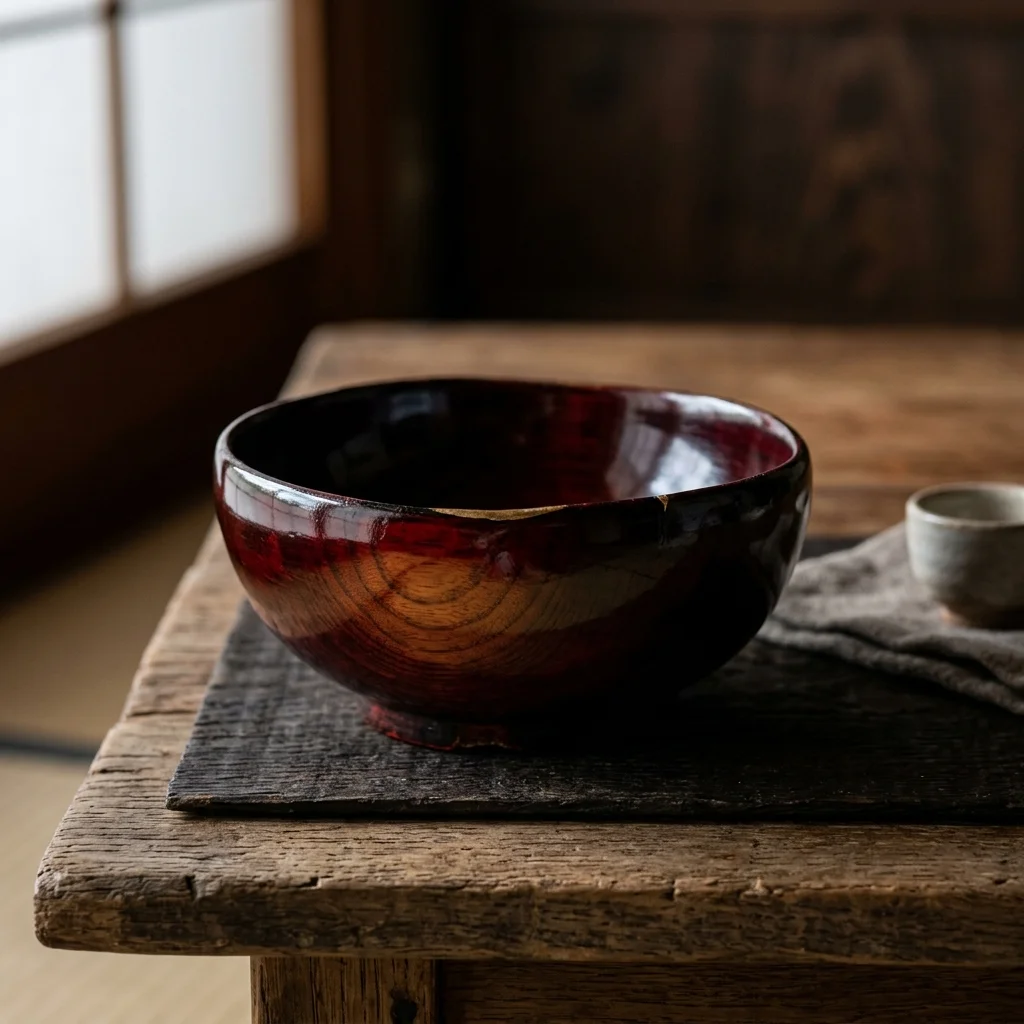
Historical Background
For over 9,000 years, dating back to the Jomon period, Japanese communities have utilized the sap of the toxic poison oak tree (Toxicodendron vernicifluum) to seal tools, coat sacred vessels, and preserve weapons. What began as a raw adhesive evolved through the Heian and Edo periods into a refined, high-status artistic medium. Modern conservation efforts continue to safeguard these ancient techniques against synthetic chemical imitations.
The Paradoxical Sap: Wounding the Forest to Heal the Vessel
At the heart of the Japanese lacquerware tradition lies a profound paradox: to protect and beautify a wooden object, one must harvest a highly toxic, skin-blistering sap. This substance, known as Urushi (漆), is the refined sap of the *Toxicodendron vernicifluum* (historically classified as *Rhus verniciflua*), a deciduous tree native to East Asia. When touched in its raw, liquid state, Urushi causes severe contact dermatitis due to active organic compounds called urushiols. Yet, when patiently applied in dozens of razor-thin coats and cured under precise conditions, it polymerizes into a glassy, smooth, and completely inert shield that resists boiling water, acids, and industrial solvents.
The harvesting of Urushi is an exercise in extreme patience and absolute ecological respect. A professional lacquer tapper, known as an Urushikaki (漆掻き), begins the harvest only when the Urushi trees reach approximately 10 to 15 years of age. The tapper works between June and October, making microscopic horizontal incisions in the bark. The tree, in an effort to heal its wounds, exudes a thick, milky-white latex sap.
Using a specialized, curved iron knife called a *kama*, the Urushikaki scrapes these tiny drops into a wooden bucket. The yield is incredibly small: a single mature tree yields only about 200 grams of raw sap over its entire lifetime. Once the tree has given its final drops in autumn, it is cut down, and from its roots, new shoots sprout naturally to begin the decade-long cycle anew. This is not a system of exploitation, but a cyclical partnership of healing, where the tree’s defensive fluid is gathered to shield everyday human objects.
In the mountain forests of Joboji, Iwate Prefecture—which produces over 70% of Japan's domestic Urushi—the harvesting process is treated with spiritual reverence. Tappers perform purification rituals before entering the forests in early summer. The relationship between the Urushikaki and the tree is deeply personal; each tapper can read the health, moisture level, and cellular stress of the tree by the color and viscosity of the exuded latex. A healthy tree under optimal atmospheric conditions yields a pure, high-viscosity sap rich in urushiols, whereas a stressed tree under heavy rain yields a thin, water-heavy latex that requires extensive dehydration.
To harvest the sap, the Urushikaki uses a series of specialized hand-forged steel tools: the *yokogama* (a heavy scoring knife to slice the outer bark), the *kama* (a scoop knife to extract the fluid), and the *eguri* (a rounded chisel to clean the wood surface). The tapping pattern must be meticulously calculated; if the tapper cuts too deep, the tree's vascular cambium is damaged, arresting its growth and ruining future yields. Each cut is exactly 2 millimeters deep, spaced precisely around the circumference of the trunk to allow nutrients to continue flowing from roots to leaves.
The Molecular Chemistry of Urushiol: Polymerization by Moisture
To the uninitiated, the process of drying Urushi is deeply confusing. Unlike synthetic varnishes, polyurethane, or oil finishes that dry through the evaporation of volatile solvents or exposure to heat, Urushi requires high humidity to cure. If placed in a dry, hot room, the lacquer will remain sticky and wet indefinitely.
This counterintuitive curing process is driven by a beautiful biochemical reaction. Raw Urushi sap is a natural water-in-oil emulsion consisting of approximately 60% to 65% urushiol, 30% water, 3% glycoproteins, 2% polysaccharides, and a tiny fraction of a crucial copper-bearing enzyme called laccase.
Urushiol itself is a mixture of closely related organic compounds consisting of a catechol ring substituted with an aliphatic chain containing 15 or 17 carbon atoms. These carbon chains may be saturated, monounsaturated, diunsaturated, or triunsaturated.
When the liquid lacquer is placed inside a humid curing cabinet—traditionally a wooden cupboard called a Furo (風呂) maintained at 20°C to 25°C (68°F to 77°F) and 70% to 80% relative humidity—the curing sequence begins:
- Laccase Activation: The laccase enzyme, which remains suspended in the microscopic water droplets within the emulsion, is activated by the high atmospheric moisture.
- Enzymatic Oxidation: The active laccase catalyzes the oxidation of the catechol ring of the urushiol molecules, converting them into highly reactive *o-quinone* intermediates.
- Radical Polymerization: These quinones undergo spontaneous, non-enzymatic coupling reactions. The reactive radicals attack the unsaturated double bonds on the long carbon chains of adjacent urushiol molecules.
- Indestructible Network: This chain reaction cross-links the liquid monomers into a dense, three-dimensional polymeric network. The water slowly diffuses out as the network tightens, locking the organic molecules into a permanent, inert solid.
The resulting polymerized coating is not just a surface glaze; it is a tough, flexible organic polymer. Once fully cured, Urushi is virtually impervious to organic acids, alkalis, alcohols, and temperatures up to 200°C. It is so chemically resistant that only highly concentrated nitric acid or prolonged exposure to ultraviolet (UV) light can degrade its molecular bonds. This is why prehistoric Jomon lacquerware, buried in damp earth for nine millennia, emerges with its red-and-black pigment still gleaming brilliantly today.
Polymerization & Structural Profiles: Urushi vs. Polyurethane
High-humidity laccase enzyme action catalyzes the cross-linking of urushiol monomers into a three-dimensional elastomeric network. The resulting polymer breathing-bonds to wood cells and is impervious to acids and boiling water.
Relies on evaporation of volatile organic compounds (VOCs) to leave a stiff, brittle plastic sheet on top of wood. Under UV exposure, the ester bonds break down, causing the plastic to yellow, crack, and peel.
Compared to modern synthetic coatings like polyurethane, which create a hard, brittle, plastic layer on top of wood, the molecular structure of Urushi represents a completely different chemical philosophy. Polyurethane molecules are synthetic chains linked by tight ester bonds that form a stiff, impermeable sheet. Over time, UV light breaks these synthetic chains, causing the plastic to yellow, crack, and peel away from the wood. Urushi, by contrast, forms a highly complex, semi-elastic natural network where the long, flexible aliphatic carbon chains cushion the rigid catechol rings. This creates a breathing, dynamic polymer skin that expands and contracts in absolute harmony with the natural movement of the underlying wood cells.
The Tactile Warmth: Physics of the Urushi Grip
Beyond its chemical durability, the true magic of Urushi is felt through the human hand. When you hold a high-quality Urushi bowl filled with steaming miso soup, your fingers experience a gentle, organic warmth that synthetic materials can never replicate. This comforting sensation is the direct result of thermal physics.
Urushi is an exceptionally poor conductor of heat. Its thermal conductivity is extremely low, acting as a highly efficient natural insulator. When hot liquid is poured into a wooden bowl coated in dozens of thin layers of Urushi, the lacquer prevents the rapid transfer of heat to your fingertips. You can hold a boiling hot bowl comfortably without burning your hands, yet as you raise it to your lips, the rim feels incredibly soft and warm.
Under a microscope, the surface of cured Urushi is not dry and brittle like synthetic glass or acrylic. The cured lacquer retains a minuscule amount of micro-moisture trapped within the polymerized matrix. This gives the surface a highly unique elastomeric property.
When your skin touches an Urushi surface, the friction is perfectly balanced—it does not feel slippery like polished plastic, nor sticky like unfinished wood. Instead, it feels like a second skin. It is warm, smooth, and yields slightly to pressure, creating a luxurious tactile interface that deepens the user's connection to the daily ritual of eating and drinking.
This sensory satisfaction has deep roots in Japanese physiological aesthetics. Tactile sensations are categorized as *Ada-gi* (a soft, yielding texture that feels welcoming to the skin). Standard acrylic or ceramic bowls have a thermal effusivity that drains heat from the skin instantly upon contact, registering as "cold" or "foreign." An Urushi bowl, however, matches the thermal profile of human tissue almost perfectly. When held, it feels like an extension of the self—a warm, breathing medium that mediates between the scorching temperature of the food and the sensitive receptors of the fingers and lips.
Artisan Experience: The Twelve Layers of Wajima-nuri
To appreciate the absolute dedication required to produce a single piece of lacquerware, one must step inside a workshop in Wajima, Ishikawa Prefecture, a coastal city internationally renowned for its Wajima-nuri (輪島塗) lacquerware. Here, creating a single bowl requires a minimum of 36 distinct steps and can take up to six months of meticulous, repetitive labor.
The Wajima technique is unique for its use of a primary base coat called Ji-no-ko (地の粉), a fine mineral powder derived from calcined diatomaceous earth sourced locally in Wajima. Diatomaceous earth consists of fossilized silica shells of microscopic algae, which are highly porous. When mixed with raw Urushi and applied to the wooden substrate, the mineral powder acts as a mechanical anchor, binding the lacquer deep into the wood grain and preventing warping or cracking over decades of use.
The application follows a rigorous, multi-layered sequence:
- Ki-urushi Sealing: The raw, hand-carved wooden bowl (usually made of stable zelkova or cherry wood) is first saturated with raw lacquer to seal the porous grain.
- Cloth Reinforcement (Nunu-bari): Vulnerable edges, such as the rim and the foot-ring, are reinforced by wrapping them in thin strips of linen cloth soaked in a paste of raw Urushi and rice starch.
- Ji-no-ko Undercoats: Multiple layers of increasingly fine diatomaceous earth paste (*Ippon-ji*, *Nihon-ji*, *Sanbon-ji*) are applied with wide wooden spatulas, with each layer dried for days in the humid *Furo* and meticulously ground flat using whetstones.
- Middle Coats (Naka-nuri): The artisan applies layers of refined Urushi with brushes made of human hair (prized for their perfect stiffness and consistency). Each layer must be carefully polished with fine charcoal sticks to remove micro-specks of dust.
- Top Coat (Uwa-nuri): The final, most demanding phase. The master artisan must apply the top layer of highly purified lacquer in a completely dust-free clean room. Even a single particle of floating dust can ruin months of work. The artisan does not wear shoes, sweeps the room continuously, and uses a specialized feather quill to pluck micro-dust from the wet surface.
This extreme dedication results in a vessel that is practically indestructible under normal conditions. In Wajima, it is common to hear that Wajima-nuri is meant to be used daily, washed with soft sponges, and passed down through three generations. With time and usage, the lacquer does not degrade; instead, the micro-moisture within the polymer matrix slowly stabilizes, making the red or black color deeper, clearer, and more lustrous than the day it left the clean room.
In Wajima workshops, artisans are divided into distinct guilds to ensure absolute mastery over every stage. The woodworkers (*Kijishi*) select only slow-grown, mountain-harvested keyaki (zelkova) wood, which is seasoned for five to seven years to eliminate internal structural tension. The undercoat specialists (*Shitajishi*) formulate the diatomaceous earth pastes, mixing the raw calcined clay with high-purity *Ki-urushi* using heavy wooden paddles. The final polisher (*研ぎ手*) utilizes natural whetstones mined from regional rivers, grinding the intermediate layers under running water to a thickness of only a few microns. This division of labor guarantees that every single bowl carries the collective wisdom and muscle memory of multiple lifelong master craftsmen.
Historical Case Study: The Golden Preservation of Kinkaku-ji
The protective power of Urushi is dramatically demonstrated in the preservation of Japan's most iconic architectural monuments. The most famous case study is the restoration of the Kinkaku-ji (金閣寺 — the Golden Pavilion) in Kyoto.
Built in 1397 and tragically destroyed by arson in 1950, the pavilion was rebuilt in 1955. However, by the late 1980s, the intense Kyoto sun, weather, and acid rain had severely degraded the fragile gold leaf coating on the exterior. In 1987, a massive conservation project was launched to fully restore the pavilion's golden skin.
The conservators did not use synthetic acrylic glues or outdoor polyurethane to apply the gold leaf. Instead, they returned to the original, ancient materials: Japanese Urushi lacquer.
The entire exterior of the pavilion was coated in multiple layers of weather-resistant raw Urushi, acting as the structural adhesive. While the lacquer was still wet and curing in the humid air, sheets of premium gold leaf (five times thicker than standard decorative leaf) were carefully pressed onto the surface.
The results are structurally extraordinary. The underlying Urushi polymer shield completely seals the cedar wood frame of the pavilion, protecting it from moisture rot, wood-boring insects, and UV radiation, while permanently bonding the gold leaf to the structure. Despite decades of exposure to extreme summer heat, freezing winters, and heavy rain, the Golden Pavilion continues to reflect Kyoto's sunlight with pristine, radiant brilliance—a living monument to the chemical mastery of ancient Japanese lacquer.
During this historic restoration, over 1.5 tons of high-grade domestic Urushi was meticulously applied by hand across the exterior facades. The restoration team discovered that the ancient formula of mixing raw lacquer with iron-rich clay pigments provided an outstanding shield against the intense ultraviolet rays of the Kyoto basin. The gold leaf, pressed flat onto the curing lacquer, forms an oxygen barrier that prevents the underlying wood from oxidizing, while the lacquer's elastic network cushions the building from thermal expansion and contraction during winter freezes. Today, despite acid rain levels that degrade concrete structures throughout urban Kyoto, the Golden Pavilion's skin remains completely unblemished, showcasing the unmatched preservation power of natural organic materials.