Historical Background
The cultivation of shaded tea was refined in the Uji region of Kyoto during the late Muromachi period, evolving alongside the spiritual philosophy of Chanoyu (the Japanese tea ceremony). While standard green teas were grown under direct sun, Kyoto's elite realized that shading the bushes created a sweet, savory concentrate fit for emperors. Today, the Uji region remains the global standard for shaded tea engineering.
The Architecture of Darkness: The Philosophy of Shading
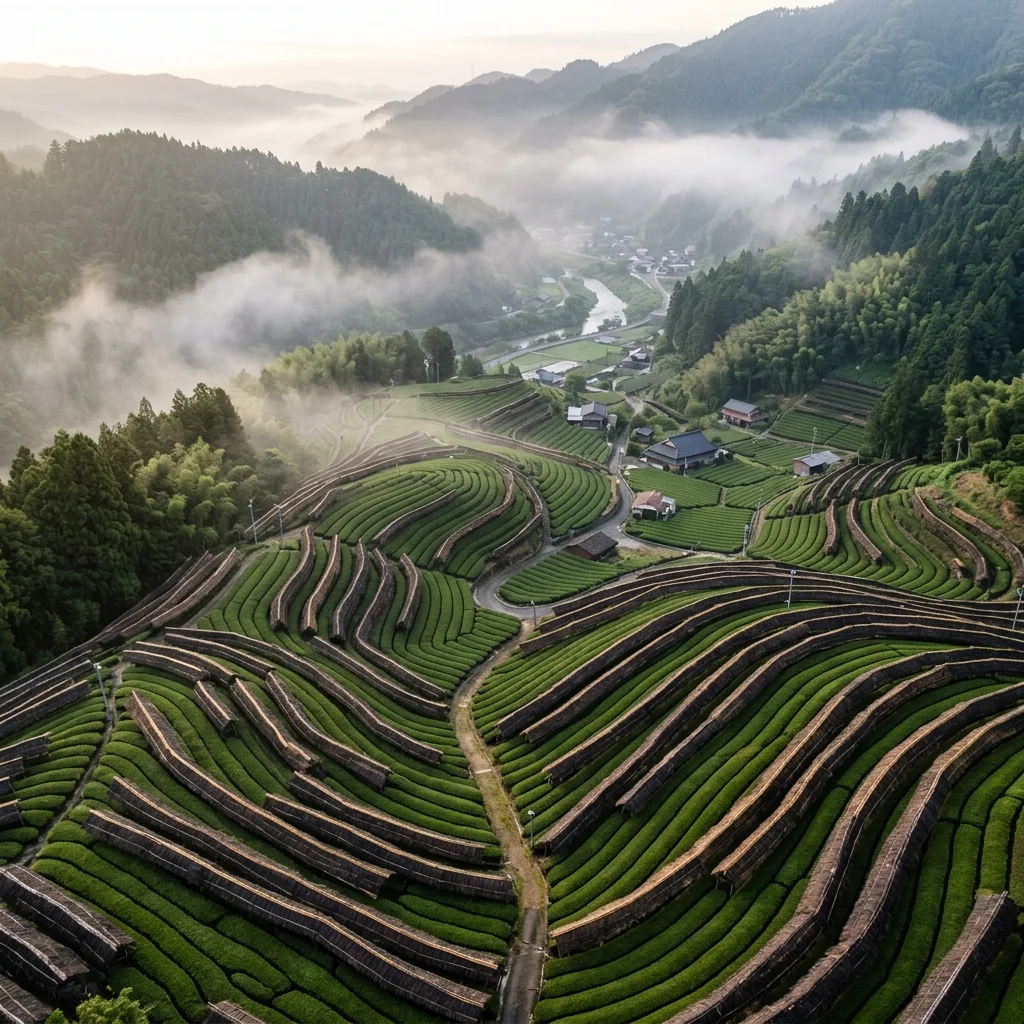
To walk through the ancient tea fields of Wazuka, Kyoto Prefecture, in late spring is to witness a silent landscape of darkness. Across the rolling terraced hills, entire fields of *Camellia sinensis* are blanketed under dark, structured canopies of straw or modern black fabrics. This practice, known as Ooi-chaya (覆い茶園) or Tana-shitate (棚仕立て), is not a simple agricultural convenience. It is a highly specialized system of deliberate light deprivation designed to radically alter the botanical physiology of the tea plant.
For approximately 20 to 30 days before the spring harvest (Shincha), tea farmers systematically reduce the sunlight reaching the leaves. The shading begins by blocking 70% of the light, and is progressively tightened until the leaves grow in near-complete darkness—blocking up to 95% to 98% of all photosynthetically active radiation (PAR).
To the untrained eye, starving a plant of its source of life seems counterintuitive. Yet, this controlled botanical stress triggers a dramatic survival response. Deprived of sunlight, the tea leaves undergo a hyper-synthesis of chlorophyll to catch every single stray photon, expanding their surface area, growing thinner, and turning a brilliant, dark jade green. More importantly, this absolute darkness arrests the chemical conversion of precious amino acids, locking in the sweet, creamy, and deeply savory flavor compounds known as Umami (旨味).
In the mountain terraced fields of Kyoto, two primary methods of shading are practiced: *Tana-shitate* (frame shading) and *Jikakuse-ooi* (direct bush shading). *Tana-shitate* is the traditional, high-end technique where a wooden or metal frame is constructed over the tea rows, suspending the reed-and-straw canopies (*hon-zu*) approximately six feet above the ground. This allows the tea leaves to grow in a completely unrestricted micro-climate with optimal air ventilation, avoiding physical contact with the shading fabric and preventing mold growth.
*Jikakuse-ooi*, by contrast, lays lightweight black synthetic mesh directly over the crowns of the tea bushes. While more economical, direct shading exposes the tender spring buds to physical friction and trapped heat. The frame-shaded *hon-zu* method remains the gold standard for producing award-winning ceremonial Matcha, as the straw materials naturally decompose slightly under spring rain, releasing rich minerals onto the soil while filtering light through organic, multi-layered lattices that mimic the natural canopy of an ancient forest.
The Molecular Alchemy: L-Theanine and Catechin Pathways
The secret behind premium Matcha’s rich, non-bitter taste profile lies in the delicate biochemical balance between two primary compounds: L-theanine (an amino acid that provides savory umami and sweetness) and catechins (tannins that produce astringency and bitterness).
Understanding this balance requires tracing the molecular pathway of the tea plant’s growth:
- Root Synthesis: L-theanine (N-ethyl-L-glutamine) is synthesized almost exclusively in the roots of *Camellia sinensis* using nitrogen absorbed from the soil. It is a unique amino acid that acts as a natural water-soluble neurotransmitter analogue.
- Leaf Translocation: During spring, the roots pump L-theanine up through the stems into the newly emerging shoots and leaves, where it serves as a nitrogen reserve.
- The Photolysis Conversion (Under Sun): If the leaves are exposed to direct, unshaded sunlight, a natural photochemical reaction occurs. The UV rays activate photolysis pathways, breaking down the L-theanine within the leaf tissue and converting it into various polyphenols, primarily epigallocatechin gallate (EGCG) and other bitter catechins.
- The Shade Blockade: By completely shading the tea bushes during the final month of growth, farmers halt this photolysis process. The enzyme pathways that convert amino acids into catechins are deactivated. As a result, the high levels of L-theanine pumped from the roots remain trapped in the leaves, while the generation of bitter catechins is severely restricted.
When the shade-grown leaves are harvested, steamed, dried (creating Tencha (緑茶)), and ground into a fine powder, the resulting tea contains up to three times the concentration of L-theanine compared to standard sun-grown green teas (like Sencha). When whisked in water, this chemical balance creates a highly unique, sweet flavor profile—an initial burst of creamy, vegetal umami, followed by a clean, grassy finish with zero harsh bitterness.
Matcha Chemical Profiles: Shaded vs. Unshaded Leaves
Shade-Grown Tencha 棚仕立て (Hon-zu)
Grown under 98% sunlight blockade for 25 days. Shading deactivates photolysis enzymes, locking L-theanine amino acids inside the cells while forcing hyper-synthesis of brilliant green chlorophyll.
Sun-Grown Sencha 露地栽培 (Sun-exposed)
Grown under direct sunlight. UV rays activate photochemical pathways, breaking down sweet L-theanine reserve compounds and converting them into bitter epigallocatechin gallate (EGCG) catechins.
The biosynthesis of L-theanine is a highly energy-intensive process that requires massive amounts of soil nitrogen. During the pre-harvest phase, Wazuka tea farmers saturate the soil with organic, slow-release nitrogen fertilizers, primarily composed of calcined rapeseed meal and organic fish meal. When the shade canopy is drawn, the plant's photosynthesis rate drops by over 90%, forcing the leaves to rely entirely on stored root reserves. The plant enters a state of metabolic preservation: rather than converting amino acids into bitter, protective catechins (which standard sun-grown leaves use as a chemical shield against solar radiation), the shade-stressed leaves store L-theanine in its raw, crystalline state within their cellular vacuole structures. This biochemical arrest is what preserves the sweet, broth-like flavor profile characteristic of premium grade Matcha.
The Granite grind: The Physics of Tencha Grinding
The processing of shaded tea leaves into Matcha is a masterclass in ancient industrial engineering. The harvested leaves are immediately steamed for 15 to 20 seconds to deactivate oxidase enzymes, preserving the green color.
Unlike other teas, shaded Tencha leaves are not rolled. Rolling breaks the cell walls and releases cell sap, which leads to oxidation. Tencha is dried flat in a massive drying oven called a *Tencha-ro*, and then passed through wind blowers to separate the pure, fragile leaf meat from the tough veins and stems.
The remaining pure leaf meat is ground using traditional stone mills made of hard granite (known as Ishiusu (石臼)). Grinding Matcha is an exercise in extreme mechanical restraint:
- The Geometry of Stone: A traditional granite mill consists of two heavy stone discs. The surfaces are carved by hand with precise, spiral-patterned grooves called *Mizo*. As the top stone rotates against the stationary bottom stone, the leaf particles are sheared and crushed outward through the grooves.
- The Heat Constraint: The mill must rotate at an exceptionally slow speed—typically 30 to 45 rotations per minute. If the mill rotates any faster, the friction between the stones will generate heat. Heat is the ultimate enemy of Matcha: temperatures exceeding 40°C (104°F) will oxidize the fragile chlorophyll, turning the powder from brilliant jade green to a dull olive brown, and degrading the delicate L-theanine amino acids.
- Micro-Particle Precision: This slow, cold-shearing process takes approximately one hour to grind just 30 grams of Matcha (the weight of a single small tin). The resulting powder has an incredibly fine particle size—typically between 1 and 5 microns (finer than baby powder). This extreme fineness allows the powder to remain suspended in water when whisked, creating a perfect, velvety emulsion.
Granite is selected for *Ishiusu* due to its thermal stability and unique crystal topography. Granite is composed of interlocked quartz, feldspar, and biotite minerals. As the stones rub against each other at a micro-level, the softer biotite wears away slightly faster than the ultra-hard quartz crystals. This creates a self-sharpening, micro-abrasive surface texture that cuts the fragile tencha leaf fibers rather than crushing them. If the leaves were simply crushed, their internal cell sap would leak, accelerating rancidity. The clean, cold-shear cuts produced by the quartz boundaries preserve the integrity of the leaf cells, locking the volatile ester compounds inside the micro-particles until the powder is whisked in warm water at the moment of consumption.
Artisan Experience: The Rhythms of Wazuka's Multi-Generational Growers
In the narrow valleys of Wazuka, tea cultivation is not a job; it is a sacred heritage. Wazuka produces nearly half of all Kyoto Prefecture’s green tea, and its farmers are considered the keepers of the shaded tea tradition.
"To grow true Tencha, you must know the language of the clouds and the soil," explains a sixth-generation tea farmer from the Wazuka Tea Growers Association. "The timing of the shading is a delicate dance. If you shade too early, the plant becomes too weak and the roots rot. If you shade too late, the sun will have already converted the sweetness into bitterness. We watch the swelling of the first buds in spring, and when they are exactly the size of a sparrow's tongue, we lay down the first covers."
The harvest itself is divided into two categories:
- Tetsumi (Hand-Plucking): Reserved for the highest ceremonial grades. Expert pluckers selectively harvest only the tender top two leaves and a bud (*Shin-me*) of each shoot. This ensures that no fibrous, bitter lower leaves enter the batch.
- Hasami-kari (Scissor-Harvesting): Used for standard grades, using hand-held mechanical shears fitted with collecting bags.
The dedication to quality extends to the fertilization of the soil. Shaded tea plants require an exceptionally high amount of organic nitrogen fertilizer (often using composted rapeseed meal, organic fish meal, and dried mountain grasses) to support the root synthesis of L-theanine. This rich, organic fertilizing regime regenerates the mountain soil naturally, maintaining the lush green ecosystem that has defined the Wazuka valley for over 800 years.
Wazuka's master cultivators focus heavily on historical cultivars like *Samidori*, *Uji-hikari*, and *Gokou*, which have been bred over centuries specifically for shade cultivation. The *Gokou* cultivar, in particular, is highly prized for its unique, rich fragrance (referred to as *oika* — the elegant "shade aroma" that carries notes of steamed rice and sweet grass). Hand-plucking (*Tetsumi*) requires incredible dexterity; an experienced plucker can harvest only a few kilograms of fresh leaves in a single 10-hour day, moving through the shaded rows with silent concentration. The freshly harvested leaves must be transported to the processing plant within two hours to prevent atmospheric heat from initiating fermentation, ensuring that the natural grassy enzymes remain completely intact.
Historical Case Study: Wazuka's Protected Tea Landscapes
The outstanding cultural and aesthetic value of shaded tea farming was officially recognized by the Japanese government under the Cultural Property Protection Act (文化財保護法). In 2015, the terraced tea fields of Wazuka were designated as an Important Cultural Landscape (重要文化的景観)—a prestigious registry reserved for landscapes that showcase an exceptional, historical, and harmonious interaction between humans and nature.
Wazuka’s tea fields are unique because they are carved directly into steep mountain slopes, with terraces rising up to 45-degree angles. This terrain prevents the use of large industrial farming tractors. Every single row of tea must be tended, shaded, and pruned by hand.
The resulting landscape is a breathtaking mosaic of green velvet ribbons curving along the contours of the mountains, dotted with dark shading canopies in spring. The cultural designation ensures that these ancient terraced configurations, historical water channels, and multi-generational farming techniques are protected from modern real estate development, guaranteeing that future generations can continue to witness the quiet botanical alchemy of Uji Matcha.
The Important Cultural Landscape registry protects not just the physical fields, but the entire hydraulic and architectural heritage of the Wazuka valley. The terraced fields are supported by dry-stone retaining walls (*Ishigaki*) constructed without mortar, utilizing local river stones fitted together by hand. These porous structures allow heavy spring rains to drain freely, preventing landslides while maintaining high humidity levels within the valley floor. The historical canal networks, originally laid down during the Kamakura period, route mineral-rich mountain meltwater directly to the roots of the tea bushes. By maintaining these ancient stone terraces and waterways, Wazuka's multi-generational growers preserve a biological and geological sanctuary where shaded tea cultivation has remained completely unchanged for nearly a millennium.