Historical Background
For over a millennium, Japan's mountainous isolation and religious decrees prohibited the consumption of meat. Cattle were revered as sacred companions in rice cultivation, laying the physiological foundation for isolated, pure bloodlines that would eventually evolve into the world's most sought-after culinary luxury during the Meiji Restoration.
The Silent Era: Mountain Terrains and Sacred Fields
Geographically Insulated Terrains
In the hidden, mist-shrouded valleys of Hyogo, Tottori, and Okayama, a silent evolutionary marvel took shape over centuries. Japan’s rugged topography, dominated by steep volcanic mountains and isolated basin plains, served as a natural barrier to travel and trade. For generations of rural farmers, the geographical isolation was an absolute reality. Communities lived in self-contained pockets, separated by steep ridges and rushing rivers. In these tight-knit mountain hamlets, native Japanese cattle, known as Wagyu (literally "Japanese cow"), lived a quiet, highly localized existence.
From Draft Companions to Ancestral Breeds
Unlike the vast pasturelands of Europe or the Americas, where cattle herds roamed across sweeping prairies, Japanese agricultural land was scarce, fragmented, and intensely cultivated. Farmers carved tiny, terraced rice paddies (Tanada) directly into steep hillsides. To cultivate these mud-soaked, narrow terraces, large, broad-framed animals were useless. Farmers required small, agile, and incredibly strong beasts capable of navigating tight corners and heavy clay soils. The native cattle became indispensable partners. They were not viewed as livestock to be fattened for slaughter; they were revered as sacred agricultural companions, working side-by-side with human families to secure the annual harvest.
- European Pasture Rearing: Large-framed cattle roaming open meadows, selected primarily for carcass volume and pasture weight.
- Japanese Terraced Agriculture: Small, agile beasts navigating tight, mud-soaked rice terraces, selected strictly for concentrated draft strength and absolute endurance.
Cultural Takeaway: Wagyu draft cattle were never treated as simple livestock or agricultural machinery, but as sacred companions that shared the family stable and secured the annual rice harvest through shared toil.
Isolated Genetic Micro-Environments
Because these beasts of burden were confined to isolated valleys, there was virtually no opportunities for genetic mixing between regions. A cow born in the Tajima region of Hyogo lived, worked, and died within a few square miles, its bloodline completely insulated from cattle in neighboring Tottori or Okayama. Without realizing it, medieval Japanese farmers were maintaining pristine, hyper-localized genetic pools. These mountain micro-environments forced native herds to adapt to rigorous physical demands, developing robust forequarters, dense muscle fibers, and a unique physiological capacity to store energy as fine webs of intramuscular fat rather than external layers of tallow. This evolutionary adaptation, born of steep mountains and isolated fields, laid the silent foundation for what would eventually become the world’s most coveted culinary masterpiece.
The Spiritual Sanctuary: The Millennium of Meat Abstinence
The Imperial Outlawing of Livestock Consumption
The physical isolation of Japan’s cattle was reinforced by a profound spiritual and legal sanctuary that lasted for over a thousand years. In the year 675 AD, Emperor Tenmu issued a revolutionary imperial decree. Heavily influenced by the introduction of Buddhist tenets of compassion and the Shinto reverence for natural purity, the Emperor outlawed the consumption of several domestic animals, including cattle, horses, dogs, monkeys, and chickens. This historic decree was not a temporary health measure; it was a deep cultural realignment that reshaped the Japanese relationship with animals for over twelve centuries.
Shinto Kegare and Buddhist Compassion
Under Shinto animism, all living things—mountains, rivers, trees, and animals—possess a spiritual essence (Kami). To slaughter a large, warm-blooded animal that labored alongside humans in the sacred rice fields was considered an act of severe spiritual defilement (Kegare). The blood of cattle was seen as a pollutant, and those who engaged in slaughter were spiritually marginalized. Cattle were viewed as sentient co-workers. They shared the farmer’s shelter, often sleeping under the same thatched roof in specialized stable rooms (Maya) built into the side of traditional farmhouses. Farmers spoke to their cattle, decorated them with woven straw ropes during local Shinto festivals, and mourned their deaths with stone Buddhist monuments (Gyu-to) erected at the edges of village fields.
- Shinto Reverence: Respect for the spiritual essence (Kami) residing within animals, deeming the blood of slaughtered beasts a severe impurity (*Kegare*).
- Buddhist Compassion: Rejection of slaughter, cultivating a peaceful, vegetarian coexistence that protected animal life for over twelve centuries.
- Family Integration: Raising draft cows directly inside farmhouses in specialized stable rooms (*Maya*), treating them as integral family members.
Sacred Custom: Stone Buddhist monuments (*Gyu-to*) were erected at the edges of village fields to mourn deceased cattle, a physical testament to the profound spiritual bond between farmer and beast.
Silent Physiological Adaptation for Intramuscular Storage
For more than a millennium, generations of Japanese grew up without ever tasting beef. The absolute absence of meat-eating practices meant that there was zero economic incentive to breed cattle for yield, tenderness, or carcass weight. Instead, breeding selection focused entirely on draft capacity, docility, and endurance. The cows with the highest capacity to utilize energy efficiently during long hours of plowing were highly prized. Unbeknownst to the medieval breeders, selecting for work capacity in wet clay soil was actually selecting for animals that could store glycogen and high-density fat directly inside the muscle fibers to support sustained, slow muscle contraction. The spiritual sanctuary of the imperial ban preserved these draft traits, ensuring that when the gates of Japan eventually opened to the West, the genetic potential of these pure draft bloodlines remained untouched.
The Great Meiji Confluence and the Crisis of Hybridization
Lifting the Ancient Taboos and the Beef Hotpot Craze
In 1868, the Meiji Restoration swept away the centuries-old feudal order, embarking on a relentless campaign of modernization and Westernization. The new leadership believed that to stand as equals with Western empires, Japan had to adopt Western habits—including the consumption of red meat. The ultimate symbolic shift occurred in 1872, when Emperor Meiji publicly consumed beef for the first time, instantly lifting the ancient taboos and sparking a nationwide culinary craze. Suddenly, beef hotpots (Gyunabe) became the ultimate symbol of enlightenment and progress in the bustling streets of Tokyo and Yokohama.
Eager Modernization and the Disaster of Crossbreeding
To meet the skyrocketing demand for beef and to increase the size and milk output of native herds, the Meiji government actively encouraged the importation of Western cattle. Between 1900 and 1910, a massive influx of foreign breeds, including Devon, Shorthorn, Brown Swiss, Ayrshire, and Simmental, arrived in Japan. Eager to modernize, local farmers rushed to crossbreed their native cattle with these large European imports. The initial results were disastrous. While the crossbred offspring were indeed larger, they lost their gentle docility and, crucially, their capacity for high-quality draft work.
- Consequence 1: Loss of essential draft docility, rendering the hybrid offspring unruly and difficult to manage.
- Consequence 2: Drop in agricultural suitability, as the large-framed crossbred cattle lacked the agility to navigate mud paddies.
- Consequence 3: Devastating decline in meat quality, replacing delicate native marbling with coarse, dry muscle fibers and thick, unpalatable outer tallow layers.
The Protectionist Rescue and the Birth of Modern Wagyu
More importantly, chefs and butchers quickly noticed a devastating drop in meat quality. The pure, native cattle possessed a natural, delicate marbling that made the meat incredibly tender when cooked in traditional simmered dishes. The new crossbred hybrids, however, yielded coarse, dry meat with thick, unpalatable outer layers of fat. Realizing that their unique agricultural heritage was on the brink of genetic extinction, the Japanese government and local breeding guilds took decisive action. In 1910, the crossbreeding programs were abruptly halted. The government closed the herd registry books, establishing a strict national classification system to systematically isolate, identify, and preserve the pure native bloodlines that had survived the hybridization crisis. This protectionist intervention marked the birth of modern, certified Wagyu.
The Genetic Blueprint: Decoding Kuroge Washu and the Four Strains
The Classification of Authentic Japanese Strains
To protect this genetic treasure, the Japanese Ministry of Agriculture systematically categorized native cattle into four distinct, officially recognized strains. Each strain represents a specific geographic origin, rearing philosophy, and genetic profile, together comprising the exclusive family of authentic Wagyu.
Comparison Matrix: The Four Authentic Wagyu Strains
Japanese Black 黒毛和種
The undisputed king of marbling. Intricate, snow-like lace fat patterns seamlessly woven into the fine muscle fibers.
Japanese Brown 褐毛和種
Lush green posture grazing. Features robust, wholesome beef flavor profiles and lower fat levels (12-15%).
Japanese Shorthorn 日本短角種
Mountain-grazed in northern Tohoku. Lean, dense cuts containing high amino acid concentration for ultimate umami.
Japanese Polled 無角和種
Extremely endangered Yamaguchi breed. Yields incredibly rich, concentrated beef taste with dense, gamey textures.
Defining the Unique Profiles of the Four Strains
- Japanese Black (Kuroge Washu): Accounting for more than 90% of the entire national Wagyu herd, the Japanese Black is the undisputed king of marbled beef. Genetically derived from the ancient draft herds of the Chugoku mountain region, this breed possesses an unparalleled genetic predisposition for intense, intricate intramuscular fat distribution (Shimofuri). The muscle fibers of Kuroge Washu are exceptionally fine, creating a texture so tender that it can be parted with chopsticks.
- Japanese Brown (Akage Washu): Raised primarily in the lush, grassy pastures of Kumamoto and the coastal hills of Kochi, the Japanese Brown (often called Red Wagyu) offers a striking contrast to the Japanese Black. These cattle are bred to be larger, hardier, and highly suited to open grazing. The meat of Akage Washu features a much lower fat content (typically around 12% to 15% intramuscular fat, compared to the 30%+ of Kuroge Washu), resulting in a deep, robust, and beefy flavor profile rich in natural umami. It represents a more rustic, wholesome approach to Wagyu craftsmanship.
- Japanese Shorthorn (Nihon Tankaku Washu): Hailing from the cold, rugged mountains of Tohoku in northern Japan, the Japanese Shorthorn is a rare and highly prized breed. These cattle graze freely on high-altitude mountain pastures during the spring and summer, feeding on wild grasses and herbs. The meat is exceptionally lean, packed with high concentrations of glutamic and aspartic acids—the chemical compounds responsible for the deep sense of savory satisfaction known as umami. For purists, the Japanese Shorthorn represents the ultimate expression of natural, pasture-driven Japanese terroir.
- Japanese Polled (Mukaku Washu): The rarest of the four strains, the Japanese Polled is an endangered breed with a national herd numbering fewer than several hundred head, kept mostly in Yamaguchi Prefecture. Characterized by their sleek, hornless black coats, these small-stature cows yield meat that is exceptionally lean, clean, and deeply flavored, with a dense, meaty texture that appeals to traditional connoisseurs who appreciate the historic, pre-modern taste of Japanese beef.
The Tajima Lineage: The Apex of Pedigree Rigor
Extreme Genetic Closure in Hyogo's Basins
Within the dominant Kuroge Washu breed, one lineage stands far above all others as the absolute pinnacle of quality and purity: the Tajima line (Tajima-gyu). Hailing from the steep, calcium-rich mountain valleys of northern Hyogo Prefecture, Tajima cattle are the genetic fountainhead from which the world-famous Kobe Beef is drawn.
Zen-en: Meticulous Ledgers and the Legacy of Tajiri
What makes the Tajima bloodline truly unique is its absolute, uncompromising genetic isolation. While other prefectures selectively shared genetic material to improve their herds, Hyogo Prefecture enacted a strict policy of total genetic closure. For over a century, no outside cattle have been allowed to enter the Hyogo breeding pool. Every single certified Tajima cow alive today can trace its ancestry back through meticulously maintained handwritten parchment ledgers—known as the Zen-en registry—to a single legendary bull named Tajiri, born in the mountain village of O代 (Oshu) in 1939. This extreme inbreeding was highly risky, but it successfully concentrated a rare recessive genetic trait: a hyper-dense, lacy network of intramuscular fat cells that weave seamlessly through the muscle tissue.
- Strict Prefecture Policy: Total genetic closure since the early 20th century. No outside sire or dam has ever been introduced into the Hyogo breeding pool.
- The Ancestral Bull: 100% of certified living Tajima cattle trace their ancestry directly back to a single legendary bull, *Tajiri* (born 1939).
- The Zen-en Registry: Meticulously maintained, handwritten parchment scrolls tracking lineage through hundreds of generations to verify absolute pedigree purity.
Field Discovery: Inspection of the handwritten *Zen-en* parchment ledger reveals a flawless, unbroken chain of genetics dating back to the late Edo period, illustrating the extreme, monastic dedication of Hyogo's lineage keepers.
Strict Criteria for Kobe Beef Certification
To be certified as authentic Kobe Beef, an animal must not only be a 100% purebred Tajima steer or heifer raised and slaughtered within Hyogo Prefecture, but it must also pass an incredibly strict post-mortem examination. The carcass must achieve a Marbling Score (BMS) of 6 or higher on a 12-point scale, a gross carcass weight of under 470 kilograms, and an exceptional meat yield rating of A or B. Of the already elite Tajima herd, only a fraction of the animals achieve this legendary designation. This relentless pedigree rigor ensures that Kobe Beef is not simply a brand name, but a certified genetic masterpiece protected by local government edict.
The Science of Shimofuri: Marbling and Molecular Alchemy
Intramuscular Adipose Chemistry
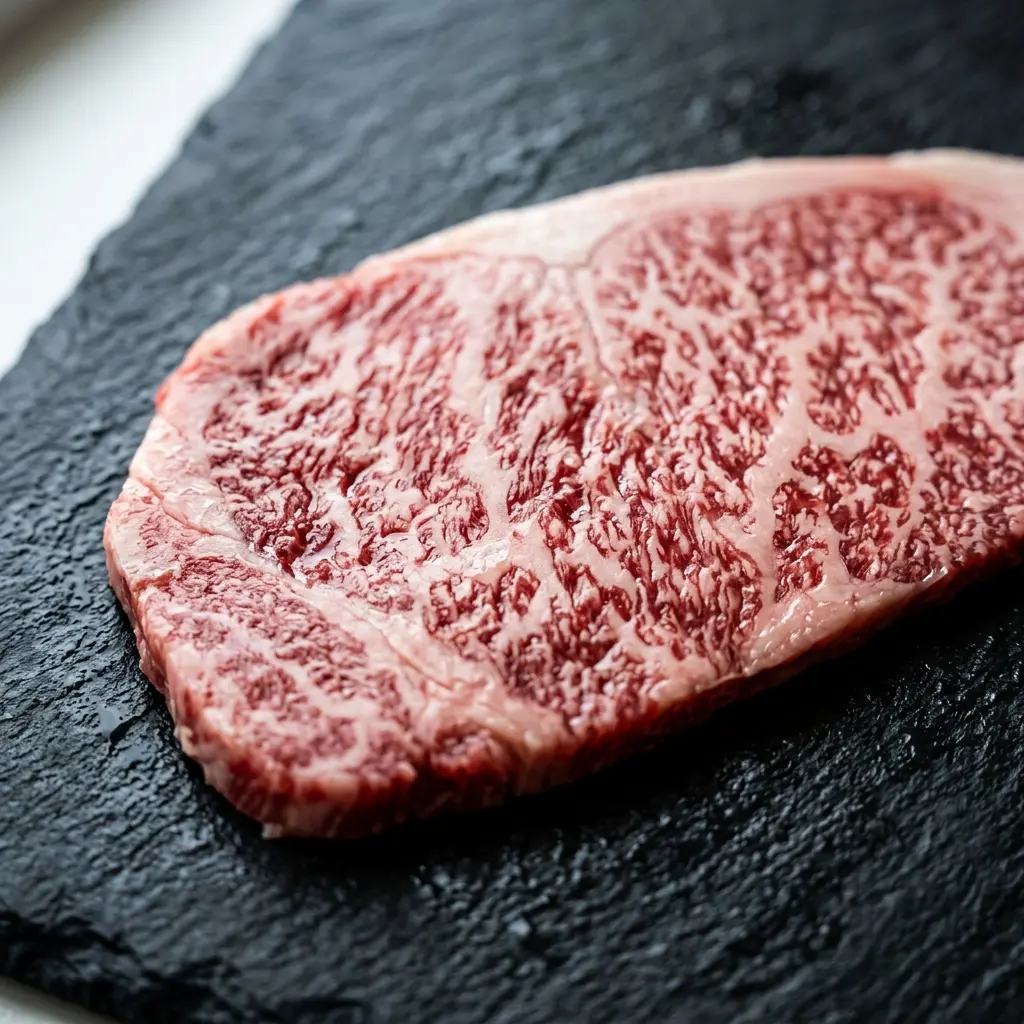
The extraordinary culinary sensation of eating top-tier Wagyu is not merely a matter of subjective taste; it is a fascinating phenomenon of molecular chemistry. The white, snow-like marbling that decorates a raw slice of A5 Wagyu is known in Japanese as Shimofuri (literally "frost descent").
Molecular Fat Melting Points (Shimofuri Chemistry)
Melting point is lower than human body temperature (37°C). micro-droplets of fat liquefy immediately upon touching the warm palate, releasing sweet peach/coconut lactone aromas.
Requires aggressive, high-heat grilling to render. Fat remains solid and waxy in the mouth, creating a much heavier, greasy chewing experience.
The Low Melting Point of Oleic Acid
From a scientific perspective, Shimofuri is highly specialized intramuscular adipose tissue. In standard Western beef, fat is deposited in thick, solid layers between the muscles (intermuscular fat) or as coarse, localized clumps. In Kuroge Washu, the fat is distributed as millions of microscopic, individual droplets suspended within the delicate muscle fibers. This unique distribution is driven by a high concentration of the enzyme stearoyl-CoA desaturase, which actively converts saturated stearic acid into monounsaturated oleic acid.
- Saturated Fat Profile: Found in high ratios in standard beef. Creates a waxy, firm fat texture with a high melting point (approx. 42°C).
- Monounsaturated Fat Profile: Dominates Kuroge Washu fat. Composed primarily of oleic acid, featuring a melting point (approx. 25°C) far below human body temperature.
The Sensory Aroma of Wagyu-ko
Monounsaturated fatty acids (MUFAs) have a remarkably low melting point. While the fat of standard beef melts at approximately 40°C to 45°C (well above human body temperature), the fat of high-grade Tajima Wagyu melts at an astonishing 25°C to 27°C. When a slice of marbled Wagyu touches the human tongue, the ambient heat of the mouth is enough to liquify the fat instantly, creating a rich, velvety broth that coats the palate. This molecular composition also yields a unique aromatic profile: when heated, the monounsaturated fats release volatile compounds known as lactones, which produce a sweet, delicate fragrance reminiscent of coconut and peaches—a sensory phenomenon known by Japanese chefs as Wagyu-ko (Wagyu aroma).
Dispelling the Cardiovascular Health Myth
On a molecular level, this alchemy also reveals that Wagyu fat is chemically distinct from industrial beef fat. Because it is rich in monounsaturated fats and oleic acids, Wagyu beef has a much higher ratio of heart-healthy HDL cholesterol precursor compounds compared to traditional red meats, dispelling the myth that highly marbled beef is inherently detrimental to cardiovascular health.
The Craft of Kodawari: Rearing as a Daily Meditation
The Philosophy of Stress Elimination
To translate this genetic potential into a flawless culinary product requires a lifetime of absolute, quiet dedication—an expression of the Japanese philosophy of Kodawari. Wagyu farmers do not manage industrial feedlots; they operate small, meticulous family farms, often caring for only 15 to 30 cows at any given time.
Breeder's Maxim: Stress is the ultimate enemy of marbling. Any spike in adrenaline triggers a rapid metabolic breakdown of the delicate intramuscular fat droplets, undoing years of silent care in a single afternoon.
The Daily Rearing Routine as a Slow Meditation
The daily routine of a Wagyu breeder is a slow, meditative practice. The animals are kept in clean, spacious, well-ventilated timber barns, open to the cool mountain breezes and filled with fresh cedar shavings. Stress is the ultimate enemy of fine marbling. When an animal undergoes stress, its body releases adrenaline, which instantly triggers the breakdown of delicate intramuscular glycogen and fat stores, ruining years of careful cultivation. To prevent this, breeders go to extraordinary lengths to ensure absolute tranquility. Stable environments are kept quiet, free from loud noises, sudden movements, or flashing lights.
- Cedar-Lined Cleanliness: Open timber barns swept daily and bedded with fresh, aromatic sugi (Japanese cedar) shavings to absorb moisture and maintain calmness.
- Auditory Serenity: Strict barn policies prohibiting raised voices, sudden horns, or high-decibel equipment that might startle the sensitive herd.
- Compassionate Grooming: Massaging the animals with stiff hemp brushes (*Tawashi*) to relieve winter muscle stiffness and promote blood flow.
Custom Artisan Nutrition and Vitamin Management
The feeding regimen is a highly customized art form. Rather than cheap commercial corn or soy pellets, Wagyu cattle are fed a carefully balanced diet of high-quality rice straw (Wara), whole barley, wheat bran, and alfalfa, accompanied by clean, mineral-rich mountain spring water. The rice straw is particularly critical: it contains high levels of vitamin A precursors, which must be carefully managed to allow the fat cells to develop slowly and evenly throughout the growth cycle.
Dispelling the Sensationalized Myths of Beer and Massage
The common Western myths of cows drinking premium beer and receiving daily full-body massages are largely sensationalized misunderstandings of practical artisan care. During the freezing winter months in mountainous prefectures, cows kept in tight indoor stalls can suffer from joint stiffness and poor circulation. To alleviate this, compassionate breeders use stiff hemp brushes to vigorously massage the cows' hides, stimulating blood flow and ensuring the animal remains relaxed and comfortable. This gentle touch is not a marketing gimmick; it is a physical manifestation of a deep-seated spiritual bond between the artisan and the beast.
The Sacred Cycle: Gratitude, Circular Ecology, and Modern SDGs
The Mottainai Closed-Loop System
At its heart, the traditional rearing of Wagyu represents a perfect, closed-loop ecological system that aligns seamlessly with modern principles of sustainability and the United Nations Sustainable Development Goals (SDGs). This circular agriculture is deeply rooted in the ancient Japanese concept of Mottainai—the profound regret over wasting resources that possess an inherent spiritual value.
The Circular Agricultural Loop: Terraced Rhythms
Terraced Rice Fields 千枚田
Cattle plow narrow mountain terraces where large tractors are useless. Their steps aerate heavy clay soil.
Autumn Rice Harvest 稲刈り
Grains are harvested for food. Empty stalks are dried on bamboo racks to produce pesticide-free winter straw.
Meticulous Stall Feeding 肥育
Cattle feed on high-quality dried rice straw (critical for vitamin balancing) and mineral-rich springs in clean barns.
Soil Regeneration 堆肥
Organic composted manure is returned to terraced fields to regenerate nutrients, avoiding synthetic chemicals.
Terraced Paddies and Barn Dynamics
In the traditional mountain villages of Japan, Wagyu rearing was never an isolated industry. It was beautifully integrated with wet-field rice cultivation. In the spring, the cattle plowed the terraced clay paddies, their organic manure providing a nutrient-rich, chemical-free fertilizer that nourished the growing rice crops. In the autumn, after the rice harvest was complete, the dried rice straw was collected from the fields and stored in farmhouse lofts to serve as the primary winter fodder for the cattle. This elegant exchange created a zero-waste agricultural loop: the fields nourished the cattle, and the cattle nourished the fields.
- Draft Tillage: Cattle aerating heavy clay terraced soil, creating optimal rice root environments where machinery cannot operate.
- Wara Nutrition: Collecting dried autumn rice straw as organic winter forage, completely eliminating imported straw feed shipping emissions.
- Regenerative Composting: Returning nitrogen-rich, composted organic cattle manure back to the mud terraces to fertilize the spring rice plantings.
Reviving Ancestral Soil Regeneration in Modern Times
Today, elite Wagyu breeders are actively reviving this ancestral circular ecology to combat the challenges of climate change and soaring feed costs. By partnering with local organic rice farmers, breeders secure high-quality, pesticide-free straw, while returning premium composted manure to regenerate depleted soil. This sacred cycle preserves the fertility of the land without relying on synthetic chemicals or imported fertilizers, demonstrating that the ancient wisdom of wabi-sabi and agricultural respect is not an obsolete relic of the past, but an essential blueprint for a sustainable, harmonious future.
Philosophical Insight: Traditional Wagyu farming teaches us that premium culinary craftsmanship does not require the exploitation of nature, but a quiet, reciprocal dialogue where waste is treated as a sacred resource.
When we sit down to experience a dish of authentic Japanese Wagyu, we are not merely consuming a luxurious meal. We are participating in a living historical continuum. We are tasting the steep volcanic mountains of Hyogo, the quiet millennium of imperial spiritual protection, the absolute genetic preservation of the Tajima registry, and the quiet, daily meditation of master breeders who treat their animals not as commodities, but as sacred guardians of a beautiful, ancient land.