Historical Background
During the Edo period, Tokushima Prefecture became the absolute center of Japan's indigo industry under the patronage of the Hachisuka clan. The leaves of the indigo plant were harvested along the Yoshino River basin and composted into precious 'Sukumo' dye compost. While synthetic chemical indigo devastated natural growers in the late 19th century, Tokushima's master artisans preserved the organic, living fermentation process.
The Living Blue: The Spirit of Aizome
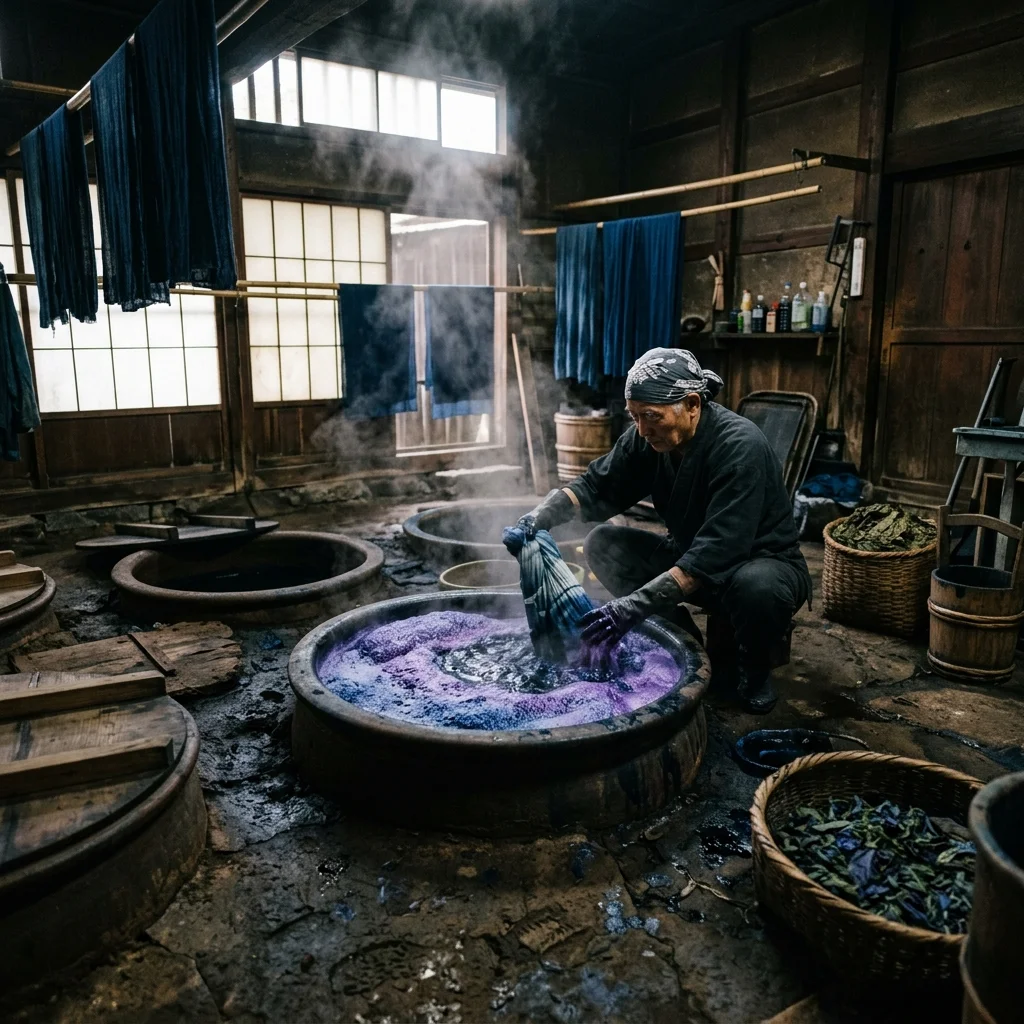
To step inside a traditional Aizome (藍染め) workshop in Tokushima Prefecture is to encounter a smell that feels ancient and biological. It is a dense, earthy, sweet-and-sour scent of organic fermentation, yeast, and wood ash. Before you lie a series of large ceramic vats buried deep into the dirt floor to maintain stable subterranean temperatures. Inside these vats bubbles a thick, dark green-blue liquid topped with a delicate, violet-colored foam called the Ai-no-hana (藍の華 — Indigo Flower).
This is not a modern industrial dye bath. It is a living, breathing home to billions of active anaerobic bacteria.
Natural Japanese indigo dyeing, specifically Awa Sho-Aizome (阿波正藍染め), is one of the most chemically sophisticated and physically demanding organic crafts in the world. Unlike modern synthetic dyes that rely on harsh petrochemicals, synthetic reduction agents, and coal-tar fixatives, authentic Aizome uses only natural ingredients: fermented indigo leaves, wood ash lye, sake, wheat bran, and lime. The resulting color—often called \"Japan Blue\"—is a deep, radiant cobalt that does not run, protects fabric from mold and rot, acts as a natural insect repellent, and actually strengthens the underlying cotton or silk fibers.
The geographical crucible of this art is the Yoshino River basin in Tokushima. The Yoshino River, historically known as a wild and unpredictable waterway, flooded annually during the summer typhoons. While this flooding ruined standard agricultural crops like rice, it deposited thick layers of nitrogen-rich volcanic silt across the valley floor.
Tokushima's ancient farmers realized that the indigo plant (*Persicaria tinctoria*), which is harvested in early summer before the peak typhoon season, was perfectly suited to this flooding cycle. The nitrogen-rich soil generated high concentrations of indigo precursors within the leaf cells. Indigo became the economic lifeblood of the region, and the workshops where the fermentation vats are kept—referred to as *Aya-ya*—became sacred architectural spaces, designed with thick mud walls to insulate the delicate, living bacterial vats from extreme seasonal temperature shifts.
The Chemistry of the Vat: Indican, Leuco-Indigo, and Oxidation
The chemistry of natural indigo is a fascinating journey of molecular conversion. The primary plant used in Japan is Awa-ai (*Persicaria tinctoria*, historically *Polygonum tinctorium*), a leafy annual herb.
The leaves of the indigo plant do not actually contain blue pigment. Instead, they contain indican, a colorless, water-soluble precursor molecule consisting of a glucose sugar bound to an indoxyl group.
Converting this colorless leaf compound into an indestructible blue textile dye requires three complex biochemical stages:
Stage 1: The Composting (Sukumo Production)
To stabilize the indican for storage and transport, the harvested indigo leaves must be converted into Sukumo (蒅).
Over a 100-day process beginning in autumn, specialized indigo farmers called Ai-shi (藍師) pile the dried leaves in a thick brick-walled storehouse. They water the pile weekly and turn it with wooden pitchforks.
Under the heat generated by natural microbial fermentation (reaching temperatures of 60°C to 70°C / 140°F to 158°F), the indican is enzymatically hydrolyzed by the plant’s natural enzymes into indoxyl and glucose.
The indoxyl molecules spontaneously oxidize in the warm compost pile, dimerizing to form indigotin—the dark blue, insoluble pigment. The composted, concentrated leaves are then packed into dried clay blocks called Sukumo.
The composting process is divided into rigid, time-honored phases: - Shikikomi (Bedding): The dried indigo leaves are piled up to a height of 1 meter on the clay storehouse floor, creating a dense, biological incubator. - Mizu-uchi (Watering): The Ai-shi sprinkles spring water over the pile, activating thermophilic bacteria that initiate the breakdown of the plant tissues. - Kiri-kaeshi (Turning): Every five to seven days, the massive steaming pile must be turned by hand using wooden pitchforks to introduce oxygen, preventing anaerobic pockets that would rot the leaves. The heat generated is so intense that the fermentation shed remains warm throughout the freezing winter months.
Stage 2: The Vat Reduction (Making the Indigo Soluble)
Indigotin is completely insoluble in water. You cannot dye fabric with it directly because the blue particles simply float on the surface and will wash off immediately. To bond the dye to the fibers, the indigotin must undergo a chemical process called reduction.
The dyer places the Sukumo inside a ceramic vat and adds wood ash lye (*Aku*) made by boiling hardwood charcoal ash in pure spring water. The alkaline lye (maintaining a high pH of 11 to 12) extracts the pigment.
To reduce the indigo, the dyer adds organic food sources: wheat bran (*Fusuma*), sake, and lime (*Ishibai*). This environment attracts anaerobic, alkali-tolerant bacteria (specifically *indigo-reducing bacilli* belonging to the *Clostridium* genus, such as *Clostridium indolis*).
These bacteria consume the sugars in the wheat bran and sake, producing electrons as metabolic waste. These electrons reduce the insoluble blue indigotin into a soluble, yellowish-green compound called leuco-indigo (or indigo-white).
The dyer must meticulously monitor this reduction. The yeast and bacteria require constant temperature regulation (maintained between 20°C and 25°C). If the vat drops below 15°C, the bacteria enter dormancy, halting the reduction process. Wood ash lye must be added in precise quantities; too little lye causes the pH to drop, which allows harmful acidic molds to breed and spoil the vat, while too much lye creates a sterile, hyper-alkaline medium that kills the beneficial *Clostridium* strains.
Stage 3: The Air Oxidation (The Birth of the Blue)
Once the vat is active and fully reduced, the dyer dips the fabric into the alkaline yellowish-green liquid. The soluble leuco-indigo penetrates deep into the core of the cotton or silk fibers.
When the fabric is pulled out of the vat and exposed to the air, an instant, magical transition occurs:
The oxygen in the air reacts with the leuco-indigo within the fibers. The molecules lose electrons and rapidly oxidize, turning from yellowish-green to deep, radiant blue.
As they oxidize, the molecules dimerize back into the water-insoluble indigotin polymer, becoming physically trapped and locked deep inside the fiber structure. The pigment is not merely coated on the surface; it is molecularly bonded to the cotton cells, creating a permanent, fade-resistant color.
The Four Stages of Indigo Molecular Transformation
Soluble Leaf Indican 生葉のインディカン
The raw green Persicaria tinctoria leaves synthesize indican, a colorless water-soluble precursor glucoside compound.
Insoluble Sukumo Indigotin 不溶性の蒅インジゴ
Fermentation hydrolyzes indican to indoxyl, which dimerizes into the water-insoluble dark-blue pigment indigotin.
Reduced Leuco-Indigo 還元のインディゴ白
Alkali-tolerant bacilli consume wheat bran sugars inside wood ash lye, reducing indigotin to yellowish-green soluble leuco-indigo.
Oxidized Fiber-Locked Blue 酸化定着の日本藍
Exposing fabric to air triggers instant oxidation, converting leuco-indigo back to solid indigotin crystals locked deep within cotton cell walls.
At a molecular level, the reduced leuco-indigo carries a negative electrical charge, which allows it to form loose hydrogen bonds with the hydroxyl groups of the cotton cellulose fibers. When exposed to atmospheric oxygen, the leuco-indigo is oxidized, losing hydrogen atoms and converting back into the neutral, highly stable indigotin crystal matrix. These crystals undergo a process called physical mechanical locking: they expand in size as they solidify, trapping themselves within the microscopic porous cavities of the cotton fibers. Because the indigotin is physically locked inside the fiber walls rather than chemically glued to the surface, natural Aizome textiles exhibit exceptional colorfastness against washing and mechanical friction, retaining their deep blue hue for centuries.
Artisan Experience: Cold Stings and the Scent of the Vat
To dye a single skein of cotton thread in Tokushima is a deeply visceral, sensory experience. \"The vat is a living child,\" explains a fifth-generation master dyer. \"You cannot force it. If you dye too many pieces in one day, the bacteria become exhausted, the oxygen levels rise, and the vat turns flat and inactive. We must feed it daily with sake and bran, keeping it warm in the winter dirt, and checking its pulse by tasting the alkaline froth on our tongues.\"
During winter, the dyer works in a cold workshop, plunging bare arms into the chilled indigo liquid. The alkaline lye stings the skin slightly, and the blue pigment stains the fingernails permanently—a proud mark of the *Aizome* craftsman known as \"indigo hands.\"
As the wet, green fabric is pulled from the bubbling vat, it is wrung out and vigorously shaken in the outdoor breeze. Under the winter sky, you watch the fabric transform in real-time. Within 30 seconds, the pale, murky green shifts into a lime green, then a deep teal, and finally settles into a clean, breathtaking sapphire blue.
This process is repeated ten, twenty, or even forty times to achieve the darkest, highly prized navy shade known as Nou-kon (濃紺) or Kachi-iro (勝利色 — Victory Color), historically worn by samurai under their armor to prevent infection in battle wounds.
The dyer's relationship with the fermentation vat is governed by silent sensory observation. A master dyer never relies on digital pH meters or laboratory assays to measure the health of the vat. Instead, they check the size and color of the *Ai-no-hana* bubbles; a healthy, fully reduced vat produces dense, highly iridescent violet bubbles that float tightly together, whereas an oxidized vat produces loose, dark blue bubbles that disperse quickly. The dyer will dip a finger into the vat and taste the liquid: a properly active alkaline vat has a sharp, metallic, slightly sweet taste, while an inactive, acidic vat tastes flat and sour, indicating that the reducing bacilli are starving and require an immediate infusion of high-quality sake or wheat bran paste.
Once the dyeing process is complete, the fabric undergoes a final, essential step known as Kawa-tsuke (川付け) or river rinsing. The dyed threads or fabrics are carried to Tokushima’s clean mountain streams, where they are washed under running water to remove unbonded superficial pigments, excess lye, and residual wheat bran. This process reveals the true, multi-dimensional shades of Japanese blue, historically graded into a highly detailed spectrum: 1. Kamenozoki (かめのぞき): The palest, icy blue, mimicking a quick glance into a deep indigo jar. 2. Asagi (浅葱): A light, greenish-cobalt reminiscent of fresh spring scallion leaves. 3. Hanada (縹): A bright, classic sky-blue worn by ordinary merchants in the Edo period. 4. Ai (藍): The standard, vibrant pure indigo blue representing the soul of the plant. 5. Kon (紺): A deep, elegant dark navy with high visual weight. 6. Nou-kon (濃紺): The absolute deepest shade, requiring up to 40 consecutive dips to black-blue saturation.
Historical Case Study: Resilience Against German Synthetic Coal-Tar
The outstanding quality and cultural value of Tokushima's natural Aizome is underscored by its historical battle for survival. In 1897, the German chemical conglomerate BASF successfully commercialized synthetic indigo (made from coal-tar derivatives and aniline). This synthetic dye was incredibly cheap, highly concentrated, and required no complex, months-long organic fermentation vats.
Within a single decade, synthetic indigo flooded the global market. In Japan, the cultivated fields of Awa-ai in Tokushima, which once spanned over 15,000 hectares, were decimated. By the mid-20th century, only a handful of master growers and dyers remained in Tokushima, preserving the traditional compost sheds and fermentation vats.
However, the late Showa period brought a profound cultural realization. Synthetic indigo dyes only duplicate the single chemical molecule of indigotin.
In contrast, natural *Sukumo* indigo compost contains a rich bouquet of organic compounds, including trace red pigments (indirubin), plant minerals, and natural waxes. These impurities give natural Aizome a highly unique visual depth—a \"living color\" that reflects light with multi-dimensional warmth, rather than the flat, cold reflection of synthetic denim.
Recognizing this irreplaceable beauty, the Japanese government designated Awa indigo composting and dyeing as an Important Intangible Cultural Property (重要無形文化財), rescuing the Tokushima masters from economic extinction and securing their place as world-class guardians of organic chemical heritage.
The economic protection provided by the Intangible Cultural Property designation is coupled with the strict preservation of the *Ai-shi* tilling guilds. Today, the cultivation of *Awa-ai* along the Yoshino River basin is conducted by a small number of certified families who compost the leaves using ancient, water-powered stamp mills and hand-turned fermentation storehouses (*Aikoya*). This ensures that the raw *Sukumo* retains its multi-layered mineral profile, rich in volcanic trace elements that synthetic indigo can never replicate. When high-grade Aizome fabric ages, the minor red pigments (indirubin) oxidize at a slower rate than the blue indigotin, causing the textile to develop a warmer, slightly violet-tinged hue over decades of wear—a phenomenon known as *Aisodachi* (the growth of indigo) that is highly prized by international collectors.