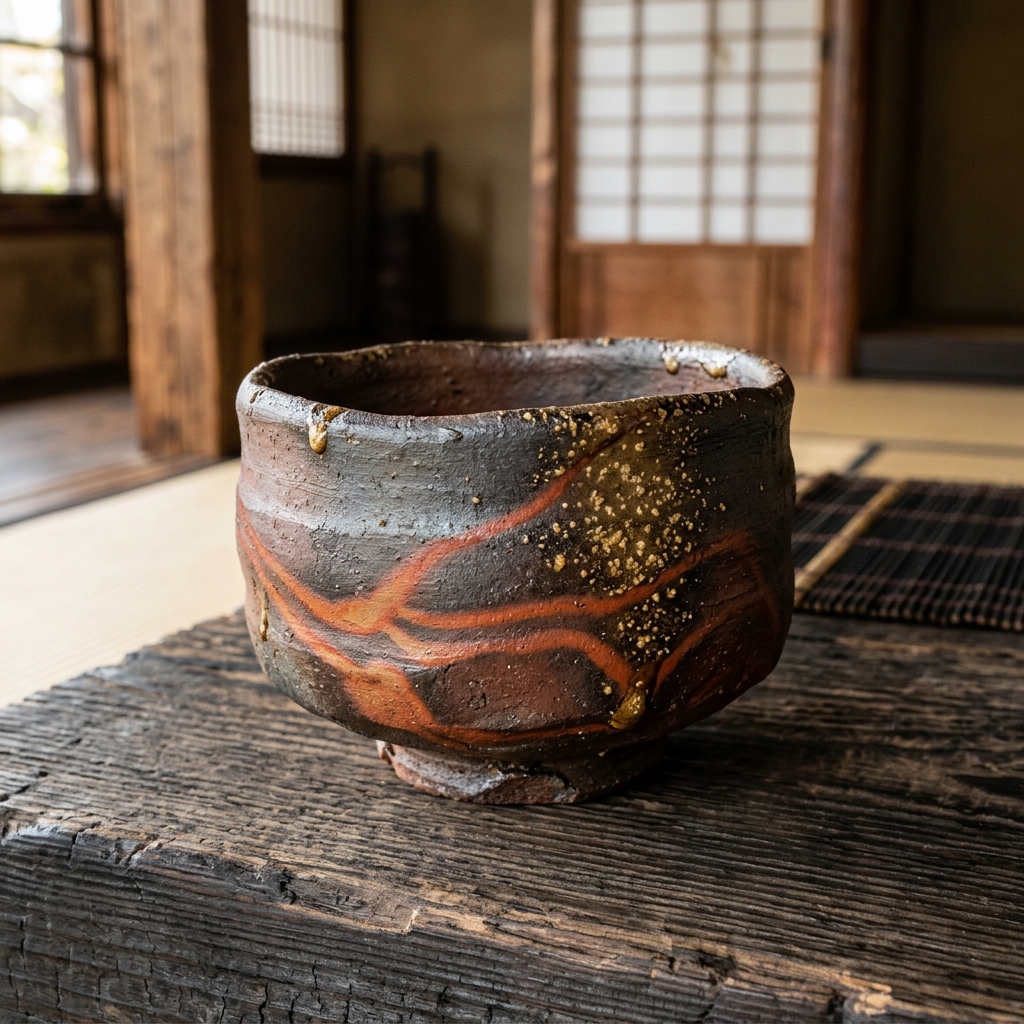
Historical Background
Bizen-yaki is one of Japan's Six Ancient Kilns (Rokkoyo), boasting a continuous thousand-year lineage that evolved from Kofun-era Sueki stoneware. Settled in the clay-rich mountains of Imbe, Okayama, local potters abandoned applied glazes during the Kamakura period, relying entirely on extreme wood-firing heat to vitrify the iron-heavy hiyose clay.
The Primordial Sintering of Imbe
In the quiet valley of Imbe, nestled within the southern hills of Okayama Prefecture, the earth carries a heavy, cold secret. For over ten centuries, this ground has yielded a dense, highly plastic mud known as *hiyose* (ひよせ). Gathered from the depths of dormant paddy fields where organic sediments have settled and compacted over ice ages, *hiyose* is an iron-rich, viscous clay. It is highly prized by artisans yet notoriously temperamental to fire. Unlike highly refined porcelain clays that withstand rapid thermal shifts, Imbe’s raw clay contains substantial mineral impurities, high organic content, and a volatile iron ratio. Fired too quickly, it shatters in a violent expansion of trapped moisture and quartz phase changes. Fired too slowly under improper draft, it collapses into a glassy, deformed slag.
Yet, when subjected to the slow, relentless crucible of a wood-fired climbing kiln (*Noborigama*), this humble mountain mud undergoes a profound molecular transfiguration. Bizen-yaki (備前焼) stands as the ultimate testament to *Yakishime* (焼き締め)—the art of high-temperature sintering without applied glazes. Every speck of color, every tactile ridge, and every glassy rivulet running down a Bizen vessel is the direct record of a chemical dialogue between earth, wood ash, and flame. It is a slow, thermodynamic choreography where the kiln itself acts as a gargantuan chemical reactor, fusing raw nature into stone.
---
The Geography of Fire: Firing Zones & Kiln Effects
A traditional climbing kiln is not a uniform box of heat. It is a multi-chambered, sloped structure built directly into the mountain incline, utilizing draft thermodynamics to draw heat upward from the lowest firebox (*dōgi*) through successive rising chambers. As the flames sweep upward, fueled exclusively by split logs of resin-rich Japanese red pine (*Akamatsu*), they carry millions of microscopic particles of wood ash. The path of these ash clouds, the local temperature gradients, and the local oxygen ratios create highly distinct environments within the kiln. Potters refer to these variations as "kiln effects" (*yōhen*), mapping the physical interior of the kiln onto the surface geography of the clay.
Firing Zones & Kiln Effects (Yakishime Topography)
Located near the firebox. Direct contact with flying pine wood ash creates a natural silicate glass glaze that speckled-cools like sesame seeds.
Placed in protective fireclay saggars or shielded from ash. Wrapped in mineral-rich rice straw to create scarlet flame-colored lines.
Buried under charcoal embers at the floor level. The carbon-heavy, oxygen-deprived environment reduces iron oxides into deep grey, blue, and black metallic coats.
The distribution of these effects is a direct function of kiln topography. Near the firebox, where temperatures rage at their highest and the air is thick with raw combustion byproducts, ash accumulation is heavy and continuous. Here, the clay is subjected to an intense, direct shower of molten pine ash. Moving deeper into the upper chambers, the temperature registers slightly lower, and the atmosphere becomes more stable. Potters strategically place pieces in these chambers inside saggars (*Saya*) or shield them behind larger vessels to control ash deposition, opening the stage for the delicate chemistry of *Hidasuki*. Near the floor of the chambers, where air currents draft slowly and oxygen is severely restricted, the carbon-rich charcoal bed creates a highly reducing environment, producing the dark, metallic colors of *Sangiri*.
---
The Molecular Chemistry of Hidasuki Scarlet Bands
To the untrained eye, the vibrant, crimson-red cords that wrap around the pale, toasted surface of a Bizen vase look like abstract brushstrokes painted by a master. In reality, no brush has ever touched the piece. This effect, known as *Hidasuki* (緋襷 - scarlet sash), is the product of a delicate solid-state chemical reaction between rice straw potassium and clay iron.
The origins of *Hidasuki* were entirely utilitarian. In ancient times, to maximize the limited space inside the communal kilns, potters stacked plates and bowls directly on top of each other. To prevent the clay bodies from fusing together at high temperatures, they wrapped the vessels in cheap, abundant rice straw (*wara*). When the kiln was opened, they discovered that where the straw had touched the clay, brilliant, fiery red lines had crystallized on the pale stoneware body, while the rest of the surface remained a soft, unvitrified white.
The chemistry behind this reaction is exceptionally precise. Rice straw is a unique biological accumulator, absorbing large amounts of silicon ($Si$) and alkali metals—specifically potassium ($K$)—from the soil during its growth. When the kiln temperature climbs to between 1100°C and 1180°C, the potassium in the rice straw acts as a highly localized fluxing agent. Upon physical contact with the *hiyose* clay, the potassium reacts with the kaolinite and silica minerals in the clay body. This localized reaction severely depresses the melting point of the clay surface, creating a microscopic liquid phase—a glassy silicate melt—only about 50 micrometers deep.
The Solid-State Chemistry of Hidasuki Scarlet Bands
Straw potassium acts as a powerful fluxing agent. When pressed against iron-rich *hiyose* clay, it locally lowers the clay's melting point, generating a micro-glassy liquid silicate layer (50 μm thick).
Within the glassy liquid, aluminum particles precipitate into corundum (α-Al₂O₃). This acts as a crystalline substrate, driving the growth of fine hematite (α-Fe₂O₃) micro-crystals that refract brilliant flame-scarlet light waves.
Within this localized liquid boundary layer, the abundant iron oxides ($\text{Fe}_2\text{O}_3$) in the Bizen clay dissolve and mobilize. As the firing reaches its plateau and the kiln enters its long, slow cooling phase, this molten liquid begins to solidify. Because the cooling rate is controlled and gradual, the dissolved iron does not freeze into an amorphous black glass. Instead, microscopic crystals of corundum ($\alpha\text{-Al}_2\text{O}_3$) precipitate out of the liquid phase first. These corundum micro-crystals serve as a perfect structural lattice for the epitaxial growth of hematite ($\alpha\text{-Fe}_2\text{O}_3$).
The hematite precipitates as ultra-fine hexagonal plate-like micro-crystals. Due to their specific nanoscale sizing and orientation, these hematite crystals act as natural light refractors, scattering high-frequency light waves to produce the brilliant, saturated flame-scarlet hue that defines classic *Hidasuki*. If the cooling process is rushed, or if the kiln is opened too quickly, the liquid phase freezes abruptly into a dull, brownish-grey amorphous matrix, destroying the scarlet luminescence. Potters must therefore manage the thermal decline of the kiln with absolute precision.
---
The Thermodynamics of the Climbing Kiln Firing Cycle
Firing a Bizen climbing kiln is an act of prolonged endurance, requiring a team of artisans to work in grueling shifts for ten to fourteen consecutive days. Unlike modern gas or electric kilns that can be programmed with the press of a button, a wood-fired kiln is a living, breathing entity. The draft must be balanced against atmospheric humidity, wind direction, and the specific moisture content of the wood fuel. The temperature must be raised along a strict thermodynamic curve to prevent the volatile clay from exploding.
Thermal Rhythm: The 14-Day Wood-Firing Sequence
Aburi (Preheating) 炙り
Days 1–3: Slow warming (20°C to 400°C) with dry pine sticks to carefully drive out chemically bound water, preventing thermal steam explosions.
Seme (Aggressive Firing) 攻め
Days 4–9: Feeding resin-rich pine logs round-the-clock. Temperatures reach 1250°C. Dynamic draft carries ash clouds that deposit on surfaces.
Jorei (Controlled Cooling) 徐冷
Days 10–14: Fireboxes are sealed. Kiln cools extremely slowly (<10°C/hr). This controlled thermal drop is critical for hematite crystal growth.
##### The Aburi Phase (炙り - Preheating)
The first phase, *Aburi*, is a test of supreme patience. For the first three days, the kiln is kept at a low, smoldering heat. Small dry pine sticks are fed slowly into the firebox, keeping the temperature between 100°C and 400°C. The objective here is physical and chemical dehydration. *Hiyose* clay is highly dense and holds a significant volume of interstitial water. If the temperature is raised too rapidly, this water will turn to steam inside the clay walls, expanding violently and shattering the pots into fragments. At around 573°C, the silica minerals in the clay also undergo quartz inversion—a sharp structural transition from $\alpha$-quartz to $\beta$-quartz that causes a sudden physical volume expansion of about 1.4%. The preheating phase ensures that the clay body is fully dried, sintered, and chemically stabilized before encountering this volatile threshold.
##### The Seme Phase (攻め - High-Heat Stoking)
By day four, the kiln has fully dried and heated through. The stoking shifts transition to the *Seme* phase. Potters now feed large, resin-rich logs of Japanese red pine (*Akamatsu*) into the primary firebox and secondary side-stoke holes (*stoke ports*) at a furious rate. Red pine is the essential fuel of Bizen. Its high resin content burns with an exceptionally long, luminous flame that reaches deep into the rising chambers, carrying heat and volatile ash particles along the draft.
During *Seme*, the chambers transform into a turbulent sea of fire. Temperatures rage between 1200°C and 1250°C. The atmosphere inside the kiln oscillates between oxidizing (oxygen-rich) and reducing (oxygen-starved) as new logs are thrown in and consumed. In this high-heat zone, the flying wood ash melts upon hitting the hot clay, reacting with the silica to form the natural vitrified glass of *Goma*. The molten ash flows in heavy drops (*Tamadare*) or adheres in dry, semi-fused crusts (*Kasegoma*), recording the velocity and direction of the fire drafts.
##### The Jorei Phase (徐冷 - Controlled Cooling)
Once the peak temperature has been held for the desired saturation period, the stoking ceases. But the work is far from finished. The *Jorei* phase is the final, critical step. The stoke holes and draft flues are sealed completely with fireclay mud to trap the heat and slow the cooling rate. The temperature must fall at a controlled, linear rate of less than 10°C per hour.
This slow cooling is not merely to prevent thermal shock cracking. It is the vital window in which mineral crystallization occurs. It allows the iron oxides to organize into the reflective hematite crystal lattices of *Hidasuki*, and permits the natural pine ash glaze to clarify into rich, glossy golden-yellow sesame tones. If the kiln cools too fast, the surface colors appear flat and lifeless; if too slow, the glaze devitrifies into a dull, opaque white. The slow thermal descent is the final touch of the kiln, locking the elemental changes into permanent vitreous form.
---
Case Study: The Mizukame Preservation Mechanism
For centuries, across Japanese households, sake breweries, and shipping vessels, Bizen-yaki was prized not just for its rustic beauty, but for its extraordinary functional properties. Specifically, Bizen water jars, known as *Mizukame* (水甕), were widely reputed to keep water remarkably fresh, cold, and sweet for months on end. A popular Edo-period merchant proverb claimed: *“Water does not spoil in a Bizen jar; sake becomes sweet in a Bizen cup.”*
While historic merchants attributed this phenomenon to Shinto spirits or mystical earth energies, modern materials science has revealed a fascinating trifecta of physical chemistry that validates these ancient claims:
- Evaporative Micro-Porosity & Aeration:
- Because Bizen-yaki is fired unglazed, its surface possesses a microscopic, interconnected network of pores. The sintering process at 1200°C is highly controlled, ensuring the clay densifies enough to hold water perfectly without leaking, yet retains a minor pore volume of approximately 8% to 12%. This micro-porosity allows the vessel to "breathe." A microscopic amount of moisture constantly migrates through the clay walls to the outer surface, where it evaporates. This evaporation absorbs latent heat from the vessel, keeping the stored water slightly cooler than the surrounding ambient room temperature—a natural thermodynamic cooling loop.
- Far-Infrared Radiation (FIR) Emission:
- The high iron oxide ($\text{Fe}_2\text{O}_3$ and $\text{Fe}_3\text{O}_4$) content of the sintered *hiyose* clay acts as a natural emitter of far-infrared radiation. Scientific measurements show that Bizen stoneware has an exceptionally high FIR emissivity rate (over 90% at room temperature). This continuous emission of far-infrared waves interacts with the hydrogen bonds of the water molecules stored inside. The radiation breaks up large, static water clusters into smaller, highly active, structured molecular rings. This molecular restructuring increases the solubility of the water, making it feel remarkably soft, smooth, and sweet on the human palate.
- Bacterial Inhibition via Metal Ions:
- The slow leaching of trace iron, copper, and manganese ions from the unglazed clay matrix creates a gentle oligodynamic effect. These positive metal ions interact with the cell membranes of aquatic micro-organisms and bacteria, disrupting their metabolic pathways and preventing cellular reproduction. This subtle, natural ionization loop keeps the water chemically pure and biologically stable, preventing algae growth and stagnation over extended periods.
---
Historical Case Study: Kaneshige Toyo and the Momoyama Renaissance
By the late 19th and early 20th centuries, Bizen-yaki was facing a slow, painful demise. The rise of industrialization had pushed local potteries to prioritize high-volume efficiency. To achieve consistent yields with minimal losses, potters constructed giant, communal climbing kilns fueled by coal or oil, and began applying synthetic iron glazes to mimic the natural wood-ash variations. The result was a tragic loss of soul: Bizen ware had become a uniform, lifeless, mass-produced industrial product.
This decline was halted by a singular, visionary artisan: Toyo Kaneshige (金重陶陽, 1896–1967).
Kaneshige recognized that in pursuing modern efficiency, the art of Bizen had lost its essential connection to the elements. He embarked on a meticulous, decades-long journey of historical and technical reconstruction, which pottery historians now refer to as the Momoyama Renaissance:
- Archival Ceramic Research: Kaneshige gathered fragments of ancient Bizen wares from the golden Momoyama period (1573–1615)—the era of Sen no Rikyu and the birth of wabi-sabi tea ceremony. He analyzed the clay composition, ash structures, and firing variations under microscopic scrutiny.
- Kiln Structural Reconstruction: He realized that the giant, efficient Edo-period communal kilns generated too much uniform heat and draft, which prevented natural ash accumulation and localized reduction. In 1933, Kaneshige bypassed the local guilds and constructed a small, low-ceilinged, authentic tunnel kiln (*Anagama*) based on Momoyama-era designs. This kiln structure forced the flame to wrap directly around the pottery, restoring the highly dramatic, chaotic variations of natural wood ash.
- The Return to Raw Hiyose: He abandoned refined, commercially blended clays and returned to the slow, labor-intensive extraction of raw *hiyose* clay from deep paddy fields, aging it for years to allow microbial fermentation to increase its plasticity and mineral depth.
Kaneshige’s tireless efforts proved that the finest Bizen-yaki was not a product of modern control, but of a willing submission to the wild, unpredictable chemistry of natural kilns. In 1956, Toyo Kaneshige was designated Japan’s first Living National Treasure (人間国宝) for Bizen-yaki, cementing the renaissance of unglazed stoneware and establishing the creative philosophy that guides contemporary Bizen artisans to this day.
---
Immersive Artisan Experience: A Night of Pine and Fire
To truly understand Bizen-yaki is to stand before the mouth of a roaring climbing kiln at three o'clock in the morning, feeling the visceral pressure of raw thermodynamics against your skin.
In late autumn, I was permitted to join the firing crew at a historic multi-chamber kiln in the hills of Imbe. The kiln had been stoking continuously for nine days. The physical exhaustion of the crew was palpable; their faces were smudged with soot and sweat, their eyes bloodshot from monitoring the small peep-holes where the inner atmosphere is read.
Inside the kiln, the temperature had reached its peak plateau of 1230°C. Peering through the small, circular quartz glass peep-hole, the interior did not look like a chamber containing solid clay objects. It was a radiant, blinding white-orange void. The pots had become translucent, glowing with the exact same luminance as the fire itself. They seemed to float in a sea of molten light.
Every forty-five seconds, the lead stoker called out: *“Kama open!”*
Two crew members pulled back the heavy fireclay door slab. A blast of pure, radiant heat rushed out, singing the hair on our forearms and smelling intensely of vaporized pine resin and hot iron. With rapid, synchronized movements, two other stokers threw three-foot logs of split red pine directly into the white-hot mouth.
The reaction was instantaneous. The wood caught fire with an explosive, roaring whoosh. The draft of the climbing kiln immediately pulled the flames upward through the rising chambers, carrying a dense cloud of golden, sparkling pine ash that danced across the glowing shoulders of the pots. The chamber shifted from a clear, blinding white to a turbulent, reducing orange-yellow as the raw wood consumed the oxygen inside.
*“Kama close!”*
The door slab was slammed shut, and the roar subsided into a deep, rhythmic hum. This stoking cycle was repeated every single minute, hour after hour, keeping the thermal energy perfectly saturated to allow the molten ash glass to flow down the clay surfaces in natural, vitrified teardrops.
At dawn, as the final stoking ceased and the air dampers were sealed with wet clay mud to begin the slow, week-long cooling descent, a profound silence fell over the mountain valley. The fire was trapped inside, slowly dying, slowly cooling, letting the hidden molecular currents of potassium and iron crystallize into the quiet, crimson-streaked, ash-dusted masterpieces that would emerge from the darkness ten days later. It was a reminder that Bizen-yaki is not merely shaped by human hands; it is forged by the supreme patience of earth and the untamed spirit of fire.