Sudare and Shoji: The Geometry and Material Physics of Traditional Light Filtration
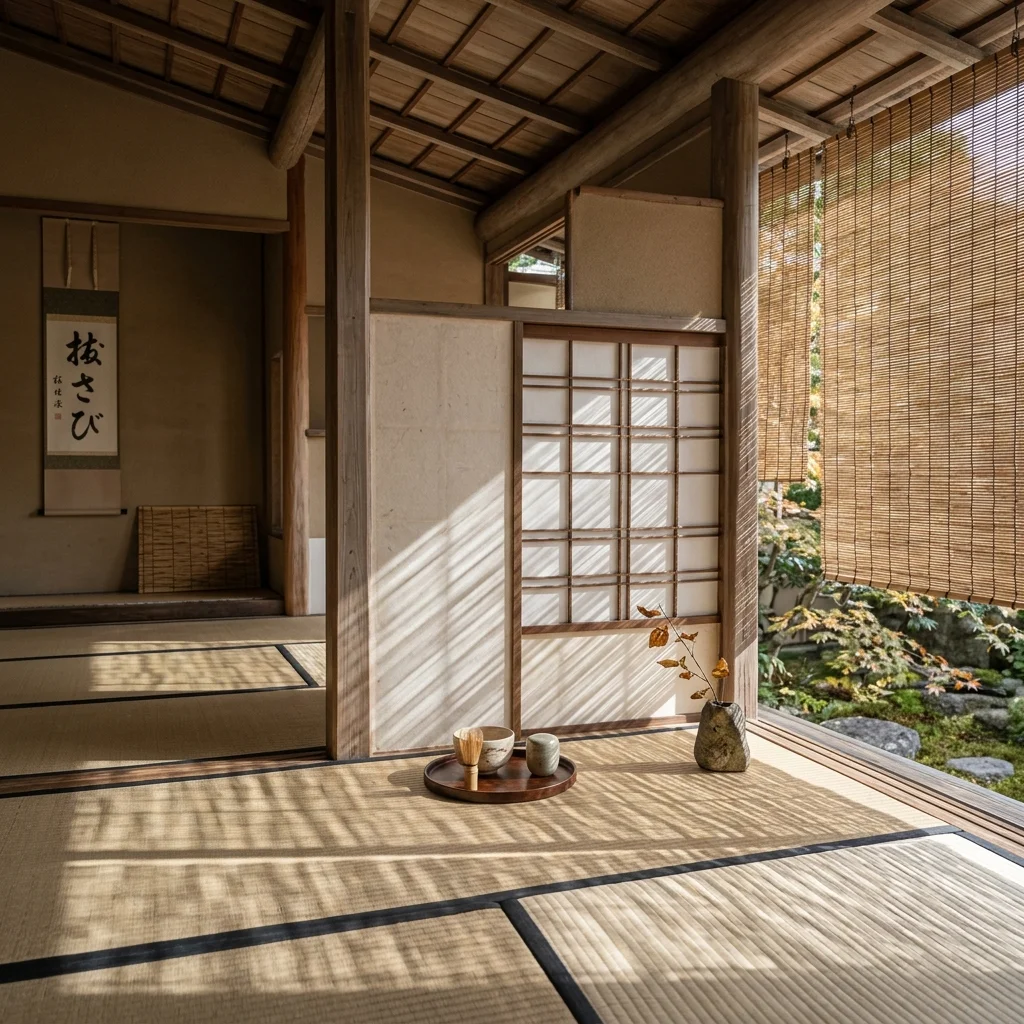
Traditional Sudare and Shoji screens orchestrate a beautiful dance of light and shadow, transforming direct sun rays into a serene, ambient glow.
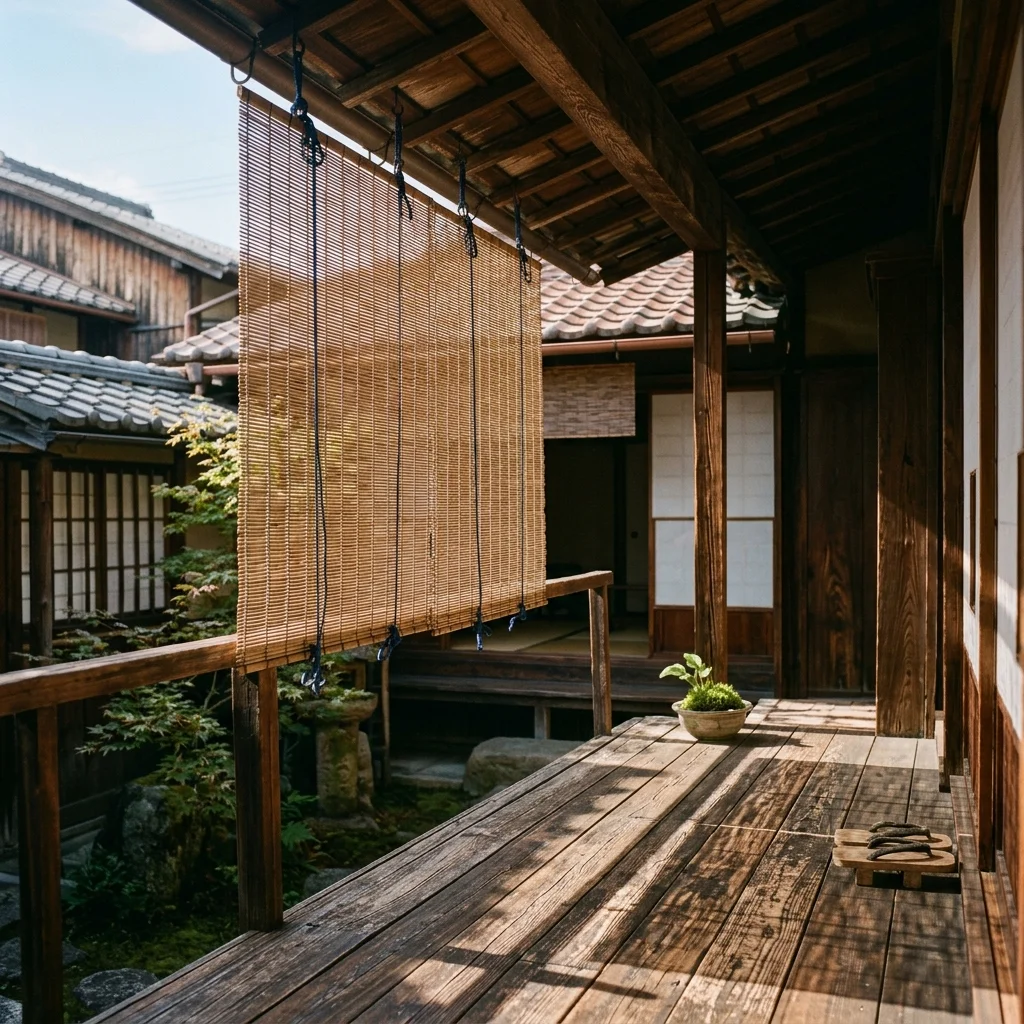
Kyoto Townhouse Summer Sudare: Thermal Engineering of Split Bamboo
This high-resolution image captures a finely woven natural bamboo screen (Sudare) hanging from the aged dark cedar eaves of a traditional Kyoto merchant townhouse (Machiya). Captured during the height of the humid summer season (Tsuyu), the image showcases the beautiful, parallel linear shadows cast across the weathered wooden deck (Engawa). In the dense urban grid of Kyoto, where houses are built wall-to-wall along narrow historic streets, the Sudare acts as a vital architectural skin. Rather than isolating the household from the outdoor environment, the screen creates a semi-permeable boundary that balances ventilation, thermal insulation, and visual privacy.
The Thermodynamics of Natural Bamboo Weaving
The construction of this Sudare reveals a sophisticated understanding of heat-transfer physics and fluid dynamics. The screen is hand-woven from highly uniform, thin slats of mature Madake (giant timber bamboo) harvested during the cold winter months when the plant's moisture content is at its lowest. The outer skin of the bamboo, containing natural silica, is oriented outward to resist weathering and reflect solar radiation. The individual bamboo slats are woven together using fine hemp twine, leaving precise microscopic gaps of approximately 0.5 to 1.0 millimeters between each slat. This spacing is highly intentional: it is narrow enough to block the high-angle, intense rays of the summer sun, preventing thermal energy from penetrating the interior, while remaining wide enough to allow hot air to rise and escape, drawing cool air in across the shaded garden floor.
Historical Case Study: Kyoto's Summer Townhouse "衣替え" (Gishiki)
The deployment of this Sudare is part of an ancient, highly coordinated cultural ritual known as Koromogae—literally, the seasonal change of clothing. Originating in the Heian imperial court, the custom of Koromogae is strictly observed by Kyoto townhouse residents on the first day of June each year. During this ritual, the household undertakes a complete physical transformation: the heavy, papered Shoji and thick, fabric-covered Fusuma sliding doors are removed and stored in overhead lofts. In their place, lightweight bamboo Sudare and reed sliding screens (Yoshido) are installed throughout the house. This seasonal reconfiguration fundamentally alters the spatial acoustics and light profiles of the home. The solid wooden walls disappear, replaced by porous, shimmering screens that filter the green light of the inner courtyard gardens (Tsuboniwa), transforming the home into a breezy pavilion that breathes in harmony with the natural elements.
Artisan Experience: Tactile Tension and Weaving Crafts
Observing a master Sudare-shi (bamboo weaver) at a traditional workshop in Kyoto reveals the intense physical discipline required to produce these screens. The artisan stands before a massive, vertical timber loom, manually throwing lead-weighted wooden spools of binding thread across the bamboo slats. The key challenge lies in maintaining perfectly uniform tension across the entire width of the screen. If the binding thread is pulled too tight, the bamboo slats will warp under winter humidity; if it is too loose, the screen will sag and lose its parallel geometric alignment under its own weight. The artisan senses this tension purely through tactile feedback, adjusting the speed of the spools with their fingertips. The resulting product is a testament to Monozukuri—the pursuit of absolute structural integrity where the human hand acts as the ultimate calibrator of functional beauty.
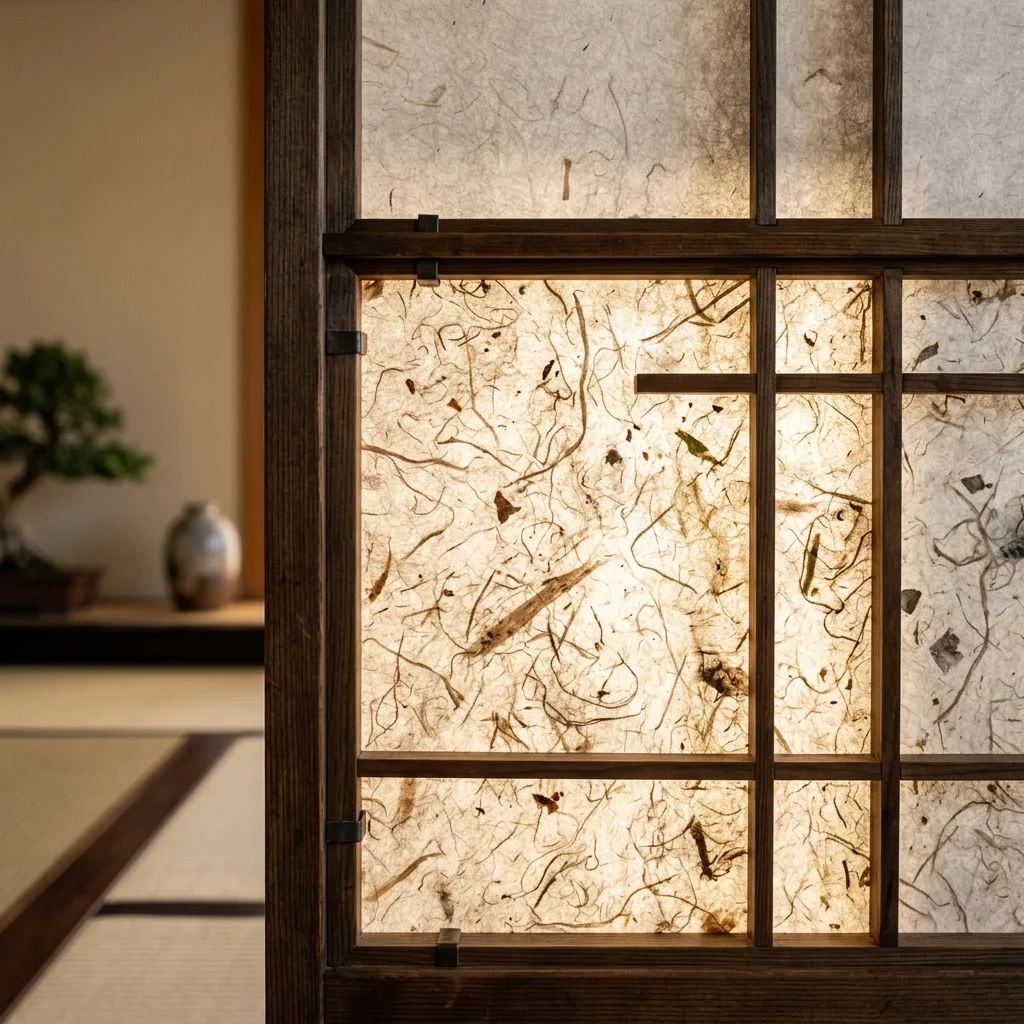
Translucent Mulberry Washi: The Optics of Soft Light Shoji
This high-resolution close-up showcases a classic Shoji sliding screen paneled with traditional hand-crafted Kozo (paper mulberry) Washi. Warm, golden afternoon sunlight filters through the paper, illuminating the intricate, organic web of interlocking plant fibers embedded within the sheet. Rather than displaying the sterile, uniform texture of industrial wood-pulp paper, this Washi surface behaves as a living, irregular canvas. The geometric lines of the dark cedar Kumiko frame cast a crisp, clean shadow grid across the glowing paper, highlighting the beautiful visual tension between structural mathematical order and organic material spontaneity.
The Biophysics of Washi Fiber-Level Light Scattering
The soft, shadow-free illumination that defines the interior of a Japanese tatami room is a direct result of the biophysical properties of mulberry fibers. Standard paper is made of short, crushed wood fibers that lie flat, creating a dense surface that reflects or blocks light. In contrast, traditional Kozo-gami is made from long, strong inner bark fibers that are beaten gently with wooden mallets to preserve their length, then suspended in a viscous bath containing Neri (a natural mucilage derived from the root of the sunset hibiscus plant). When the paper is scooped onto a bamboo screen, the long fibers intertwine in three dimensions. As sunlight passes through the paper, it strikes these natural cellulose tubes at various angles, causing refraction and scattering rather than direct transmission. This creates a highly uniform, low-contrast illumination that eliminates harsh glare and spreads a calm, soft light across the entire room, reducing eye strain and enhancing mental focus.
Historical Case Study: Gifu's Mino Washi and Shoji Standardization
The historical evolution of Shoji paper is deeply linked to Gifu Prefecture’s Mino region, where high-quality Mino Washi has been produced for over 1,300 years. During the Edo period (1603–1867), the Shogunate recognized the exceptional optical and structural qualities of Mino Washi, officially designating it as the standard paper for the Shogun's palaces and the samurai estates in Edo (Tokyo). A specialized classification of Shoji paper known as Hon-Mino-gami was developed specifically to meet the architectural demands of these massive residences. The paper had to withstand the intense winter winds blowing off the Kiso mountains while remaining thin enough to maximize indoor daylight. Today, the craft of making Hon-Mino-gami is registered as a UNESCO Intangible Cultural Heritage, preserving a highly sophisticated agricultural and manufacturing system that depends on pristine, ice-cold river water and native mulberry cultivation.
Artisan Experience: Tactile Sensation and Paper Pasting
The act of installing or repairing Shoji paper is itself a quiet, meditative ritual that requires high tactile sensitivity. Traditional craftsmen do not use synthetic adhesives or staple guns; instead, they utilize a natural, home-cooked starch paste made from refined rice flour (Sokui). The artisan applies the warm, white paste along the thin wooden grids of the Kumiko lattice using a specialized, short-bristled horsehair brush. The paste must be applied in a thin, perfectly uniform layer to prevent the wood from absorbing excess moisture and warping. Once the glue is applied, a continuous roll of Washi paper is carefully unrolled across the frame, and the artisan gently presses the paper onto the wood using the side of their hand. After the paste has dried, the artisan lightly sprays the paper with a fine mist of clean water. As the water evaporates, the mulberry fibers shrink slightly, pulling the paper taut across the cedar grid until it resonates with the deep, satisfying acoustic ring of a tightly tuned drum when tapped.