Japanese Manhole Covers: Art and Engineering Underfoot
Japanese manhole covers merge heavy industrial engineering with local identity, turning everyday asphalt into a public canvas.
Osaka Castle: A Canvas of Thermosetting Epoxy Resin
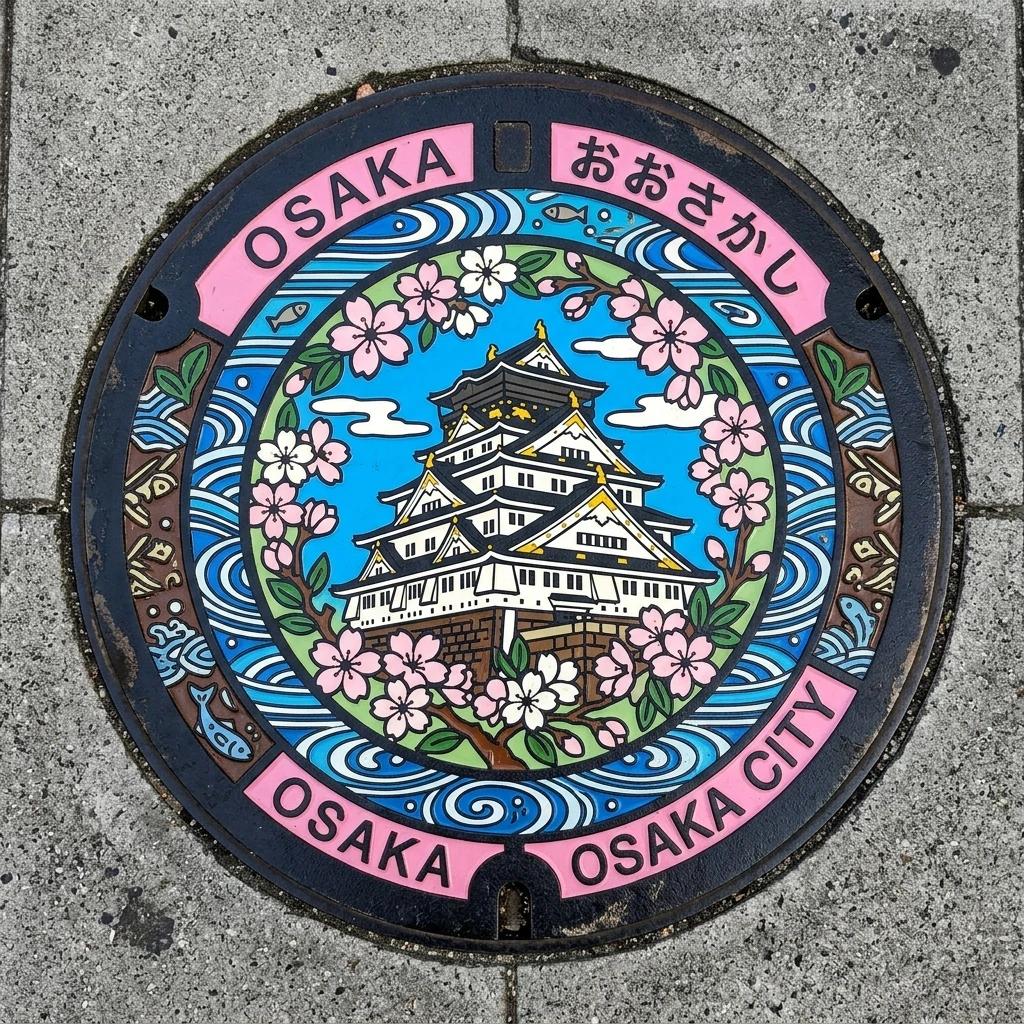
This high-resolution image showcases a premium colored manhole cover located in the vicinity of Osaka Castle Park (Osaka-jo Koen). The design is a vibrant, multi-colored municipal emblem featuring a central rendering of the historic Osaka Castle Keep (tenshukaku), framed by elegant cherry blossom petals (sakura) and stylized, rhythmic water swirls that represent the Yodo River and Osaka’s ancient heritage as the "water metropolis" (suikyou). While standard utility covers are cast with flat, monochromatic finishes, this colorful specimen demonstrates a highly advanced fusion of industrial casting and manual artisan decoration.
The brilliant, glassy colors visible on the surface are not merely painted on; they are the result of a precise hand-pouring process utilizing thermosetting epoxy resins, closely mimicking the traditional Japanese Shippo-yaki (cloisonné enamel) craft technique. In the specialized manufacturing facilities, raw ductile iron covers are first cast with deep, recessed channels outlining the desired design. Once the iron has cooled and undergone precision surface blasting, master colorists manually inject liquid epoxy resins mixed with high-potency organic pigments into the individual compartments using specialized pneumatic syringes.
The fluid resin must be carefully balanced to achieve the perfect viscosity. If the resin is too thin, it will overflow the cast-iron metal borders; if it is too thick, it will trap air bubbles, leading to premature cracking under real-world conditions. Once all colors are manually applied, the entire cover is transferred to a specialized industrial oven where it undergoes a multi-stage thermal curing process at temperatures exceeding 120 degrees Celsius. This heat treatment triggers a molecular cross-linking reaction within the polymer, transforming the liquid resin into a hard, glossy, and highly resilient enamel layer that is flush with the metal ribs.
Historical Case Study: Osaka's Expo '70 and Water Reclamation Branding
The origin of Osaka’s distinctive colorful cover designs is deeply rooted in the city's post-war public health initiatives. Following the massive infrastructure expansion surrounding the historic 1970 World Exposition (Osaka Banpaku), the city faced a critical challenge: convincing citizens to support major municipal taxation for advanced wastewater treatment and water reclamation facilities. In 1985, to celebrate the completion of the city’s comprehensive sewage modernization program, the Osaka Municipal Water Works Bureau launched a pioneering design competition.
The winning entry, depicting Osaka Castle amidst cherry blossoms and water swirls, was officially adopted as the permanent visual signature of the city's sub-surface utility grid. By embedding these highly artistic, colorful markers directly outside major cultural landmarks and residential neighborhoods, the municipal government succeeded in rebranding a typically stigmatized sanitation utility into a source of civic pride and environmental awareness.
Artisan Experience: The Hand-Pouring Guild of Nagashima Imono
Witnessing the hand-pouring process at the historic Nagashima Imono foundry reveals the extraordinary degree of human craftsmanship required to produce a single color cover. The artisans work in a hushed, climate-controlled clean room to prevent airborne dust from contaminating the wet resins. Using handheld gas torches, the craftsmen gently sweep hot flames across the freshly poured resin surfaces. This technique utilizes heat to force microscopic air bubbles to rise and pop, ensuring a perfectly smooth, solid cross-section.
The artisan's hand must remain perfectly steady; a single millimeter deviation would spill bright pink cherry blossom resin into the deep blue water channels, ruining the entire cast. This meticulous human intervention elevates a mass-produced municipal fixture into an authentic piece of public functional art, exemplifying the Japanese concept of craftsmanship spirit (monozukuri).
Kyoto Iron: Wabi-Sabi and Mechanical Acoustics
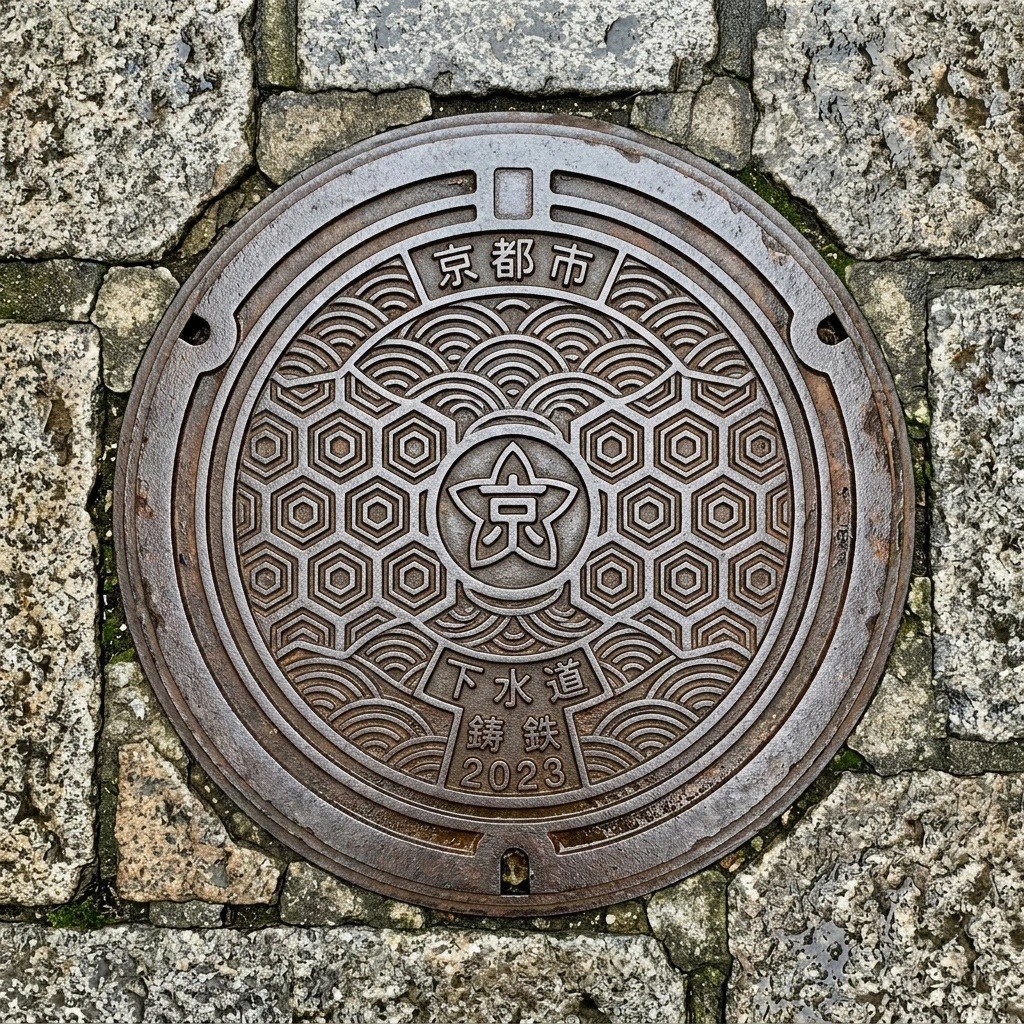
In stark contrast to the vivid, resin-filled colors of Osaka's covers, this image captures a classic, unpainted cast-iron manhole cover embedded in a historic street within Kyoto’s Gion preservation district. The design features a beautifully symmetrical, interlocking geometric pattern centering on the ancient imperial crest of Kyoto—a stylized wheel motif (goshoguruma) that recalls the elegant ox-carriages of the Heian court nobility. The raw, textured dark-iron surface displays a subtle, weathered patina that integrates seamlessly with the surrounding historic cobblestones and the traditional wooden facades of adjacent machiya townhouses, embodying the classic Japanese aesthetic of Wabi-Sabi—finding deep beauty in imperfection, simplicity, and natural aging.
From a design and safety standpoint, this unpainted cover is a masterpiece of high-traction surface engineering. Because Kyoto experiences high foot traffic from international tourists and local residents wearing traditional wooden sandals (geta), and is navigated daily by thousands of motorbikes and bicycles, the cover's surface must provide exceptional slip resistance, especially during the humid monsoon season (tsuyu). The cover is engineered with specialized anti-skid wavy grooves and interlocking hexagonal cells.
These precise geometric recesses are tribologically designed to channel rainwater away from the contact patch between the tire and the metal surface, preventing the dangerous phenomenon of hydroplaning. The micro-traction textures cast into the iron raise the sliding friction coefficient to match that of the surrounding asphalt, ensuring that two-wheel vehicles can turn across the wet metal covers without losing traction.
Historical Case Study: Kyoto's Ancient Waterways and the 1996 Aesthetic Standard
Kyoto’s approach to utility cover design is heavily governed by historical preservation mandates. In 1996, the Kyoto Municipal Government established a comprehensive aesthetic code under the Kyoto City Landscape Act. This legislation sought to eliminate visual pollution from the city's historic core. While other cities rushed to deploy bright, eye-catching color covers, Kyoto's design council made a deliberate decision to prohibit highly saturated, painted resins in designated historic preservation zones.
Instead, they mandated the use of raw, unpainted cast iron that had undergone an industrial black oxide treatment. The result was a design that did not scream for attention but rather whispered its presence, respecting the quiet, historic atmosphere of Kyoto’s ancient alleyways while still fulfilling its modern civil engineering duties.
Artisan Experience: The Acoustic Silence of Gion Alleys
A late-night walk through the historic paved lanes of Gion reveals one of the most sophisticated, yet completely invisible engineering achievements of Kyoto's utility covers: absolute acoustic dampening. In many global cities, driving a vehicle over a manhole cover produces a loud, metallic rattling sound (gata-gata). This noise is caused by microscopic gaps between the lid and the outer frame, which allow the cover to rock under dynamic loads. In Kyoto's quiet residential alleys, such sudden metallic noises would severely disrupt the peaceful nocturnal environment.
To solve this, Japanese foundry technicians machine the seating surfaces of both the cover and the frame using high-precision lathes, achieving a tapered mechanical interface with a dimensional tolerance of less than 1/100th of a millimeter. When a vehicle passes over the cover, the load is distributed perfectly symmetrically across the tapered edge, preventing any physical rocking or metal-on-metal collision. The resulting silence is an extraordinary engineering achievement, demonstrating a profound respect for the sensory quality of the urban environment and the daily lives of the citizens.