Chochin: Folding Geometry and Portable Illumination in Japanese Daily Life
Chochin paper lanterns capture the folding genius of Japanese spatial design, scattering a warm, textured glow through bamboo rings.
The Accordion Pleat: Structural Elasticity of the Concentric Bamboo Higo
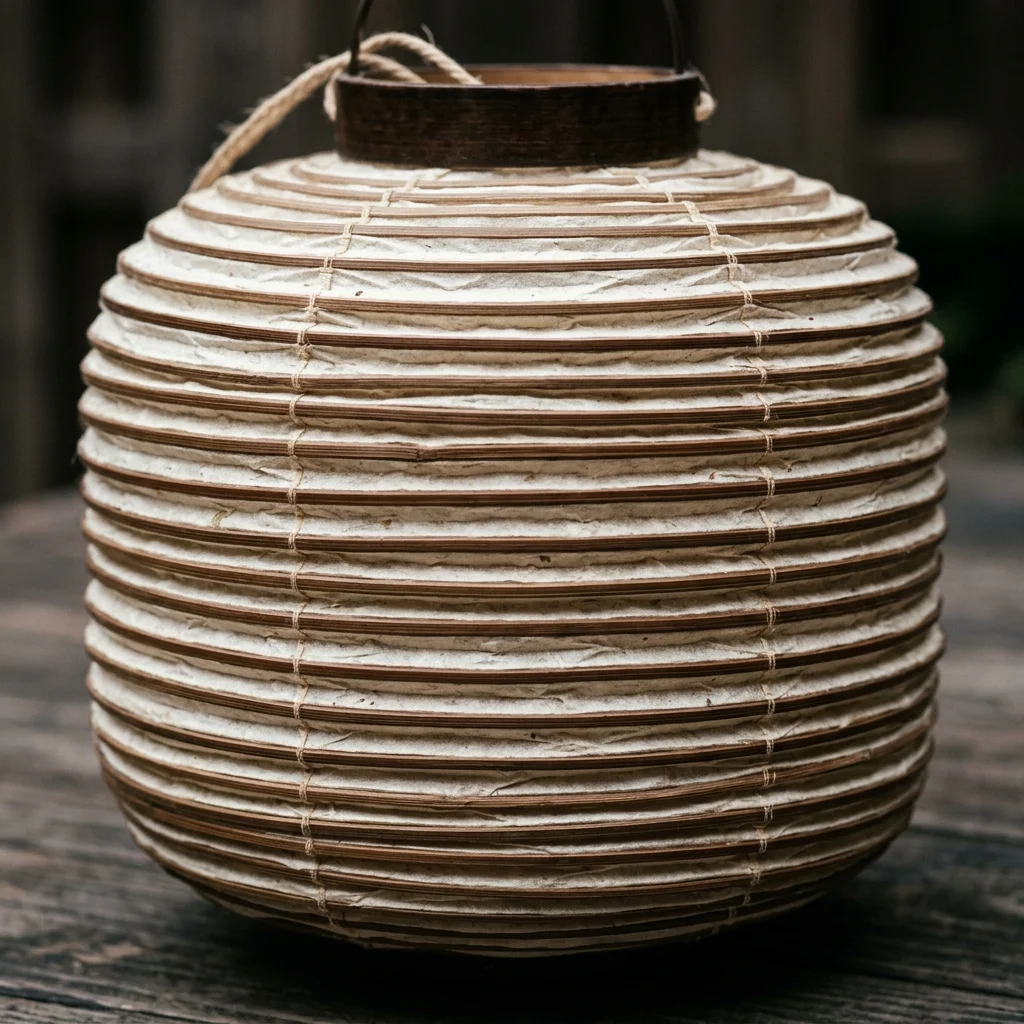
This high-resolution close-up captures a traditional Chochin paper lantern in its partially compressed state. The image showcases the dense, uniform concentric rings of split bamboo (Higo) pressed closely together, with the delicate mulberry paper folded neatly into sharp accordion pleats in between. The wooden collar at the top provides a solid anchor, while the raw, textured surface of the Washi paper reveals the organic plant fibers that give the lantern its strength. This visual juxtaposition illustrates the high-precision geometry and material ingenuity of traditional Japanese industrial design, turning a simple lighting fixture into a folding sculptural masterpiece.
The Engineering of the Collapsible Bamboo Skeleton
The ability of the Chochin to collapse flat without tearing the paper is a triumph of material engineering. The key lies in the preparation of the bamboo Higo. Craftsmen split green bamboo into extremely thin, uniform strips using a specialized double-bladed knife, ensuring that each strip retains its natural outer skin, which contains high levels of flexible silica. These strips are then bent around a wooden mold and secured with thread. The distance between the bamboo rings is calculated precisely: if they are too far apart, the paper will sag and tear when collapsed; if they are too close, the lantern will be too heavy and fail to expand fully. The paper is pasted onto the frame while the mold is fully extended. Once dry, the natural creases formed between the bamboo rings act as built-in accordion hinges, allowing the lantern to compress to less than ten percent of its expanded height.
Historical Case Study: Gifu Chochin and the Meiji Export Boom
The historical epicenter of premium Chochin manufacturing is Gifu Prefecture, where Gifu Chochin has been produced since the mid-Edo period. During the Meiji era (1868–1912), as Japan opened its borders to the world, Gifu Chochin underwent a massive export boom, becoming highly sought after in Europe and North America for their delicate, artistic designs. To meet this global demand, local manufacturers standardized the production process, introducing high-potency natural dyes and complex stenciled patterns depicting delicate autumn flowers, birds, and landscapes. The Gifu lanterns were celebrated for their exceptional lightness, utilizing ultra-thin Mino Washi and high-grade wild bamboo. This export success helped preserve traditional plastering, woodcarving, and paper-making guilds in the region, illustrating how global trade can support local heritage.
Artisan Experience: Winding the Higo and Pasting the Paper
Watching a master lantern maker (Chochin-shi) at work reveals the incredible level of manual dexterity required for this craft. The artisan sits at a low wooden bench, holding the heavy wooden mold between their knees. Using their left hand to spin the mold, their right hand guides a continuous, long strip of split bamboo around the wooden pegs, creating a perfect, tight spiral. The artisan then applies refined starch paste along the bamboo ribs using their fingertips, ensuring a light, uniform coat. Thin, pre-cut panels of Washi paper are then pressed onto the wet ribs, utilizing a soft dry cloth to smooth out any air bubbles. The artisan must work quickly before the glue dries, adjusting the tension of the paper with their thumbs to ensure that it shrinks evenly, creating a drum-like surface that will fold perfectly.
Gion Red: The Typonymic Calligraphy of Nocturnal Signs
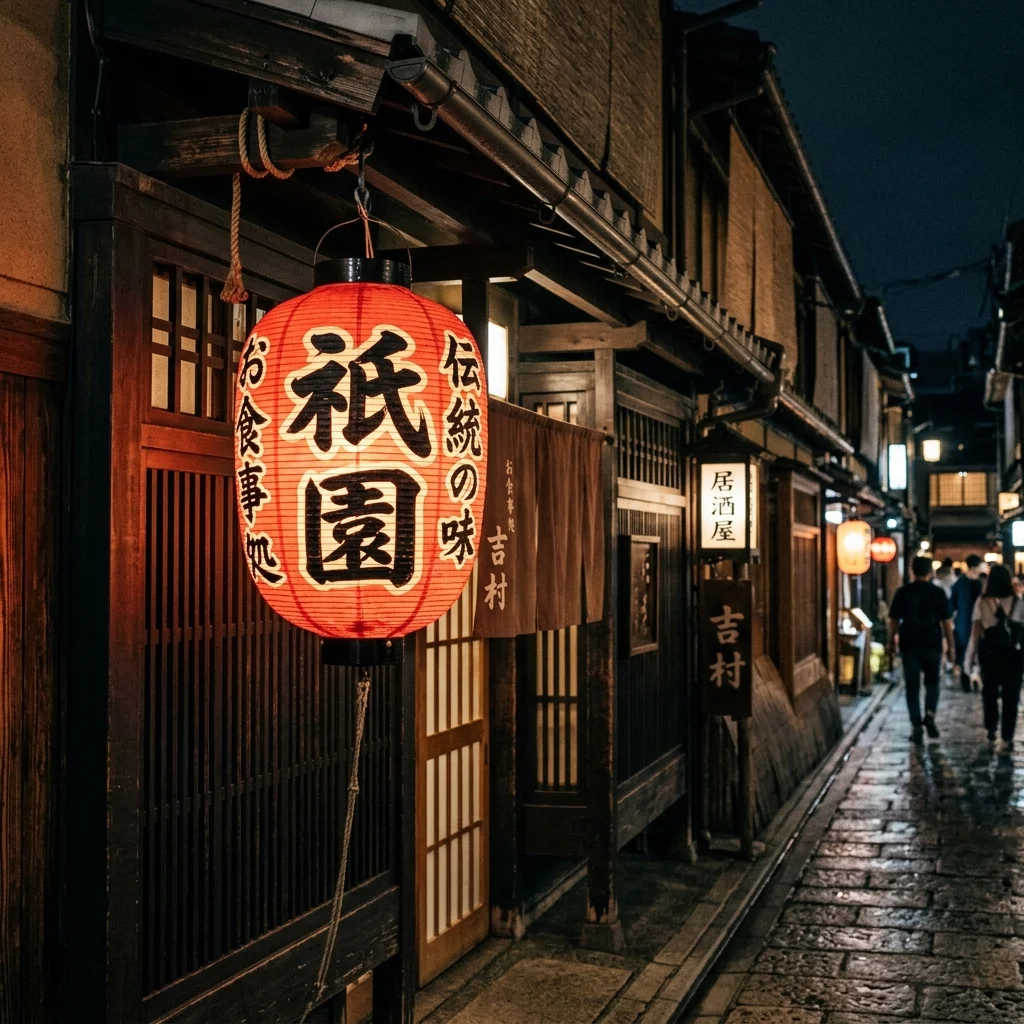
This high-resolution night photograph captures a large, traditional red paper lantern (Aka-chochin) hanging from the dark wooden eaves of a historic restaurant in Kyoto's Gion district. The lantern casts a warm, atmospheric red glow across the wet cobblestone street (Ishidatami) and the dark wooden lattice windows (Koushi) of the adjacent tea houses. Bold, black brush calligraphy characters are hand-painted on the glowing red Washi paper, displaying the historic district's name "祋園" (Gion) and "伝統の味" (Traditional Taste). The visual composition captures the classic, mysterious mood of Kyoto's nightlife, where the soft, glowing lantern acts as a welcoming beacon and a historical marker.
Typographic Legibility and the Physics of Red Light Diffusion
The choice of bright red for these outdoor signage lanterns is a highly intentional design decision rooted in visual physics and urban safety. Red light has the longest wavelength in the visible spectrum, meaning it is scattered the least by atmospheric particles like fog, smoke, or rain. In the dark, unlit streets of historic Kyoto, a glowing red lantern could be seen from several hundred meters away, acting as a highly legible beacon for travelers. The black lettering is painted using a high-density, waterproof carbon ink (Sumi) mixed with natural lacquer. The intense black ink blocks the light completely, creating a high-contrast silhouette against the glowing red background that remains legible even in heavy rain or low visibility, illustrating a brilliant fusion of typography and light physics.
Historical Case Study: The Aka-chochin and Edo's Night Economy
The cultural association between the red lantern and casual dining spots (Izakaya) is deeply rooted in the commercial history of the Edo period. In the 18th century, as the Shogunate relaxed curfew laws, casual sake shops began staying open late to serve workers returning home. To stand out from formal restaurants, these shops hung a simple, unadorned red paper lantern outside their doors. The Aka-chochin quickly became a universal visual shorthand for affordable food, drink, and warm hospitality. This night economy allowed for the emergence of a vibrant, democratic social space where rigid class distinctions were temporarily forgotten over a hot bowl of stew and a cup of sake, transforming a simple paper lantern into a powerful symbol of community solidarity.
Artisan Experience: Painting the Calligraphy on the Curved Surface
Painting bold, crisp calligraphy onto a fully expanded, three-dimensional curved surface is one of the most challenging skills in the lantern-making craft. The artisan cannot lay the paper flat; they must paint directly onto the fragile, hollow lantern while it is suspended in the air. Using a massive, long-bristled brush loaded with thick carbon ink, the craftsman sweeps their arm in fluid, deliberate strokes, applying precise pressure to prevent the ink from running or bleeding into the porous paper. The artisan must visualize the curved distortion of the letters beforehand, ensuring that the characters appear balanced and legible when viewed from the street below. There is zero room for error: a single stray drop of black ink would ruin the entire red lantern, requiring the artisan to start the entire assembly process from scratch.